
Why Supplementary Education Is Important?
📅 16 Aug, 2013 · ✍️ Admin
Last updated: 30 September 2026
Education is critically essential in our lives. The count of educated people of a country defines its growth and development in economical and financial terms. Also, education is vital for individuals to survive, be self-sufficient, and be independent enough to be able to earn a livelihood.
In a developing economy like India, where agriculture is still a major source of livelihood, education is one of the important areas on which the country spends. Around the year 2011, India was spending a little over 3% of its GDP on education.
A poignant fact today is that the schools and colleges alone cannot cater to all the education needs in this age of competition. Then the significance of supplementary education courses like Abacus comes into the picture. These courses are designed and structured to support the overall development of students so that they become more competent, confident, and better prepared to face challenges.
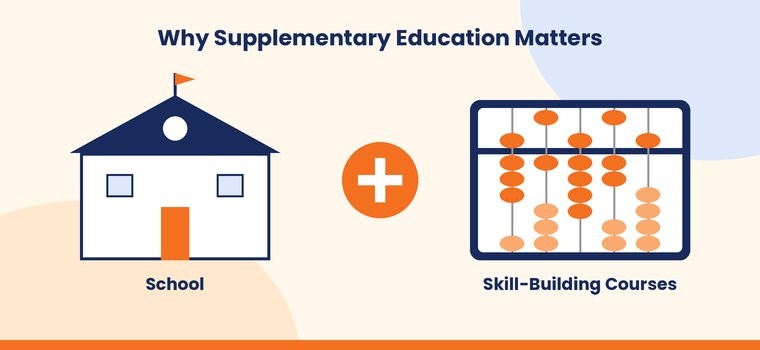
School and Supplementary Learning Work Together
Supplementary education is not a replacement for school, and it is not the same as repeating the syllabus after school. The table below shows what each one usually does for a child. If you are comparing options, our list of skill-building courses parents are choosing today is a useful starting point, and our post on how Abacus education compares with school math looks at one subject in detail.
| Area of learning | What school usually provides | What a good supplementary course can add |
|---|---|---|
| Syllabus and exams | Covers the board syllabus and prepares children for tests and exams. | Does not repeat the syllabus; builds a skill that supports learning across subjects. |
| Pace of learning | One pace for a full classroom, tied to the academic calendar. | Level-based progress, where a child moves ahead after completing each stage. |
| Practice time | Limited by the period bell and the number of subjects in a day. | Regular, focused practice on one skill, in class and for a few minutes at home. |
| Thinking skills | Concentration, memory and visualization are expected, but seldom taught as separate skills. | Activities designed to exercise these skills directly, such as picturing beads in Abacus. |
| Confidence | Mostly linked to marks and rank in class. | Small, frequent wins that are not tied to the report card. |
Both parents and students are aware that if they perform well in academics, they can more easily enter the field of their choice for pursuing their career. For this, the demand for supplementary courses helps them succeed.
Courses like Abacus act as overall brain development tools for children of young age which also adds to their mental arithmetic skills. Right from an early age, the children are prepared to imbibe skills like visualization, concentration, logical thinking, visual memory, and recall within themselves. This helps them grow in confidence to compete on a wider platform. To enroll in an Abacus course, contact Mastermind Abacus.
Frequently Asked Questions
What does supplementary education actually mean?
Supplementary education is any structured learning a child does outside regular school hours to add to what school teaches. It includes skill-based courses such as Abacus, languages, music, coding and sports coaching. The aim is not to repeat the school syllabus, but to build abilities that the school timetable has little time for.
Is supplementary education the same as tuition?
Not quite. Tuition usually repeats the school syllabus so that a child scores better in exams. A supplementary course builds a separate skill, such as mental arithmetic, concentration or communication, which then supports learning across subjects. Many families use both, but they serve different purposes and should be chosen for different reasons.
My child already scores well at school. Is a supplementary course still needed?
It is not compulsory, and no child needs a course simply because classmates have joined one. Good marks show that the syllabus is understood. A supplementary course is worth considering when you want your child to build something marks do not measure. We discuss this honestly in our post on whether classes like Abacus really help Indian children.
Will adding a course after school leave my child with too little free time?
It can, if too many courses are added together. For most school-going children, one or two well-chosen courses leave enough room for homework, play and sleep. Watch your child's energy and mood for a few weeks after joining. Our post on whether extra-curricular activities are really useful explains the signs of an overloaded week.
How do I choose the right supplementary course for my child?
Start with your child's interest and the skill you want to build, not with what is popular in the neighbourhood. Then check the teacher's training, the batch size, how the course is structured and how progress is shared with parents. A trial class helps. Our guide on how to select the right math program covers this step by step.
Why is Abacus treated as a supplementary course and not a school subject?
Abacus is not part of the regular board syllabus, so most children learn it after school at a centre or in a live online class. Some schools do add it to their timetable through an Abacus programme for schools. At Mastermind Abacus, the course runs in 10 levels of three months each, with two one-hour classes a week.
Is there a right age to begin a supplementary course such as Abacus?
It depends on the course. Mastermind's Abacus programme is for children aged 6 to 14, both online and at our centres. For children aged 5 to 6, we offer Lingo Bingo at our offline centres. A child who can sit comfortably and follow instructions is ready; that matters more than starting as early as possible.
How soon will a supplementary course show in my child's school performance?
There is no fixed timeline, and no honest course can promise marks. Skills such as focus and mental calculation, which we describe on our benefits of Abacus learning page, build gradually with regular classes and a little home practice. Parents often notice small changes, like quicker sums or longer attention, before the report card changes.
Author – Mr. Naveen Chowdhari
Naveen Chowdhari is the Founder & Director of Mastermind Abacus, a leading name in children’s mental math and brain development training. By blending traditional abacus methods with modern teaching techniques, he has created an innovative system that enhances children’s concentration, memory, visualization, speed, and overall cognitive skills. Under his leadership, Mastermind Abacus now provides worldwide online abacus classes and has built a strong global franchise network, making quality brain-development education accessible across the world.
Last Updated: 30 September 2026