
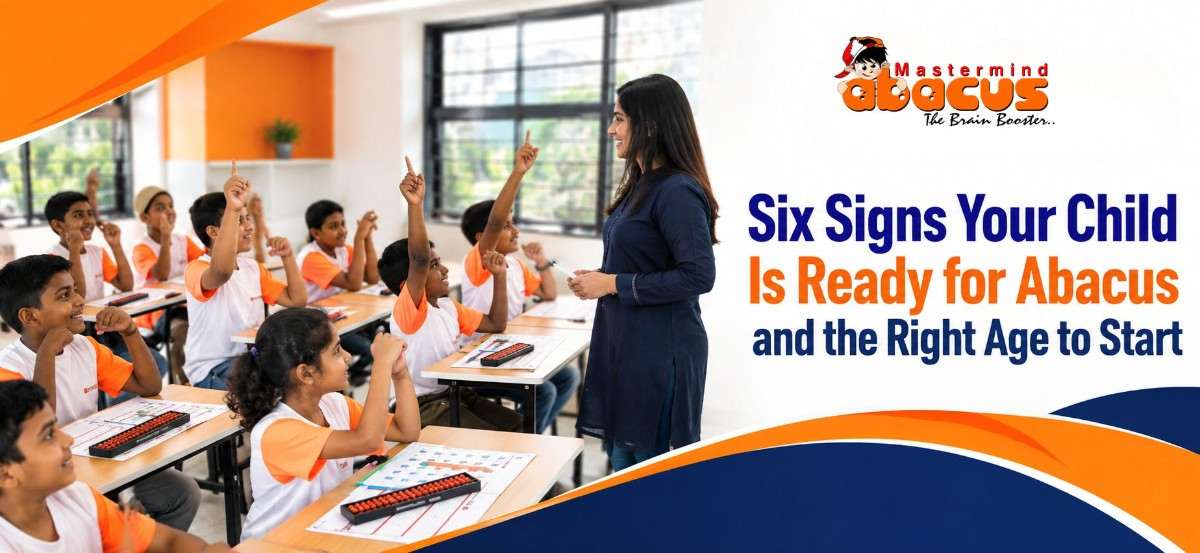
Six Signs Your Child Is Ready for Abacus and the Right Age to Start
📅 31 Mar, 2022 · ✍️ Admin
Last updated: 24 September 2026
Although Abacus has been accepted as one of the most effective whole brain development programs by most parents, several still have this question 'Why Abacus for kids?'
This question needs to be answered because the parents must know how Abacus training would benefit their kids in their academic performance in the future? Secondly, they should also know which the right age is and what the benefits of early training in Abacus are.
Let us try to answer the first question first.
What Are The Benefits of Abacus For Kids?
Numerous scientific studies have shown that Abacus training to use Abacus for calculations inculcates several lifetime skills in children. It is widely observed that Abacus training for kids triggers whole Brain development. These skills have a lasting effect in augmenting their Academic performance and adding value to their overall personality. Let us list down the benefits of Abacus:
1. Lack of concentration and a not-so-good memory can be directly linked to a child's poor listening ability as they do not listen with apt attention to what the teacher says during a class. The poor listening level affects the overall performance of the child. Abacus training develops a natural habit of listening with adequate concentration. The improved concentration ensures retention of what is taught & learned.
2. Recalling the right thing at the right time plays a vital role in a student's performance and reflects vividly in exam results. We, too, have often encountered such situations during our exams when we could not recall a particular answer, despite having learned it well. We may remember the same later. Poor recall ability is responsible for this. Abacus training for kids improves their recall ability for a lifetime.
3. Fear of numbers is a common problem faced by several students. They hate numbers and math. The reason for this is the non-availability of any object to which they could relate or connect a number. Kids learn to relate everything to some object; for example, an Orange has a size and shape, and they relate to it and can easily understand it. But this does not happen with numbers. Since the kids cannot connect numbers with objects, this affects their logical understanding, resulting in disinterest and poor math performance. Over a period, it leads to math phobia. The Abacus tool comes in handy in providing them to equate the numbers with the beads (object); this eases their understanding and develops in them a liking for numbers. They learn to calculate accurately, thus adding to their confidence in assimilating numbers. During the training, the kids develop a love for math and out goes the Math fear. The kids undergoing Abacus training develop Mental Math skills, i.e., they can solve arithmetic questions mentally without the help of an external tool, with accuracy and a speed that often beats reaching for a calculator.
4. Abacus training is accepted as a whole brain development program for kids. The human brain has two hemispheres, the left and the right. The left part of the brain is responsible for logic, number, counting, and identification of black and white colors. The right part of the brain takes care of creativity, art, other colors, thinking, imagination, concentration, and recall. Abacus education, if initiated at the proper age, augments the development by activating both the hemispheres and promoting whole-brain development. Thus the outcome is enhanced concentration level, sharper visual memory, improved logical thinking ability, increased visualization capacity of the brain, enabling recall, and instilling apt listening ability. The gross outcome of the above development is improved grades for the child. For a complete overview of these benefits, see our page on the benefits of abacus training for children.
Six Signs Your Child Is Ready for Abacus
Before you worry about the “perfect” age, look at readiness. A child who shows most of the signs below will settle into Abacus classes quickly and enjoy them, whatever their exact age. To see what this early start adds up to over the years, read our blog on how abacus training boosts a child’s IQ and EQ.
| Readiness sign | What you may notice at home | Why it matters in Abacus class |
|---|---|---|
| Recognises numbers 1 to 10 | Reads digits on a clock, a bus or a page and counts small groups of objects | Bead values are taught on top of basic number recognition |
| Follows a two-step instruction | Can do “pick up the book and keep it on the shelf” without being told twice | Sums in class are dictated by the teacher, so listening drives learning |
| Stays with one activity | Finishes a puzzle, drawing or game before moving on | Classes run for about one hour, twice a week |
| Uses fingers or objects to add | Counts on fingers or toys to find a total | The child already links numbers to objects; the Abacus beads make this natural |
| Enjoys games and small challenges | Likes puzzles, board games or beating their own score | Mastermind lessons and practice are game-based |
| Is between 6 and 14 years old | Age 6 is the entry point; older starters usually catch up quickly | Programme eligibility; children aged 5 to 6 start with Lingo Bingo |
The Second Question Which Is The Right Age To Start Abacus Education?
There is a great dilemma among the parents as to when to initiate the training of Abacus for kids?
Experts broadly agree that the early school years are the best window to begin structured skill training such as Abacus. The logic is that a large part of brain growth and connection-building happens in early childhood, and habits learned then tend to stay for life. Keeping this in mind, the Mastermind Abacus Program is designed for children aged 6 to 14. For younger children aged 5 to 6, we offer Lingo Bingo, our play-based early childhood programme, which builds number sense before formal Abacus training begins. You can read more about this stage in our blog on how early education shapes your child’s cognitive growth.
They are also of the opinion that between 6 to 14, the kids can be involved in various activities to add momentum to the brain's development process. Moreover, the brain at this age is in a learning phase and easily adapts to new things. The learning of this age lasts a lifetime.
We all know that at this age, the responsibilities are the least, and so are the otherworldly burdens'. Their brain can easily learn new things, ideas, processes, etc., and adapt to these with the least difficulty. It is the right time to introduce them to new skills that will make their academic journey more pleasant.
I am sure the two most important questions of the parents stand answered.
The next challenge for the parents is identifying the RIGHT Abacus classes for their kids.
When selecting the most appropriate Abacus class, one should keep in mind the distance to be traveled to attend the class. Long travels always tire the child and can also create disinterest in learning. Remember, Abacus is an after-school program.
To reduce traveling time, you can enroll your child in Online Abacus classes of Mastermind Abacus. They now have the Online Live Abacus E-Learning Platform along with their offline Abacus classes.
Training quality is another important point to consider before making a decision. If the teaching standards are not up to mark, the child will likely lose interest, drop out midway, and not complete the entire Abacus Training course of 10 levels.
Mastermind Abacus, be it their offline or online Abacus course, has made it highly engaging. While the teaching process in the offline Abacus Classes keeps the students involved throughout the class time, the Online Abacus Class is designed hi-tech and loaded with math-based abacus video games for class work, homework and practice. These have made the learning process with Mastermind Abacus way smarter and more effective.
Frequently Asked Questions
What is the right age to start abacus classes?
The Mastermind Abacus Program is designed for children aged 6 to 14, both online and at our centres. A good time to start is when your child recognises numbers and can follow a teacher’s spoken instructions, usually in the early school years. Children aged 5 to 6 begin with Lingo Bingo, our play-based foundation programme.
Is 10 or 12 too late for my child to start abacus?
No. The programme accepts children up to 14, and older beginners often move through the early levels faster because they already know basic arithmetic. What matters is regular attendance and short daily practice. A child who starts at 10 and completes the levels still gains the mental math, focus and confidence benefits.
My child is 5 years old. Can they join abacus classes?
Not the abacus programme yet. Abacus training needs a child to recognise numbers, follow spoken sums and sit through an hour-long class, which most 5-year-olds are still building. That is why Mastermind offers Lingo Bingo, an offline, game-based foundation programme for ages 5 to 6, which prepares children to join the abacus programme at 6.
How do I know my child is ready for abacus classes?
Look for a few simple signs: your child counts objects, recognises the digits 1 to 10, can follow a two-step instruction and can stay with one activity for a while. If most of these are true and your child is 6 or older, they are ready. A free demo class is the easiest way to confirm.
Should my child start abacus online or at a centre?
Both formats follow the same 10-level curriculum with two one-hour classes a week, so choose what suits your family. Live online classes save travel time and use math-based games for class work and practice. A nearby centre suits children who learn better face to face. A free demo helps you decide.
How long does the full abacus course take?
The Mastermind Abacus Program has 10 levels of about three months each, with two one-hour classes a week, so a child who starts at 6 or 7 usually completes it in roughly two and a half to three years. Progress depends on attendance and daily practice, and many parents notice better focus much earlier.
If you want to enroll your child in Mastermind Online Abacus Classes, Book a Free Demo for a first hand experience.
Also Read: Abacus Class and Its Future Advantages For Kids
Author – Mr. Naveen Chowdhari
Naveen Chowdhari is the Founder & Director of Mastermind Abacus, a leading name in children’s mental math and brain development training. By blending traditional abacus methods with modern teaching techniques, he has created an innovative system that enhances children’s concentration, memory, visualization, speed, and overall cognitive skills. Under his leadership, Mastermind Abacus now provides worldwide online abacus classes and has built a strong global franchise network, making quality brain-development education accessible across the world.
Last Updated: 24 September 2026