

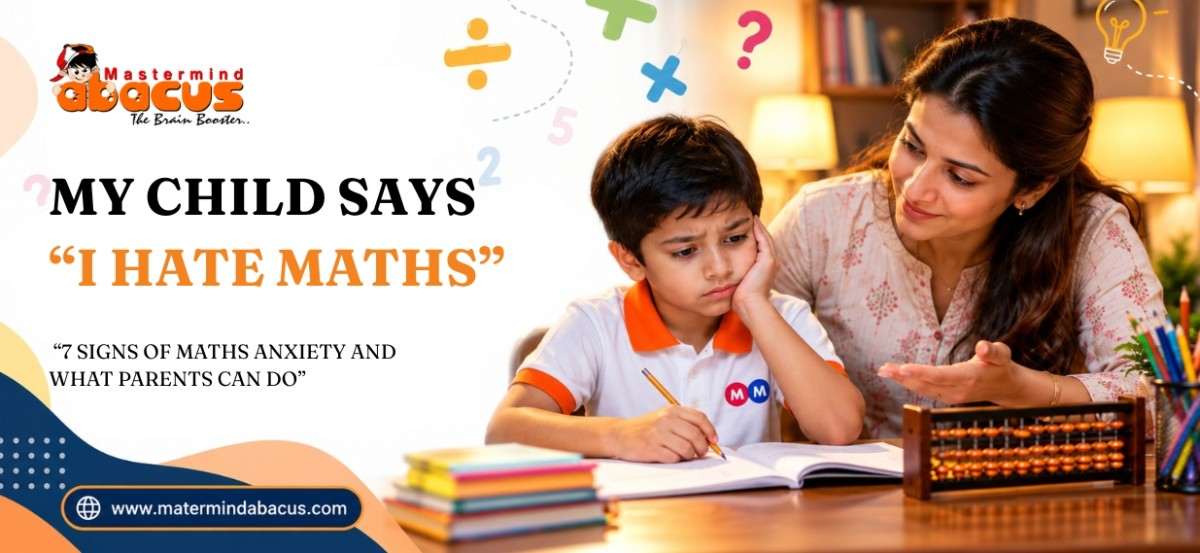
7 signs of maths anxiety and what parents can do
📅 15 Oct, 2026 · ✍️ Admin
It's 8:30 at night. The homework is open, the pencil is chewed, and your child has just said the sentence that makes every parent's heart sink: "I'm just bad at maths." Maybe there were tears. Maybe a stomach ache that appeared out of nowhere on the morning of the unit test.
If that sounds familiar, you're not alone, and your child isn't lazy. What you're likely seeing is maths anxiety: a real mix of worry, negative beliefs and mental overload that shows up when numbers appear. The good news is that it's usually learned, which means it can be unlearned. This guide covers how to spot it, why it happens, what research says about the parent's role, and seven calm things you can do at home.
1. What Maths Anxiety Actually Is (and Isn't)
Direct answer: maths anxiety is a feeling of tension, fear or panic that appears when a child has to do maths, out of proportion to how well they actually understand it. It is different from simply disliking the subject, and it is not a measure of intelligence.
Many children say they "hate maths" the way they say they hate vegetables. That's ordinary. Maths anxiety is different: the child tenses up, avoids, freezes or cries, and often knows more than they can show on the day. In India, where maths decides so much about streams, entrance exams and how a child is "seen" in class, the pressure can build early.
2. Seven Signs to Watch For
No single sign proves anything, but a pattern across a few weeks is worth noticing.
- Avoiding maths homework by doing every other subject first, or "forgetting" the book.
- Physical complaints such as headaches or tummy aches before maths tests or classes.
- Negative self-talk: "I'm stupid," "I'm not a maths person," "I'll never get it."
- Freezing on easy questions that they could answer comfortably when relaxed.
- Finger-counting or guessing wildly under time pressure, then going blank.
- Tears or temper when you offer to help, especially with word problems.
- Marks that don't match understanding: they explain it well to you afterwards, but lose marks in the exam hall.
3. Why Worry Makes Sums Harder
To solve a mental sum, the brain uses working memory, a kind of mental notepad that holds numbers while you work on them. Worry uses up that same notepad. A child who is busy thinking "I'm going to get this wrong" has less space left for the actual calculation.
Researchers have measured this in children. In a 2012 study in Europe's Journal of Psychology, psychologist Marcus Witt tested children aged 9 and 10 on working memory tasks, once using letters and once using digits. The children who reported more maths anxiety showed a bigger drop in performance when the task used digits. In other words, the mere sight of numbers was enough to crowd their thinking.
This explains the confusing pattern parents notice: a child who "knew it yesterday" and "forgot it in the exam." The knowledge didn't disappear. The notepad was full.
4. The Part Parents Play, and a Surprising Study
Here is something many parents don't expect. A 2015 study in Psychological Science, led by Erin Maloney at the University of Chicago, followed 438 first and second graders and their primary caregivers. Children whose parents were maths-anxious learned less maths over the school year and were more likely to become maths-anxious themselves. The effect appeared only when those parents frequently helped with maths homework. Reading, used as a comparison, wasn't affected.
Please read that carefully, because it's easy to misread. It does not say that parents who find maths hard should stay away. It says that a tense, uncertain style of homework help can pass the worry along. The researchers' own suggestion was to give parents better tools: ways to enjoy maths with children through books, games and apps, and guidance on how to help without stress.
If you grew up thinking "maths isn't for me," you're in very good company. The goal isn't to become a maths teacher overnight. It's to be the calm person in the room.
5. Seven Things You Can Do at Home
1. Watch your own words
Avoid "I was never good at maths either." Try "This looks tricky. Let's work out how to start." Children copy our attitude to difficulty more than our advice.
2. Praise effort and method, not speed
"I liked how you checked your answer" lands better than "so fast!" Praising speed teaches a child that being slow means being bad.
3. Normalise mistakes
Share one of your own mistakes at dinner and how you fixed it. When errors are ordinary, they stop being frightening.
4. Rebuild from the step they can do
If fractions feel impossible, go back to the last thing that felt solid. Anxiety shrinks when a child experiences a quick, honest win.
5. Use maths in daily life
Let your child total the grocery bill, split a pizza, or compare two discounts. Maths that has a real purpose feels less like a test.
6. Keep practice short and regular
Ten relaxed minutes daily beats a weekend marathon. Short, predictable sessions give the brain a chance to feel competent without dread.
7. Turn the timer off at first
Build accuracy and understanding before speed. Speed tends to follow on its own once the worry fades.
6. Where Abacus Fits In, Honestly
We run abacus classes, so it's fair to be clear about what we can and can't claim. We are not saying abacus is a medical or psychological treatment for maths anxiety. We aren't aware of research that shows it is. What we can say is why many parents find it a gentle way back into numbers.
Abacus learning moves in three stages: sliding physical beads, then picturing the abacus in the mind, then calculating mentally. The first stage is hands-on and concrete. Numbers become something a child can see and touch, which takes away the "floating symbols" feeling that triggers panic. Each level is small and builds on the last, so a child collects steady wins rather than facing a wall.
There is also credible research on what sustained abacus practice does. A 2019 study in the Journal of Neuroscience followed 144 children, half of whom received regular abacus-based mental calculation training over five school years. The trained group performed better on arithmetic and on visuospatial working memory, the same mental notepad that worry tends to crowd. A stronger notepad and more fluent arithmetic can leave a child with more room to think, though this study didn't measure anxiety directly.
At Mastermind Abacus, the main program is for children aged 6 to 14 across 10 progressive levels, available at centres and as live online classes. Each level ends with an assessment so you can see real progress. For ages 5 to 6, the Lingo Bingo foundation program builds number sense through play. And if you'd like low-pressure practice at home, the free abacus worksheet generator lets you choose the operation, the number of questions and the digits, so you can start easy. New to the idea? Our page on what an abacus is explains it simply.
The best way to know if it suits your child is to watch them in a free demo, where you can see whether they relax, smile and engage. If they come out calmer than they went in, that tells you a lot.
7. When to Talk to the School or a Specialist
Home support has limits. Speak to your child's class teacher if the pattern lasts for months, if your child's marks are dropping, or if the fear is spreading to other subjects. If you see persistent distress, sleep problems, panic or refusal to attend school, speak to your paediatrician or a child counsellor. Maths anxiety is common and treatable, and asking for help early is a sign of good parenting.
Key Takeaways
- Maths anxiety is worry about numbers, not lack of ability, and it can be learned and unlearned.
- Worry takes up working memory, which is why children "forget" what they know under pressure.
- A University of Chicago study of 438 families found anxious homework help was linked to less maths learning, so be the calm helper.
- Praise effort and method, share your own mistakes, and keep daily practice short.
- Abacus can offer concrete, step-by-step wins, but it is not a treatment for anxiety. Use a free demo to see how your child responds.
- If the fear is long-lasting or affecting wellbeing, talk to the school or a counsellor.
Frequently Asked Questions
What is maths anxiety in children?
Maths anxiety is a feeling of tension, fear or panic that appears when a child faces maths, out of proportion to how well they understand it. It is different from simply disliking the subject and is not a sign of low intelligence.
What are the signs of maths anxiety?
Common signs include avoiding maths homework, headaches or tummy aches before tests, saying "I'm bad at maths," freezing on easy questions, tears when asked for help, and marks that are lower than the child's real understanding.
Why does my child forget what they know in maths exams?
Worry uses up working memory, the mental notepad needed to hold numbers while solving. The knowledge is still there, but anxiety leaves less room to use it.
Can my own fear of maths affect my child?
It can. A 2015 study of 438 first and second graders found that children of maths-anxious parents learned less maths when those parents often helped with homework. Staying calm and positive matters more than knowing every answer.
Should I stop helping with maths homework if I'm not good at it?
No. Help in a relaxed way: ask your child to explain the question, work through it together, and say "let's find out" when you are unsure. Short, calm help is better than none.
Does abacus help with maths anxiety?
Research hasn't shown that abacus treats maths anxiety. Many children do find the hands-on, step-by-step approach reassuring, and sustained abacus training has been linked to better arithmetic and visuospatial working memory in a 2019 study.
At what age does maths anxiety start?
It can appear in the early primary years and often grows if it goes unnoticed. Noticing small signs early and keeping maths relaxed and playful gives children the best start.
How long should my child practise maths at home each day?
Around ten relaxed minutes a day is a good starting point. Short, regular practice builds confidence better than long, stressful sessions.
Should I use timed tests to build speed?
Not at first. Build understanding and accuracy without a clock, and introduce light timing later once your child feels comfortable. Speed usually follows confidence.
Is tuition the answer to maths fear?
Not always. Extra classes can help, but if the root cause is worry or a gap in basics, more pressure can make it worse. Look for patient teaching in small steps and a child who leaves feeling capable.
What age can my child start abacus?
Mastermind's main abacus program is for children aged 6 to 14. Children aged 5 to 6 begin with the Lingo Bingo foundation program, which is taught at centres.
When should I speak to a counsellor?
Speak to the school or a child counsellor if the fear lasts for months, spreads to other subjects, or comes with sleep problems, panic or refusing to go to school.
Conclusion
"I'm bad at maths" is rarely the truth. More often it's a worried child with a full mental notepad and a lost bit of confidence. You can't fix that with more pressure, but you can with patience, small wins, a calm voice and short daily practice. Start with one change this week: a mistake shared at dinner, a timer switched off, a sum worked out aloud. Small shifts like these can help your child feel that numbers are something they can understand.
See how your child responds to abacus
Book a free demo and watch whether your child relaxes, smiles and joins in. No pressure, no obligation.
Book a Free Demo Class Try Free Practice Worksheets