
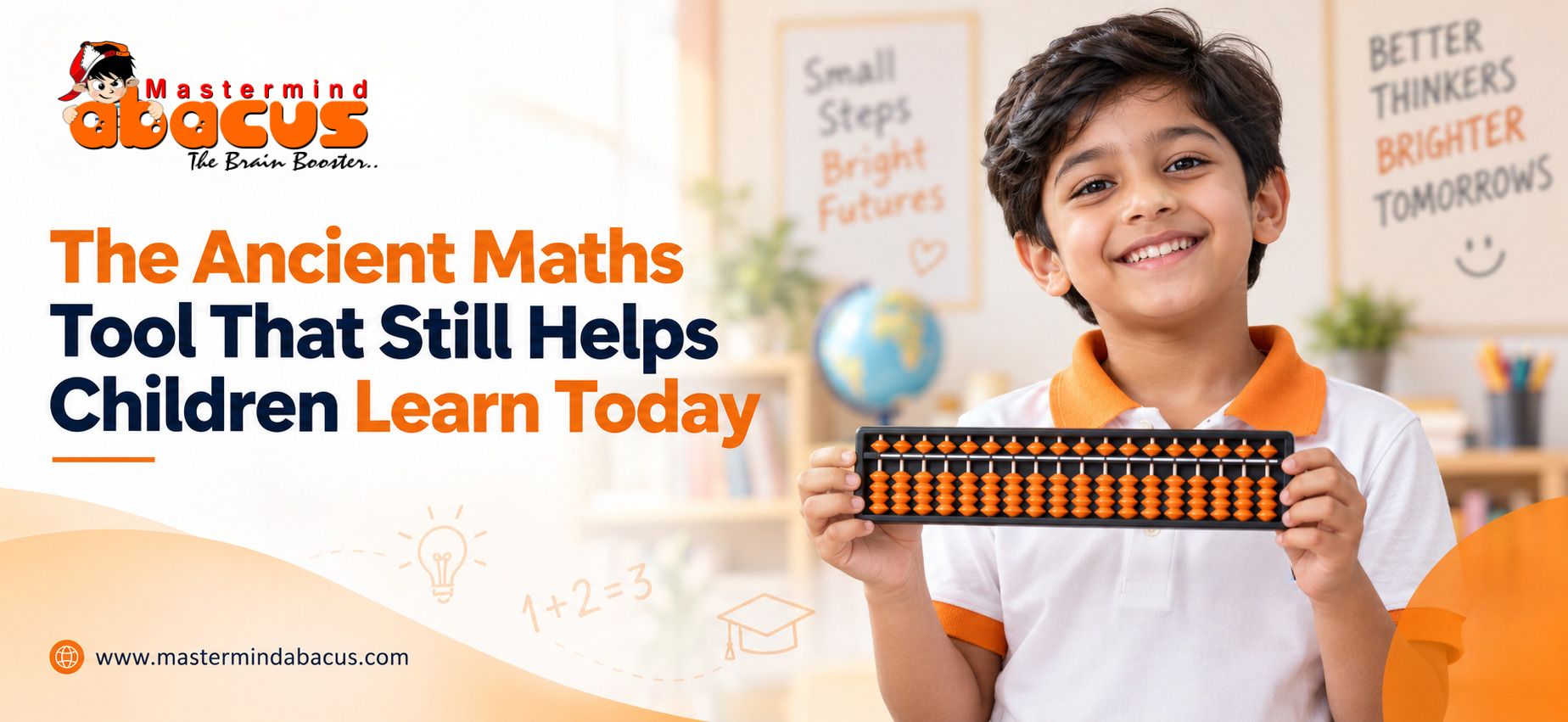
The Ancient Maths Tool That Still Helps Children Learn Today
📅 28 Dec, 2022 · ✍️ Admin
Last updated: 22 September 2026
One fact that we all know about benefits of Abacus for kids is that the modern Abacus is widely used as a brain development tool for children, which helps in improving one's mental math ability.
In mathematical history, Abacus holds a very special place. Abacus is one of the oldest calculation devices, and it is primarily used to calculate basic arithmetic problems. The word "abacus" comes from Latin, which borrowed it from the Greek word "abax", meaning a flat surface or board.
This phenomenal device comprises rods, beads, and a wooden frame. Each rod represents a specific place value, and each bead signifies a number. These beads are used by moving them along the rods according to the need of the calculations.
There are a few more amazing facts about Abacus that you might want to know. A few are listed below;
1. Most people confuse the Abacus with the counting board, but the real fact is that these tools are extremely different.
2. The earliest known written record of the Chinese abacus dates back to the second century BC.
3. The creator of the Cranmer abacus is Tim Cranmer. It is used to conduct calculations quickly and simply for Visually Impaired individuals. Cranmer Abacus was developed for blind people to learn calculations easily and accurately.
4. Our current computers handle numbers in binary, and a binary abacus is sometimes used to show how this works.
5. The name given to the Russian Abacus is ''Schoty''. The difference between other abacuses and Schoty is that it does not have a middle bar dividing it into two decks. The Schoty stayed in everyday use in Russian shops for a very long time. Around 1820, the mathematician Jean-Victor Poncelet took it from Russia to France.
6. The Chinese Abacus is called a "Suanpan." This term typically means 'a calculating tray.' China is amongst the famous countries that influenced Abacus the most, and the Suanpan was in wide use there by around the 14th century CE. Neighbouring countries gave the Abacus their own names, such as Jupan in Korea and Soroban in Japan.
7. The Abacus in the Japanese version is called a Soroban. In Japan, the abacus is still taught in primary schools as part of mathematics lessons.
Now That We Know Some Facts About Abacus Let Us Answer Some of The Common Questions You Might Have
1. What Material Is Used For Making The Abacus?
An Abacus is traditionally made with a wooden or bamboo frame, along with some beads and rods or wires. You can find beads of different shapes. These beads help children learn to count and calculate.
Abacus was created as a counting device for calculation in ancient times.
2. What Is The Person Who Uses The Abacus Called?
The term for person who uses an abacus is called an Abacist.
3. How Was Abacus Teaching Initiated?
At the earlier stage, the only use of the Abacus was in calculations. But with time, people found difficulties in learning math. Only after this people started using Abacus as a tool for learning and later find out about the different benefits of the Abacus for kids.
4. What About Technological Development
While calculators have taken the place of Abacus as a tool, they can certainly not replace Abacus learning program because of the different advantages it offers.
5. What Is Unique About The Modern Abacus?
At present, we use Soroban for calculations. It has one bead of value 5 in the upper deck, and one can set the Abacus to zero by pulling horizontally along the frame centre.
6. What Is The Use of An Abacus For Kids?
Using an abacus for your kid's learning can support your kid's brain development. It also enhances mental arithmetic in kids and adults.
7. Is Abacus Really Helpful For Your Kid?
Well, Abacus is effective in a child's overall mental development in several ways. This includes advantages like faster learning, better memory skills, stronger listening abilities, increased attention span, self-confidence, etc.
When Do Abacus Benefits Start to Show?
Parents often ask me how long it takes before abacus training makes a real difference. The honest answer is that the benefits build step by step across the 10 levels, and the pace depends on regular classes and practice. The table below shows what a typical journey looks like; for a closer look at the thinking skills it builds, read 7 surprising ways abacus training boosts your child's IQ and EQ, and for the complete list, see our guide to the benefits of abacus for children.
| Stage | What your child works on | What parents may notice |
|---|---|---|
| Level 1 · first 3 months | Learning bead values and moving beads with both hands | Growing interest in numbers and a calmer approach to simple sums |
| Levels 1–4 · about the first year | Place value and quick, accurate bead work on the physical abacus | Better concentration in class and more confidence with school sums |
| Levels 5–8 · about the second year | Picturing the abacus in the mind and solving sums without the tool | Noticeably faster and more accurate mental calculation |
| Levels 9–10 · final 6 months | Longer, multi-step mental sums with speed and accuracy | Confident, independent problem-solving with numbers |
| All 10 levels · about 2.5–3 years | The complete journey from beads to mental maths | Strong mental maths habits, focus and self-confidence |
Every child is different. Progress depends on regular attendance and practice at home.
Several promoters provide Abacus training through their Abacus classes operated by their franchisees.
The parent's challenge is choosing the right Abacus Company for their ward.
Mastermind Abacus is a world-renowned Abacus mental math program for children aged 6-14 years old. The program is specially designed to help children overcome the fear of math.
Mastermind abacus is a pioneer Abacus Company, working in Abacus Education since 2005. It has a global presence in 17 countries with 1,000+ Abacus centres.
Moreover, Mastermind Abacus provides both Offline Abacus Classes and Online Abacus Classes to its students.
We have developed an Online Abacus E-learning platform and a hybrid Abacus E-Teaching platform. Together, they form Mastermind's live online abacus learning platform, a live and interactive portal especially designed to teach Abacus.
The online Abacus course is developed into learning videos to be used in the presence of a teacher. The students learn through Abacus Math-based game videos.
The entire system is developed, allowing the constant presence of the teacher throughout the class via an inbuilt video conferencing system.
With years of experience, we have found that using Abacus to understand math concepts is quite engaging for children. It helps the students adapt to distinct learning styles that activate both the creative and logical sides of the brain.
The program begins with the basics of the Abacus and gradually moves on to getting children to visualize beads and calculate in their brains.
Frequently Asked Questions About How Soon Abacus Benefits Show
How soon will I see the benefits of abacus in my child?
Many parents first notice small changes, such as better focus in class and a friendlier attitude towards numbers, within the first few months. Faster and more accurate mental maths builds gradually, level by level. The pace is different for every child and depends on regular attendance and short daily practice at home.
How long does it take to complete the Mastermind Abacus programme?
The Mastermind Abacus programme has 10 levels, and each level lasts about three months, so the full course takes roughly two and a half to three years of steady learning. Children attend two 1-hour classes a week, online or at a centre. Long breaks or missed classes can stretch the timeline a little.
Does my child need to finish all 10 levels to benefit from abacus?
No. Each level builds on the last, from reading bead values to picturing the abacus and solving sums mentally. Completing all 10 levels gives the deepest mental maths ability, but better focus, number confidence and good calculation habits start developing from the early levels onwards, well before the final level.
Which benefits usually show first, focus or maths speed?
In my experience, concentration and listening often improve before speed does, because every abacus sum needs full attention from start to finish. Speed comes later, once your child can picture the beads. To understand how this training uses both logical and visual thinking, read how abacus connects your child's left and right hemispheres.
Is my child too young or too old to start abacus?
The Mastermind Abacus programme is designed for children aged 6 to 14, both online and offline. Older children often move through the early levels a little faster. For 5-year-olds, our Lingo Bingo early number programme (ages 5–6, offline) builds number sense through games before they are ready for abacus.
What if my child is not improving after a few months?
Progress is rarely a straight line, so first check attendance and whether short practice happens at home most days. Speak to your child's teacher, who can see where your child is getting stuck and adjust the practice. If difficulties with numbers continue, it is wise to have them assessed by a qualified professional.
Mastermind abacus for kids has brought a global math program that makes ''Math'' enjoyable for children.
So book a free demo now, and do not miss this chance to get the full benefits of Abacus.
Also Read: Abacus For Kids - Prepares Them For Future Competitions
Author – Mr. Naveen Chowdhari
Naveen Chowdhari is the Founder & Director of Mastermind Abacus, a leading name in children’s mental math and brain development training. By blending traditional abacus methods with modern teaching techniques, he has created an innovative system that enhances children’s concentration, memory, visualization, speed, and overall cognitive skills. Under his leadership, Mastermind Abacus now provides worldwide online abacus classes and has built a strong global franchise network, making quality brain-development education accessible across the world.
Last Updated: 22 September 2026