

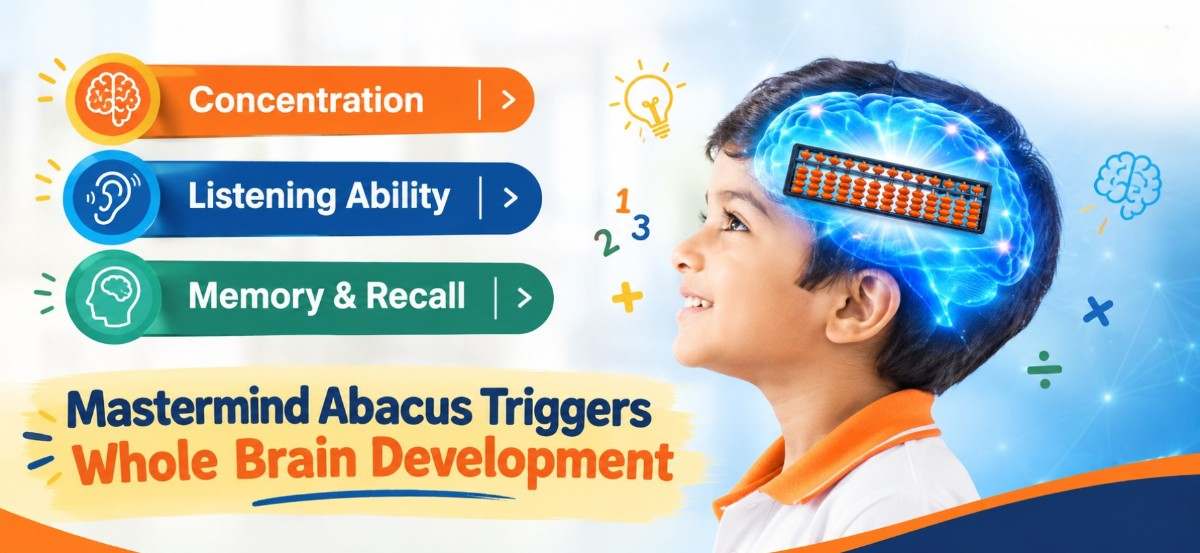
Concentration, Listening Ability, Memory And Recall, Why And How Are They So Important
📅 05 Oct, 2020 · ✍️ Admin
Last updated: 26 September 2026
At a first glance, the four qualities of Concentration, Listening Ability, Memory, and Recall mentioned in the title of this blog don’t appear that significant but let me assure you these four, or I may say the lack of them is the prime cause behind the most common problem we come across in the academic performance of kids. In layman’s language, it is said that the child is poor in studies; technically we can term it a result of lack of concentration, poor listening ability & memory, and weak recall.
Interestingly these four are interconnected with each other and the right or the creative hemisphere of the brain is responsible for them.
Low Attention Span
We often say that a child is not focusing or has a low attention span while studying. Do we really know that this is actually because of a lack of concentration which actually has a scientific reason and is not being done voluntarily by the child?
The human brain is a very intelligent organ and if not focused is incapable of concentrating on a task or work project, it has a tendency to distract and keeps engaging itself automatically. For example, if a child is studying and is only partially concentrating or focusing the brain is likely to get distracted and will engage itself in other thoughts. Thus the child is only able to utilize his brain partially and in common language; we call it low attention span. This lack of concentration leads to other connected issues like poor listening ability.
Poor Listening
While listening is a process that primarily involves the auditory organs like ears, lack of concentration actually leads to poor listening ability despite having no issues in the auditory system. When the child is not concentrating in the class, they are naturally not able to listen to what the teacher is saying or teaching as due to lack of focus whatever they hear is actually not processed in their brain.
Poor Memory
Having a poor memory is also one thing that largely affects the academic performance of the child. As the same is directly related to recall. Only and only if a child is having an excellent memory, he will be able to recall during the examinations whatever he has learned. A most common problem in kids is not remembering what they have learned which is the reason for losing marks in examinations.
Reason
These four important traits actually directly affect the academics of the child and interestingly the creative or the right hemisphere of the human brain is responsible for all of them. In a large number of individuals, the right hemisphere of the brain is predominantly less active resulting in poor concentration, listening ability, memory, and recall.
Everyday Signs Parents Often Miss
Before jumping to a label like ‘lazy’ or ‘careless’, it helps to notice the specific behaviour a child shows at home, since concentration, listening and memory struggles usually show up in small everyday moments rather than dramatic ones — the wider list of benefits of abacus training for children covers how structured practice supports all four of these areas over time. If screen time is part of your child’s daily routine, this guide on building a child’s attention span in 30 days without banning screens looks closely at the everyday habits that make the biggest difference.
| What You Might Notice at Home | What It Usually Means |
|---|---|
| Rereads the same page but can’t say what it meant | Weak listening-to-memory transfer, not laziness |
| Drifts off mid-sentence during homework | Low concentration span still developing |
| Forgets an instruction given a minute ago | Working memory that needs more practice |
| Can’t repeat back what was just explained | A listening-retention gap, not a hearing problem |
| Takes longer to recall answers in exams than in practice | A weak recall pathway under pressure |
| Gets pulled away by every small sound nearby | An attention span that is still building up |
For a wider look at how daily screen habits affect a child’s focus, our digital detox guide for young minds is a useful next read.
Remedy - Join Abacus Classes
Thankfully an Abacus an interesting program improves all of these attributes by activating the right hemisphere. An ancient calculating device used for doing calculations when used by a defined process through structured course content results in the complete brain development of the child by activating both the hemispheres.
Abacus specifically works on improving the concentration of the child leading to improved listening ability. Kids doing abacus develop a much stronger memory and are able to memorize and recall a lot more easily, almost as if a photograph is imprinted in their brain. This actually results in an improved recall. Most importantly they develop unique skills to FOCUS which prevents them from frequent diversions and distractions.
As against the popular belief that the Abacus is a math improvement program that develops the Mental Math ability of a child, the fact is that Abacus is much more than only Math. This has been proved through several studies and Research on Abacus by eminent Scientists and Mathematicians.
If done properly through a correctly structured course and content it results in an excellent improvement in the overall performance of the child. Hence it is in essence a whole brain development tool and not just limited to math skills.
During the lockdown, the physical classes of Abacus had to be closed down. It resulted in the discontinuation of the Abacus classes for many.
Mastermind Abacus one of the pioneer companies promoting Abacus education since 2005 has introduced the Mastermind's live online Abacus Learning Platform. The Online Abacus Classes of Mastermind Abacus give ascertained and satisfactory results. The features of the Online Platform is compatible with both the Teacher and the student.
This has also brought in an answer to the long-time search of the parents, 'Abacus Classes near me. Now they can access Abacus Online Class with just a Laptop and internet connection.
Also Read: Make It A Whole Brain Development For Your Ward With Mastermind Abacus
Frequently Asked Questions
My child seems fine at home but doesn’t follow instructions at school – is that low concentration?
It can be. Concentration and listening are closely linked, so a child who follows instructions one-on-one but struggles in a group class is often getting distracted by classroom noise rather than being deliberately inattentive. A structured, focus-building activity done regularly for a few weeks usually shows a visible difference.
Is poor listening the same as a hearing problem?
No. A child can have completely normal hearing and still struggle to listen, because listening also depends on concentration and how the brain processes what it hears. If a hearing check comes back normal but the listening issues continue, the cause is usually attention-related rather than physical.
How is memory different from recall, and why does my child forget things during exams?
Memory is storing information, while recall is retrieving it on demand. A child can ‘know’ something and still go blank in an exam if the recall pathway hasn’t been practised under similar pressure – regular practice using timed recall, not just repeated reading, is what strengthens this.
We already limit screen time – why is our child still easily distracted?
Screen time is one factor among several; attention also depends on sleep, structured practice and how a child’s brain has been trained to focus over time. Our digital detox guide covers screen-related habits, while an activity like abacus specifically trains sustained focus.
At what age should we start working on this, and is Abacus suitable for a 5-year-old showing these signs?
The regular Abacus programme is designed for children aged 6 to 14, since it needs a level of reading and number recognition that is typically in place by then. For a 5 to 6-year-old showing early attention or listening signs, Lingo Bingo is the age-appropriate starting point before moving into the main Abacus programme.
Author – Mr. Naveen Chowdhari
Naveen Chowdhari is the Founder & Director of Mastermind Abacus, a leading name in children's mental math and brain development training. By blending traditional abacus methods with modern teaching techniques, he has created an innovative system that enhances children's concentration, memory, visualization, speed, and overall cognitive skills. Under his leadership, Mastermind Abacus now provides worldwide online abacus classes and has built a strong global franchise network, making quality brain-development education accessible across the world.
Last Updated: 26 September 2026