
Are Classes Like Abacus, etc., Really Helpful To Indian Kids?
📅 25 Nov, 2021 · ✍️ Admin
Last Updated: 25 September 2026
Abacus learning, does it really help Indian Kids? This very question is being asked; as I read between the lines, it probably is indicating at the point that Indian Kids and Indian as such are good at Math. So why do they need anything like an Abacus, a Kumon, or Vedic Math?
Well, it is not like that. Even if it were correct that Indians are good at Maths, if Abacus and Kumon courses have value to add to their Mathematical skills, I would certainly say these are useful for them too. However, the benefits may be age-specific only.
Abacus Math, An After-School Program
To understand this, let us discuss how Abacus helps a child improve their Mathematical ability or their ability to do mental math.
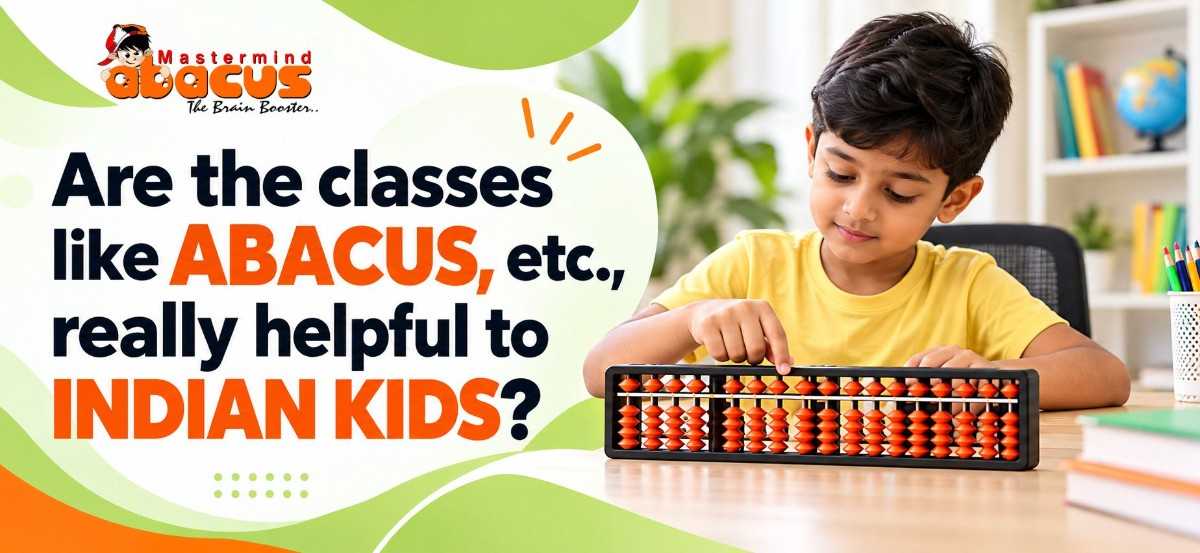
Abacus learning involves an Abacus Tool. The beads in the Abacus have a numeric value. The tool user is trained to move the beads vertically up and down per the numbers and the arithmetic operators to be applied in a sum. The final position of the beads on the Abacus instrument is the answer. The beads are moved with both hands. Using both hands triggers a whole brain development in the Abacus trainee.
Over time, the Students in the Abacus classes learn to visualize the Abacus tool. They can move the beads mentally per the requirements and reach accurate answers. They learn to do this at a great speed. It has been seen that the Abacus Students can do sums with multiple digits and rows at great accuracy and speed.
The science behind these benefits of Abacus learning has a lot of research and backup by eminent scientists and educationists. The students who undergo Abacus training exhibit higher levels of concentration, logical thinking ability, and ability to visualize and recall. The overall improved performance of the kids in their Academics reflects their enhanced abilities.
The Mastermind Abacus program is designed for children in the age group of 6 to 14 years, whether they join online or at an offline centre. It runs across 10 levels of 3 months each, with two 1-hour classes a week.
Other After-School Math Programs
Kumon: It follows the traditional method of learning math by repetition. It is engaging and relies on children practicing sums on pre-developed worksheets by Kumon. Although it is a huge brand having its presence worldwide, majorly in the Western World, it is less popular in India. Any student starting from 3 years of age to High School can take up this course.
Vedic Math, the ancient Indian Math Program - This is one process of Mathematics that can, in real terms, be labeled as ancient. It finds its roots in the Up-Veda of the Atharva Veda. Originally written in Sanskrit. It was later translated into commonly understandable Mathematical language by Adi Shankracharya, Swami Bharati Krishna Tirtha Ji Maharaj.
Vedic Math calculations are based on 16 sutras and 13 sub-sutras or formulas. These help mathematical calculation by skipping several steps generally followed in conventional methods. Vedic Math also helps in fast calculations of a complex mathematical equation of Algebra, etc. It is of great help and has its applications in competitive exams.
A child best learns it in the early teens with a certain level of intelligence.
Abacus vs Kumon vs Vedic Maths: A Quick Comparison
Since abacus, Kumon and Vedic Maths are the three after-school math programs Indian parents compare most often, here is a side-by-side look at how they differ in starting age, method and format. The concentration and recall gains linked to abacus practice are also covered in our overview of abacus research and learning outcomes, and if you are weighing several skill-building options for your child, see our guide to skill-building courses parents should consider.
| Feature | Abacus (Mastermind) | Kumon | Vedic Maths |
|---|---|---|---|
| Starting Age | 6–14 years | From around 3 years | Best suited to early teens |
| Method | Visualising bead movements for mental math | Repetition-based worksheet practice | Sutra-based calculation shortcuts |
| Class Format | Two 1-hour classes/week, online or offline | Regular worksheet sessions | Usually self-study or coaching |
| Program Length | 10 levels, 3 months each | Ongoing, level-based | Varies by learner |
| Popularity in India | Growing rapidly, especially online | Less common in India | Long-standing but niche |
Frequently Asked Questions
Is abacus learning really useful for Indian kids who are already good at math?
Yes. Abacus training works on concentration, visualization and mental calculation speed, skills that complement school math rather than duplicate it, so even strong students benefit from the practice.
What is the right age to start abacus classes?
Mastermind Abacus classes are designed for children aged 6 to 14, whether they join online or at an offline centre, with the program structured across 10 levels of 3 months each.
Is abacus better than Kumon or Vedic Maths?
Each program has a different focus: abacus builds visualization and mental math, Kumon builds practice-based fluency through worksheets, and Vedic Maths offers calculation shortcuts for older learners. Many families choose abacus first and explore the others later.
Can a child do both abacus and Vedic Maths?
Yes, many students complete an abacus program first and move on to Vedic Maths once they are a bit older, since the two use different techniques and can complement each other.
What are the real benefits of abacus training for kids?
Abacus training is associated with better concentration, faster mental calculation, and improved visualization and recall in children who practice consistently — see the full list of abacus learning benefits for details.
Does abacus training actually improve a child's focus and confidence?
Many parents notice improvements in focus, confidence and problem-solving after consistent abacus practice. We've explored this in more depth in 7 surprising ways abacus training boosts your child's IQ and EQ.
Conclusion
I want to conclude that the Abacus depends on the Abacus Tool and has its technology of calculations. It has long-term benefits like improved concentration, visualization, recall, photographic memory, etc. It is equally useful for a student from any part of the world. After completing the Abacus course, they could move on to Vedic Maths.
As far as Vedic Maths, it has its indigenous technique for calculations. One who is proficient in it could do miracles with math. The can solve simple to complex mathematical calculations mentally without using any calculator. It uses the intelligence of a person rather than relying on any gadget.
BUT If you are interested in the simple traditional mathematical practice, you could opt for Kumon. It does not introduce any new technique of calculations. It enables lots of practice.
All these courses ABACUS, VEDIC MATHS and KUMON, have their benefits for students, be they Indian or from any other part of the world.
Mastermind Abacus offers you the option of choosing from Offline one-to-one Abacus Classes and Online Abacus Classes. We also have an option if you would like to set up Abacus classes in School.
Also Read: Abacus Learning leads to a better understanding of Math calculation
Author – Mr. Naveen Chowdhari
Naveen Chowdhari is the Founder & Director of Mastermind Abacus, a leading name in children’s mental math and brain development training. By blending traditional abacus methods with modern teaching techniques, he has created an innovative system that enhances children’s concentration, memory, visualization, speed, and overall cognitive skills. Under his leadership, Mastermind Abacus now provides worldwide online abacus classes and has built a strong global franchise network, making quality brain-development education accessible across the world.
Last Updated: 25 September 2026