

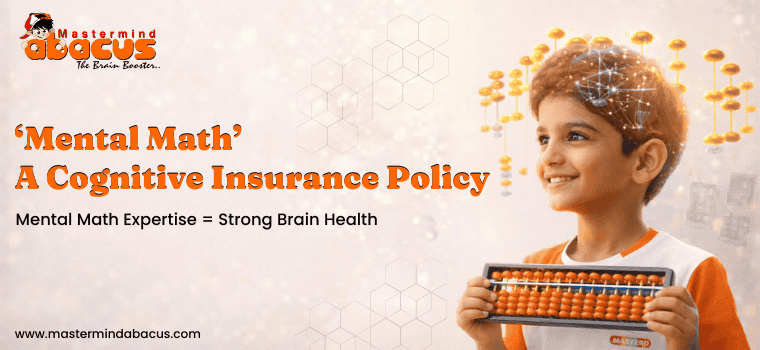
Why Top Experts Say Mental Math is a Cognitive Insurance Policy
📅 13 Apr, 2026 · ✍️ Admin
In an era where every seven-year-old has access to a calculator via a smartphone, I’m often asked: "Naveen, why bother teaching a child to calculate in their head?" It’s a fair question. But it misses the point of what we do at Mastermind Abacus. We aren't training "human calculators" we are building what neuroscientists now call a "Cognitive Insurance Policy." Think of it this way: technology is a great servant but a poor master. When a child relies entirely on a screen to think for them, their mental agility atrophies. Mental math is the "insurance" that ensures their brain remains sharp, focused, and capable of high-level logic, even when the devices are turned off.
The "Mental Anchor" Logic: How It Actually Works
To understand the "insurance" aspect, you have to look at the transition from physical beads to mental imagery. It’s a sophisticated process that happens in three distinct phases:
1. Tactile Wiring: We start with the physical abacus. The specific finger movements required to move beads stimulate the brain’s motor cortex and logic centers simultaneously.
2. Visualization (The Leap): This is where the magic happens. We remove the physical tool. The child must now "project" a mental image of the abacus in their mind’s eye.
3. Active Processing: As they move these "virtual beads," they are performing whole-brain thinking—combining the creative right brain (visualization) with the logical left brain (calculation).
Classroom Reality: I often see students who, before training, would "freeze" when faced with a multi-step problem. After developing this mental anchor, they don't just find the answer—they stay calm. They have a system they trust.
A Real-World Shift: The "Before and After"
I remember a student who joined us last year. Let’s call him Sam. Sam was brilliant but "scattered." He could solve math problems, but he had zero mental stamina. If a problem took more than two steps, he’d give up.
Before: Sam was "device-dependent." He lacked the focus to hold three numbers in his head at once.
After (The 'Insurance' Kick-in): Six months into his training, Sam wasn't just faster at math; his teachers noticed a change in his English and Science classes. Why? Because his working memory had expanded. He could now hold complex instructions in his head while working on a task.
That is the "Cognitive Insurance Policy" in action—it pays dividends in every subject, not just math.
Watch this real example of a child performing mental calculation:
The 5 Pillars of the "Policy"
Why do educational experts in 2026 value this so highly? It’s about these five core brain developments:
• 1. Photographic Memory: By visualizing the abacus, children strengthen their right brain, making it easier to "record" and recall visual information.
• 2. Expanded Working Memory: Think of this as upgrading the RAM in a computer. It allows the child to process more information simultaneously.
• 3. Unshakeable Concentration: You cannot solve a 10-row mental sum if you get distracted by a notification. It forces a level of "deep work" that is rare today.
• 4. Instant Self-Confidence: Nothing builds a child's ego faster than realizing they can calculate faster than their parents can type on a phone.
• 5. Long-term Neuroplasticity: We are literally strengthening the neural pathways that will support them when they learn to code, lead teams, or solve complex global problems later in life.
To understand how this works in a structured learning environment, you can explore our online abacus classes where children develop these abilities step by step.
Mental Math vs. Traditional Learning
| Benefit | Traditional School Math | Mastermind Abacus Method |
|---|---|---|
| Focus | Short-term | Long-term |
| Brain Activity | Left-brain | Whole-brain |
| Dependency | High | Zero |
| Result | Correct Answer | Stronger Brain |
If you want to understand the science behind this, read our detailed guide on how abacus connects both hemispheres of the brain.
Common Pitfalls: Tips from a Founder’s Perspective
To make sure this "insurance policy" actually works, avoid these common mistakes:
• The "Speed Trap": Don't force speed before accuracy. The brain needs to "see" the beads clearly first. Speed is a byproduct of clarity.
•Skipping the Physical: The physical abacus is the foundation. If you skip it too early, the mental image will be "blurry" and prone to errors.
•Inconsistency: You wouldn’t pay an insurance premium only once every three months. Mental math needs 10–15 minutes of daily "premiums" to stay effective.
Parents who follow a structured system see better results, which is why many choose abacus programs with proper training systems.
FAQs Parents Often Ask
Is this just for kids who struggle with math?
Actually, it’s the opposite. It builds brain capacity.
What is the best age to start?
Between 5 and 12 years.
Can online classes be as effective?
Yes, interactive learning ensures strong results.
The Bottom Line: Real Results in Schools
When schools introduce the Mastermind Abacus Program, the results often surpass expectations. School leaders have observed remarkable improvements in students’ concentration, logical reasoning, and overall learning confidence. Specifically, our early-learning module—a game-based abacus program for ages 4–6—is designed to build strong number sense and a positive foundation in mental math. Furthermore, programs like Lingo Bingo contribute to holistic development, enhancing the overall learning experience. This feedback highlights why schools across the country are increasingly choosing Mastermind programs to prepare young learners for a future driven by skills and innovation.
Watch this testimonial from a school leader:
In 2026, a sharp mind is the ultimate competitive advantage. By enrolling in a structured program like Mastermind Abacus classes, you aren't just teaching a skill—you’re securing your child's cognitive future.
Author – Mr. Naveen Chowdhari
Naveen Chowdhari is the Founder & Owner of Mastermind Abacus, a leading name in children’s mental math and brain development training. By blending traditional abacus methods with modern teaching techniques, he has created an innovative system that enhances children’s concentration, memory, visualization, speed, and overall cognitive skills. Under his leadership, Mastermind Abacus now provides worldwide online abacus classes and has built a strong global franchise network, making quality brain-development education accessible across the world.
Last Updated: 13 april 2026