
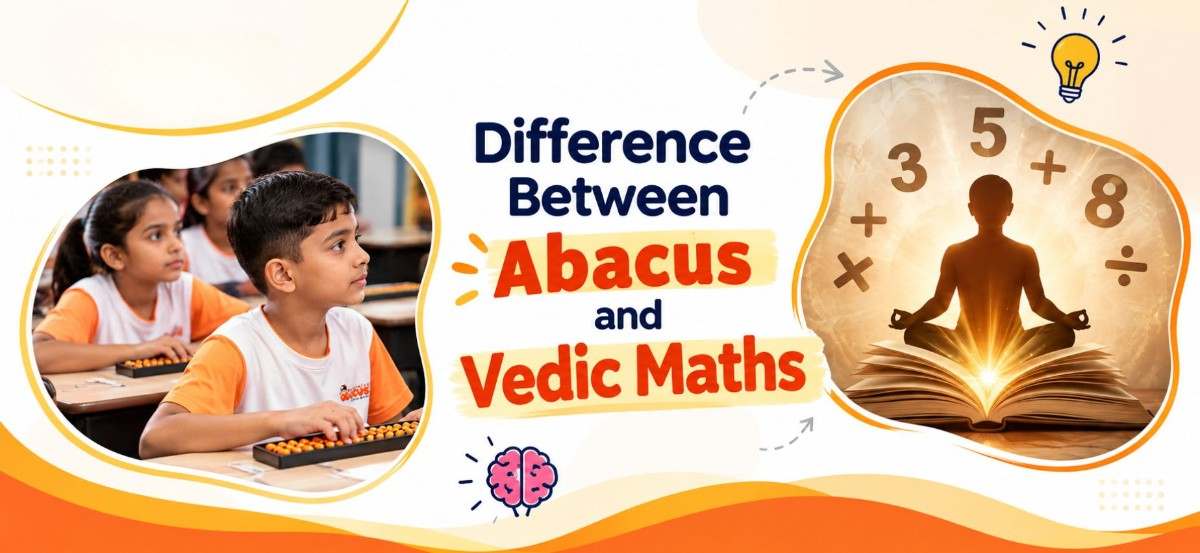
Difference Between Abacus and Vedic Maths
📅 19 Nov, 2021 · ✍️ Admin
Last updated: 25 September 2026
This question, which is better, Vedic Maths or Abacus Classes, is often asked. To start with, both Vedic Math and Abacus are ancient calculation methods. Both these are ancient systems created to facilitate the calculation of small, large and complex calculations that too mentally without the help of any physical calculating device. These calculating systems were of great importance as no calculating devices were available like we have today.
We can understand the differences between Abacus Math and Vedic Math once we know how these methods function.
Vedic Mathematics
It is the oldest known method of calculation, as old as 5000 BC. It is an ancient Indian calculating system well documented in the Atharva Vedas. It is a highly advanced system of Mathematics based on 16 Vedic sutras. These sutras were translated from Sanskrit to simple and commonly understandable mathematics. The system allows mental calculation at a fast pace as it skips several steps used in the Metric system of Mathematics. Vedic Mathematics also includes the solutions for complex Algebraic, geometric and Trigonometric calculations. Learning Vedic math can be initiated from 8 years of age. The Vedic Sutras help speed calculation from simple basic arithmetic to complex and higher mathematical calculations. It is highly handy when it comes to cracking competitive exams.
Abacus
As After School Programs
Several Schools are now including Abacus Math or Vedic Maths or even both as their afterschool program. The idea is to generate enough interest in mathematics among the children. It is very important as many kids shy away from maths and are even scared of Math.
Abacus vs Vedic Maths At A Glance
If you're wondering whether your child should learn Abacus, Vedic Maths, or both, here's a quick side-by-side look at how the two systems compare. For a deeper look at how the two stack up against regular school math as well, read our guide on choosing the right foundation for your child.
| Aspect | Abacus (Mastermind) | Vedic Maths |
| Origin | Ancient calculating tool, adapted today for mental math training | Ancient Indian system documented in the Atharva Vedas |
| Ideal starting age | 6–14 years (5–6 years via Lingo Bingo) | From around 8 years of age |
| Core skill built | Visualisation and mental calculation using an imagined abacus | Sutra-based shortcuts for faster arithmetic |
| Program structure | 10 levels, two 1-hour classes a week | Varies by course or institute |
| Best suited for | Building number sense and whole-brain development early | Speeding up calculations for competitive exams |
Learning Mental Math
FAQs: Abacus vs Vedic Maths
1. Can a child learn Abacus and Vedic Maths together?
Yes, many parents choose to introduce both. Abacus builds mental calculation and whole-brain skills from a young age, while Vedic Maths adds speed-based shortcuts once a child is comfortable with basic arithmetic, usually from around age 8.
2. Which should my child start first, Abacus or Vedic Maths?
Abacus is usually started first since it can begin from age 6 (or 5–6 with Lingo Bingo), helping build early number sense. Vedic Maths works best once a child already has a strong grasp of basic arithmetic, typically from age 8 onwards.
3. Is Abacus or Vedic Maths better for competitive exams?
Vedic Maths' sutra-based shortcuts are especially handy for speeding up calculations in competitive exams, while Abacus training strengthens the underlying mental math and concentration skills that support overall exam performance.
4. Does learning both Abacus and Vedic Maths confuse a child?
Not typically. The two methods use different techniques — visualisation for Abacus and rule-based shortcuts for Vedic Maths — and most children adapt well when the two are introduced with some gap between them rather than at the same time.
5. What age should my child start Abacus classes?
Mastermind's Abacus classes are designed for ages 6–14, with Lingo Bingo available for younger children aged 5–6 who want an early, age-appropriate start.
Conclusion
So to conclude, both Abacus and Vedic Maths greatly help the students develop speed and accuracy in doing mental math. You could start training your child in Abacus Math from age 6 onwards, with options like Lingo Bingo available for younger children aged 5–6. You have the option to send your child to physical Abacus classes, or else you have the option of going for Online Abacus Classes. Vedic Math is best to start after 10 years of age. You can get several Vedic Math classes, online study material, and books that can help your child learn Vedic Maths. While Abacus will help in whole brain development and help in overall academic performance, Vedic Math is of great help for success in competitive exams.
For getting information about the benefits of Mastermind’s Abacus learning program, join the free webinar class of Mastermind Abacus. To book your seat in the webinar fill out the form.
Also read: Abacus For Kids - Prepares Them For Future Competitions
Author – Mr. Naveen Chowdhari
Naveen Chowdhari is the Founder & Director of Mastermind Abacus, a leading name in children’s mental math and brain development training. By blending traditional abacus methods with modern teaching techniques, he has created an innovative system that enhances children’s concentration, memory, visualization, speed, and overall cognitive skills. Under his leadership, Mastermind Abacus now provides worldwide online abacus classes and has built a strong global franchise network, making quality brain-development education accessible across the world.
Last Updated: 25 September 2026