

Benefits of Learning Abacus
📅 17 Sep, 2020 · ✍️ Admin
Last updated: 26 September 2026
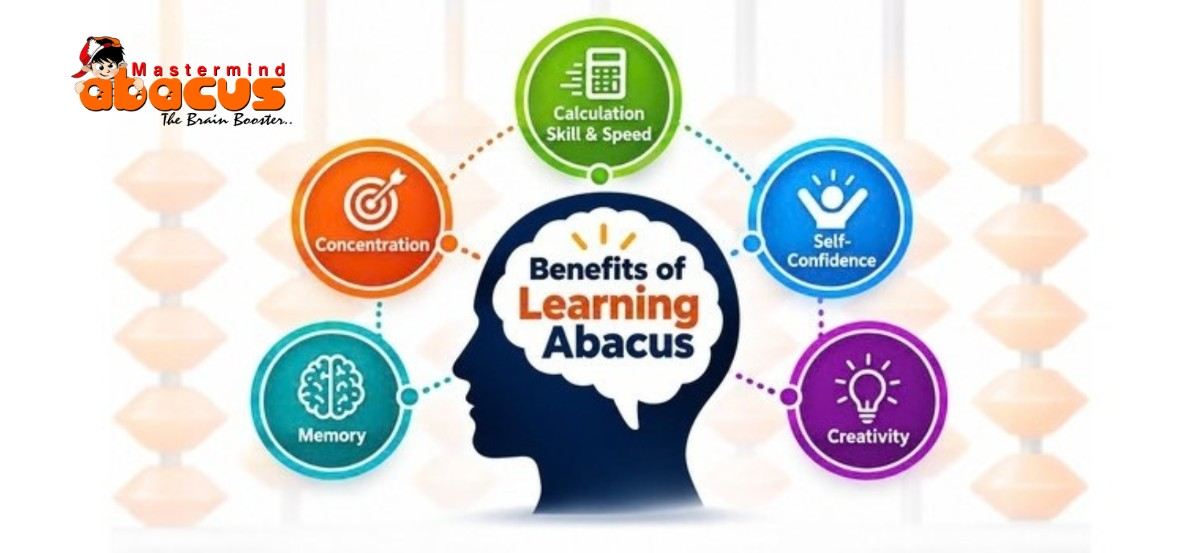
Learning Abacus, the ancient calculating tool solely used initially for purpose of doing higher arithmetic calculations has emerged as a holistic brain development program for kids. While improved Mathematical calculation is the immediately visible outcome, the list of benefits of Abacus learning goes much beyond. The program of Abacus is designed specifically for kids from 6 to 14 years of age as during this phase the process of brain development or Neurogenesis is maximum. Being a complete brain development program for kids, abacus learning activates both left and right hemispheres of a child’s brain resulting in added benefits such as
• Improved Concentration - Learning abacus activates the right hemisphere of a child’s brain which improves the child’s concentration remarkably. This is a solution to one of the most common problems of kids which is lack of concentration. The kids doing Abacus are more focused & attentive in class.
• Improved Listening Ability - The children doing the mental calculation in Abacus need to concentrate and listen to the sums to do correct calculations. This results in bringing appreciable improvement in their listening ability. Thus the kids are now able to listen and grasp what is being taught in the class more accurately.
• Improved logical thinking - Abacus is a mathematical program that uses lots of calculations, and formulas, and uses logic with continuous activation of the Left hemisphere or the logical brain resulting in improvement in logical thinking.
• Improved Recall – The kids doing mental calculations in Abacus are required to recall the previous steps thus improving their capability of recalling. This is an imperative quality very helpful in examinations. Kids normally have a problem of forgetting and not remembering the answers during the exams due to poor recall, Abacus learning helps them come out of this problem.
• Developing Photographic Memory - The kids doing abacus develop photographic memory which can be explained as the capacity to remember something as if the photograph of the same has been imprinted in the brain.
How to Spot These Benefits at Home
You don't have to wait for a report card to know abacus training is working. Most parents notice smaller, everyday signs long before scores change. Here's a quick way to connect what you're seeing at home to the benefit it reflects — and if you'd like to go deeper into how these changes actually show up in a child's thinking, our post on how abacus training boosts a child's IQ and EQ covers it in more detail.
| What You May Notice at Home | Which Benefit It Reflects |
|---|---|
| Finishes mental sums faster, without reaching for a calculator | Improved concentration and recall |
| Sits through homework or reading for longer without getting distracted | Improved concentration |
| Remembers instructions from school or class without needing repeats | Improved listening ability and recall |
| Stays calm on a tricky maths problem instead of avoiding it | Reduced maths phobia, more confidence |
| Explains how they got an answer, not just the answer itself | Improved logical thinking |
| Starts doing better in subjects other than maths too | Improved overall academic performance |
For the fuller picture of how these skills build up over time, see our detailed guide on the benefits of abacus learning.
• Improved overall academic Performance - With improved concentration, recall, photographic memory, logic, and listening ability, the child not only performs better in mathematics but also shows exceedingly improved results in all the subjects.
• Overcome Math Phobia – The kids doing abacus classes start thinking the numbers in the form of images of the bead position. This helps them in becoming comfortable with the numbers and coming out of the Math Phobia. When a numerical is asked to a kid, normally the calculation is done in the logical left hemisphere of the brain. But for a kid who is doing the abacus program, the child imagines the abacus instrument in their right brain, the numbers get converted into an image of bead positions, the calculation is done in the right brain by moving the imaginary beads and the final result is obtained in the form of the image of the bead position. This final answer is then transferred to the logical left hemisphere where the image is converted into numbers and the child answers. This technique of doing calculations not only fastens the speed but also helps the student in overcoming the Math phobia.
• Improved Self-Confidence – When the overall academic performance of the child improves remarkably, the child starts becoming more participative in the classroom ultimately resulting in being more confident.
Frequently Asked Questions
How soon can I expect to see these benefits after my child starts abacus classes?
Most parents notice smaller changes — like better concentration or a calmer reaction to a tough sum — within the first few months. Bigger academic gains build up gradually as your child moves through the levels, so consistent weekly practice matters more than expecting an overnight change.
My child is already good at maths — will abacus still help them?
Yes. Abacus training works on concentration, memory, listening and logical thinking, not just calculation speed, so a child who is already strong in maths usually still gains better focus and improved performance across other subjects too.
Will these benefits last even after my child stops abacus classes?
Skills like concentration and logical thinking tend to carry over into other learning once they've been practised consistently across the levels. How much stays long-term varies from child to child, so we wouldn't promise a fixed outcome either way.
Is online abacus training as effective as offline classes for building these benefits?
Both formats follow the same structured programme of two one-hour classes a week across the levels, so a child builds the same core skills whether they join online abacus classes or attend a centre. Pick whichever fits your family's routine better.
Which of these benefits usually shows up first?
Concentration and listening ability tend to become noticeable earliest, since every class asks a child to focus closely and follow the sums. Deeper gains like logical thinking and photographic memory usually build more gradually as your child moves up the levels.
Can abacus help a child who feels anxious about maths, not just one who calculates slowly?
Yes — many parents start abacus classes specifically because their child avoids maths or feels nervous about it. The visual, hands-on method helps children think in images rather than under pressure. Abacus is an educational activity, not a therapy, so if the anxiety feels severe or persistent, it's worth having a qualified professional assess your child alongside these classes.
Looking at all the above benefits of Abacus training, we can say that it is one of the most amazing supplementary education programs for kids that not only improves mathematics but also brings complete overall development to the child. You can refer to Mastermind Abacus's online abacus classes, one of the most modern Abacus training programs for students. Their program is an excellent amalgamate of modern technology and the ancient Abacus learning and training methods. The learning here has been transformed through a gaming platform making it a very interesting whole brain development program for the kids.
Also Read: Learning Abacus-Prepares Kids For Future Competitions
Author – Mr. Naveen Chowdhari
Naveen Chowdhari is the Founder & Director of Mastermind Abacus, a leading name in children’s mental math and brain development training. By blending traditional abacus methods with modern teaching techniques, he has created an innovative system that enhances children’s concentration, memory, visualization, speed, and overall cognitive skills. Under his leadership, Mastermind Abacus now provides worldwide online abacus classes and has built a strong global franchise network, making quality brain-development education accessible across the world.
Last Updated: 26 September 2026