

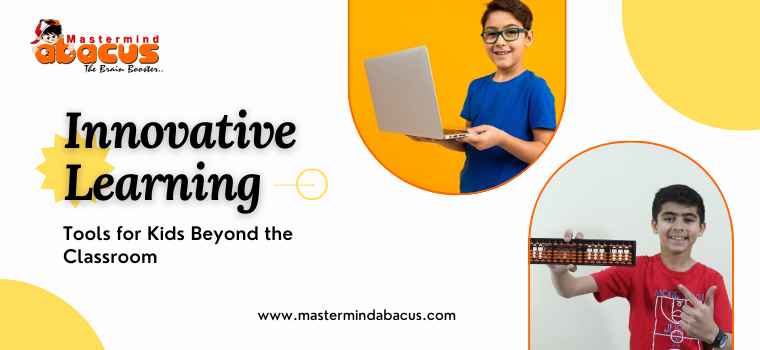
Creative Learning Tools That Go Beyond the Classroom
📅 27 Mar, 2025 · ✍️ Admin
As parents, we all want the best for our children, especially when it comes to their education and development. In today's fast-paced world, traditional classroom education is just one piece of the puzzle. To truly unlock a child's potential, it's essential to explore creative learning tools that go beyond the classroom. These tools not only make learning fun but also foster critical cognitive skills like concentration, memory, and logical thinking.
One such tool that has been gaining popularity among parents and educators alike is the abacus. While many think of the abacus as an ancient calculating device, it's much more than that. Abacus learning is a powerful educational tool that can significantly enhance a child's cognitive abilities. Let's explore how creative learning tools, particularly the abacus, can contribute to a child's overall development and provide actionable tips for parents looking to integrate these tools into their child's daily routine.
The Power of Creative Learning Tools
Creative learning tools are designed to engage children in a way that traditional methods often fail to do. They turn abstract concepts into tangible experiences, making learning more interactive and enjoyable. Here are some key benefits of using creative learning tools:
1. Enhances Cognitive Skills: Tools like puzzles, building blocks, and the abacus improve problem-solving skills and boost memory and concentration.
2. Encourages Curiosity and Exploration: Creative tools inspire children to ask questions, explore new ideas, and think critically.
3. Promotes Active Learning: Unlike passive learning, where children simply absorb information, active learning involves them in hands-on activities that reinforce concepts.
4. Develops Fine Motor Skills: Activities that require precision, like moving beads on an abacus or fitting puzzle pieces, help develop fine motor skills.
5. Builds Confidence and Independence: Mastering new tools and techniques helps children feel more confident and independent in their learning journey.
A Story of Success: How Abacus Learning Transformed Amy’s Learning Experience
To illustrate the power of creative learning tools, let's take a look at the story of Amy, a 7-year-old girl who struggled with math in her early school years. Amy's parents noticed that she often became frustrated during homework time, particularly with math problems. She found it difficult to focus and frequently forgot basic arithmetic operations.
Concerned about her progress, Amy’s parents decided to try a different approach. They enrolled her in an online abacus class. At first, Amy was hesitant, as she thought it would be just another boring math lesson. However, to her surprise, the classes were interactive and fun. The use of the abacus turned numbers into visual objects that she could manipulate, making it easier for her to understand complex concepts.
Within a few months, Amy's concentration improved significantly. Her teachers noticed she was more attentive in class, and her math grades started to improve. More importantly, Amy began to enjoy learning math. The abacus had not only improved her mathematical skills but also boosted her confidence and made her a more enthusiastic learner.
This success story highlights the transformative power of creative learning tools like the abacus. Amy’s experience is just one of many that show how such tools can make a real difference in a child’s education.
Why Abacus Learning Stands Out
So, what makes abacus learning such a powerful tool for young minds? Here are some key reasons:
- Visual Learning: The abacus provides a visual and tactile way to understand numbers, which is especially beneficial for young children who learn best through visual cues.
- Boosts Concentration: Manipulating the beads requires focus and attention, which helps improve a child’s concentration over time.
- Improves Memory: The practice of visualizing abacus movements in the mind enhances memory retention and recall, a skill that is valuable in all areas of learning.
- Develops Mental Math Skills: Regular practice with the abacus trains children to perform calculations mentally, improving their speed and accuracy in math.
- Encourages Logical Thinking: Abacus learning involves breaking down complex problems into simpler steps, fostering logical and analytical thinking.
If you’re interested in exploring abacus learning for your child, Mastermind Abacus offers comprehensive online classes that provide a fun and interactive learning experience. Our classes are designed to cater to children aged 5 to 12, focusing on enhancing cognitive skills while making learning enjoyable.
Tips for Parents: Integrating Creative Learning Tools at Home
Integrating creative learning tools at home doesn’t have to be complicated. Here are some practical tips for parents:
1. Start with Simple Tools: Begin with easy-to-use tools like puzzles, building blocks, or simple abacus exercises. The key is to make learning feel like play.
2. Set a Routine: Allocate a specific time each day for creative learning activities. Consistency helps children build a habit and reinforces the learning process.
3. Use Everyday Opportunities: Incorporate learning into daily activities. For example, use cooking to teach measurements or grocery shopping to practice addition and subtraction.
4. Encourage Exploration: Give your child the freedom to explore different tools and activities. This will help them discover their interests and strengths.
5. Praise Efforts, Not Just Results: Encourage your child by praising their efforts rather than just the outcomes. This builds confidence and a love for learning.
6. Join the Fun: Participate in learning activities with your child. This not only makes the process more enjoyable but also strengthens your bond with them.
The Convenience of Online Learning
One of the unique benefits of enrolling in online abacus classes, like those offered by Mastermind Abacus, is the convenience and flexibility they provide. With busy schedules, it's not always easy for parents to find time for additional learning activities. Online classes can be accessed from the comfort of your home, eliminating travel time and allowing you to integrate learning seamlessly into your daily routine.
Moreover, our online classes are led by experienced instructors who understand the unique needs of young learners. The interactive sessions ensure that children stay engaged and motivated throughout their learning journey. You can learn more about our program and its benefits by visiting our online classes page.
Conclusion
In a world where education is evolving, it's essential to think beyond traditional classroom methods and explore creative learning tools that can truly make a difference in a child's life. Whether it's through puzzles, games, or the abacus, these tools offer unique ways to develop critical cognitive skills, foster a love for learning, and build confidence in young minds.
Remember, every child learns differently, and it’s our job as parents and educators to provide them with the right tools and opportunities to succeed. If you're looking for a structured, fun, and effective way to enhance your child's learning experience, consider exploring the abacus and other creative learning tools. You never know; it might just be the key to unlocking their full potential.
For more information on how to get started with abacus learning, check out our online classes at Mastermind Abacus. Let’s make learning a fun and enriching experience for our children!
Creative Learning Tools – FAQs
1. What are creative learning tools?
Creative learning tools are hands-on educational resources—like puzzles, building blocks, and the abacus—that make learning interactive, enjoyable, and more effective for children.
2. How does the abacus help in my child’s learning?
The abacus enhances concentration, memory, logical thinking and helps children visualize numbers, which strengthens both math skills and overall brain development.
3. At what age can a child start learning the abacus?
Children as young as 6 years old can begin learning the abacus, as this is the age when their cognitive and motor skills begin to develop rapidly.
4. Will abacus learning improve my child’s performance in school?
Yes! Abacus training improves mental math speed, focus, and memory. These skills naturally support better performance in school, especially in mathematics.
5. Is online abacus learning effective?
Absolutely. Online abacus classes offer interactive sessions, flexibility, and structured learning, making them just as effective as traditional in-person classes.
6. How much time should my child spend on creative learning tools daily?
Just 15–20 minutes a day is enough to build consistency and significantly boost cognitive development.
7. Can creative learning tools replace traditional schooling?
No, they are meant to complement formal education—not replace it. These tools enrich learning by making difficult concepts easier and more enjoyable.
8. What other tools can I use besides the abacus?
Puzzles, building blocks, memory games, flashcards, brain teasers, coding toys, and STEM kits are all great options to boost creativity and problem-solving.
9. What if my child loses interest?
Keep sessions short, fun, and pressure-free. Join your child during activities and let them experiment freely. Engagement increases when learning feels like play.
10. How can I integrate creative learning tools into daily routines?
Use simple daily tasks—like cooking, shopping, or organizing toys—to teach math, logic, and problem-solving in a natural, enjoyable way.
Benefits of Creative Learning Tools vs. Traditional Learning Methods
| Aspect | Creative Learning Tools (Abacus, Puzzles, Blocks, etc.) | Traditional Learning Methods (Books, Worksheets) |
|---|---|---|
| Learning Style | Hands-on, interactive, multi-sensory | Mostly theoretical and text-based |
| Engagement Level | Highly engaging; game-like learning | Moderate; can feel repetitive |
| Cognitive Development | Strong improvement in memory, concentration & logical thinking | Basic enhancement through repetition |
| Problem-Solving Skills | Encourages analysis, visualization & creative thinking | Focuses on standard methods and formulas |
| Motor Skills Development | Improves fine motor skills through physical interaction | Minimal or no motor skill involvement |
| Confidence Building | Boosts confidence through mastery of tools | Confidence depends heavily on academic scores |
| Adaptability | Flexible learning pace; suitable for multiple learning styles | Often standardized; less personalized |
| Fun & Motivation | Fun-based, encourages curiosity | Can feel like a chore for young children |
Author – Mr. Naveen Chowdhari
Naveen Chowdhari is the Founder & Owner of Mastermind Abacus, a leading name in children’s mental math and brain development training. By blending traditional abacus methods with modern teaching techniques, he has created an innovative system that enhances children’s concentration, memory, visualization, speed, and overall cognitive skills. Under his leadership, Mastermind Abacus now provides worldwide online abacus classes and has built a strong global franchise network, making quality brain-development education accessible across the world.
Last Updated: 2 March 2026