

Abacus-Journey From A Physical Calculator To Mental Math Tool
📅 10 Dec, 2021 · ✍️ Admin
Last Updated: 25 September 2026
This write-up will give you all the information you have been looking for about Abacus. You will get a brief history of Abacus and its journey from a physical calculator to a mental math tool. Also used as a modern-day Brain development tool for the younger brains.
History of Abacus
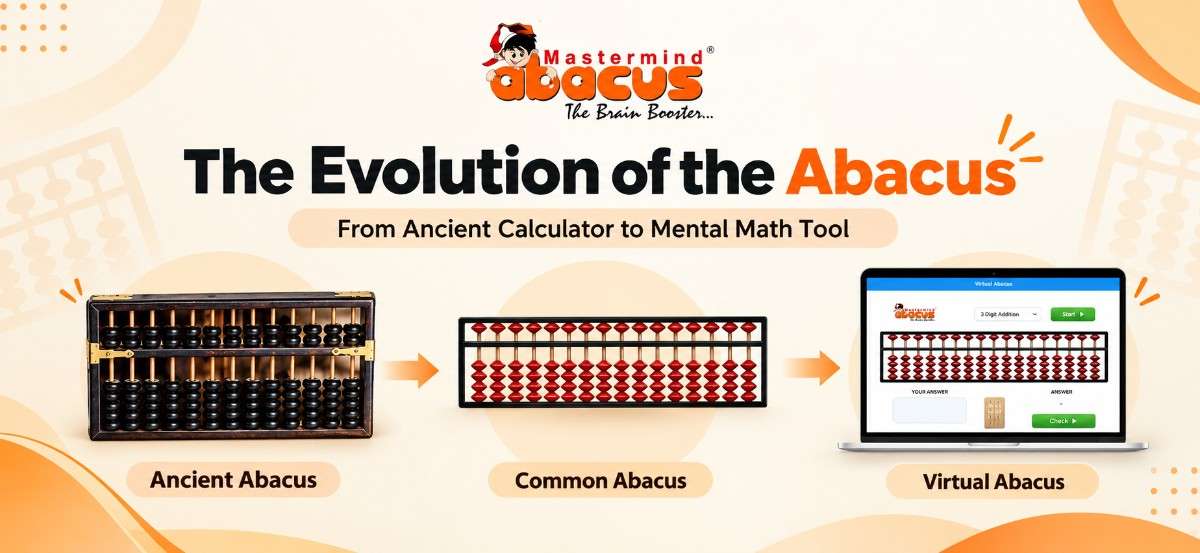
When we look into the history of Abacus , the word Abacus originates from the Greek word 'abax' or 'abakon,' meaning 'tabular form. Abacus is a calculating device invented about 3000 years ago, primarily in China, which later spread through countries like Korea, Japan, Taiwan, Malaysia, etc. in ancient days. The Abacus Tool, in its journey, has gone through several changes to ease its use by the masses. The Abacus involves the Basic Arithmetic System for calculating numbers. The Suanpan, the Chinese Abacus with 2/5 decks, got replaced by Soroban, a Japanese Abacus to cut down on the complexities in calculations. This modification is credited to the Japanese mathematician Seki Kowa. It has an upper and lower deck to make with 1/4 decks. The modified Soroban Abacus gained popularity worldwide as Globalization happened.
It is now being used majorly as a 'Whole Brain Development' tool over the last two decades, making Math learning easy and effective.
Scientific studies support the claim that the Abacus enhances the comprehension of Math and promotes accurate and faster calculation in addition to augmenting problem-solving abilities.
Research On Abacus
It is a simplistic calculating device that lasted through generations and millennia. The Abacus instrument became a topic of study for both educationists and scientists. The topic of interest and research in the 20th century was the speed and accuracy that Abacus users showed while doing mathematical calculations.
The observation was that the students who had attended a reasonable number of Abacus Classes under well-trained experts showed excellent mental calculation skills. The scientific studies and neurological documents further proved that using the Abacus effectively develops the Right Brain.
The above was only a hypothesis that got validated once scholars did extensive research on Abacus with the help of hi-tech equipment. The preliminary study on the effects of Abacus training on the human Brain was done by 3 eminent scholars and scientists Dr. Toshio Hayashi, Prof. Shizuko Amaiwa and Ms. Kimiko Kawano.
Development Of The Right Brain By The Abacus Method Of Mental Calculation.
The Human Brain has a left hemisphere or the Left Brain and a right hemisphere or the Right Brain. Although both the parts function in tandem, they have certain individual functions to be performed.
The Left Brain or the digital Brain controls reading, writing, calculation, and logical thinking. It is also responsible for our three-dimensional sense, creativity, and our artistic sense.
Some researchers associate underdeveloped Right Brain activity with a higher risk of cognitive decline in later life, including dementia. Because of this, many educators believe our education system should place more focus on training the Right Brain of the kids alongside the Left Brain.
During the Abacus training, the students learn to visualize the Abacus instrument. Visualization is the beginning of learning to do Mental Math with an Abacus. The students move the Abacus beads in their heads on the imaginary Abacus instrument and carry out the calculations. Visualization is one of the primary reasons attributed by the scientists that they conclude could be responsible for effectively training the Right Brain.
The super-advanced medical equipment helps accurately measure cerebral physiology developments, indicating the Brain's blood flow. The studies on Abacus users who can do Mental Math indicate that it is highly effective in activating the Right Brain.
The students who complete all 10 levels of Abacus training become a master in Mental Calculation. They acquire several additional attributes.
A) The Improvement of Numerical Memory
Students trained with efficient use of the Abacus are seen to have far superior and accurate memory and recall compared to non-abacus learners of similar age. They can memorize and retain a large number of digits. It becomes possible because of their ability to visualize the Abacus, manipulate the beads, and decipher the bead position into numeric values.
B) Speed & Accuracy
The most significant advantage of learning the Abacus is speed and accuracy in solving simple mathematical problems. The ability to visualize aids in doing mental math without actually using the physical Abacus Tool.
The abacus calculation method does not bind a student to a fixed process. They have the liberty to innovate while calculating, unlike the non-abacus students, where the process lacks flexibility.
C) Verbal Thinking and Image Processing (Visualization)
When people do a mental calculation, they use the inner voice, like in 55 minus 5 is 50.
But a child who has learnt to use Abacus also learns visualization. The important thing is that they can also use them for other subjects. Not only also use this ability developed in an Abacus class in different ways.
While for beginners, Abacus helps to quickly grasp images in addition and subtraction problems as the beads move in front of their eyes. The child also can learn the decimal system.
The Journey From Abacus Beads To Anzan
Visualization doesn't happen overnight — it builds step by step as a child progresses through a structured Abacus programme. Below is a simple look at how that journey typically unfolds, from moving physical beads to solving sums purely in the head. Even as calculators and AI tools handle everyday number-crunching, this is exactly the kind of mental muscle-building we talk about in Mental Math in the Age of AI: Why Your Child's Brain Still Needs to Do the Work.
| Stage | What The Child Does | Skill Being Built |
|---|---|---|
| Foundation | Learns to use the physical Abacus confidently | Number sense, finger dexterity |
| Building Visualization | Starts picturing the Abacus mentally while solving sums | Mental imagery, working memory |
| Anzan Practice | Solves sums without touching the Abacus, using the mental image alone | Anzan (mental Abacus) skill |
| Mastery | Performs fast, accurate calculations purely in the head | Speed, accuracy, focus |
Glimpses of Improvisations In Abacus and Its Developments
To enable students to get the best from Abacus education and also the learning is eased out for the students, Mastermind Abacus has developed a hi-tech Abacus program. Still, it has ensured the sanctity of the ancient Abacus learning method is kept intact. The program is developed to give the children a joyful experience through the 2 years of Abacus training. It overcomes the flaws in the existing Abacus Training Systems.
1. The Calculating System Adapted Is School Curriculum Based
Most Abacus programs follow the pattern of calculating from left to right, but the schools teach calculations from right to left. The new process interferes with the understanding and adaptation to varying patterns. Mastermind Abacus follows the school method of calculating from right to left.
2. Mastermind Abacus E-Learning Platform
Before the lockdown due to the Covid pandemic, i.e., until the advent of 2020, Abacus learning was considered an exclusive offline program that could be conducted in an Abacus class where teachers take physical classes. They both have to move out of their homes. Starting an Abacus Class required infrastructure and monthly overhead rental. The students were always limited to surrounding areas.
In 2020, all schools and educational institutes were shut down. These restrictions forced the promoters to develop an online Abacus learning and teaching system. Creating a virtual classroom accessible from the comfort of the homes. Thus facilitating Abacus online.
Mastermind Abacus now has a conventional Abacus teaching and Learning program and a Hi-tech hybrid Abacus E-Learning Platform. It enables the teacher to teach from a remote, undoing the geographical limitations. It also offers a multilingual option.
The system meets all the parameters of an Abacus conventional teaching system, like teaching correct finger movement. Mental Math, assigning Homework, conducting online exams, real-time evaluation, certification etc. All this is done through a well-developed and easy-to-operate Teachers Panel.
The students learn on their system on their student's panel that comes with additional advantages like:
A) Abacus Math Game-Based Learning

The learning happens through pre-recorded learning videos under the guidance of a certified Abacus teacher. Classwork, Homework and practice are done by playing Abacus Math-based game videos.
The system has a video conferencing window that allows the teacher to keep a vigil on the students, and also, the students can converse with the teacher if need be.
B) Mastermind Abacus Virtual Abacus

A Virtual Abacus, like a ready assistant, is available as and when required to help the students and teachers. This tool is beneficial for assisting both the students and teachers when no one is around to guide them physically.
Mastermind E-Learning Platform- A Boon For Students and Trainers
Mastermind Abacus E-learning Platform has user-friendly features that make learning as effective as any conventional Abacus classroom. It is a convenient option for those who have had to either discontinue or want to learn Abacus in the present situation when educational institutes are yet to open. Location is also no more a hindrance.
Frequently Asked Questions
What is Anzan, and how is it different from using a physical Abacus?
Anzan is the stage of Abacus training where a child solves calculations by picturing the Abacus in their mind, instead of using the actual tool. It develops gradually as visualization skills strengthen through the higher levels of the programme.
At what stage does a child stop needing the physical Abacus?
Most children start relying more on visualization once they move into the middle-to-advanced levels of a structured programme, though the exact stage varies from child to child depending on practice and consistency.
Does mental math training actually improve memory and focus?
Abacus and Anzan practice is widely associated with stronger numerical memory, focus and visualization skills, since children must hold and manipulate numbers mentally rather than on paper. Individual results vary with regular practice — see our guide on Abacus visualization exercises parents can try at home for ideas.
How many levels does the Mastermind Abacus programme have?
The Mastermind Abacus programme is structured across 10 levels, each building on the visualization and calculation skills from the one before, with two one-hour classes a week. You can see how the levels progress on our Abacus Math programme page.
Is Abacus training a substitute for learning math the traditional way at school?
No — Abacus training works alongside a child's school curriculum, strengthening number sense, speed and visualization. It isn't a replacement for regular classroom math learning.
Conclusion
If you want to enroll your child at an Abacus Class, go ahead without hesitation. It will benefit your child in improving their concentration, ability to visualize, memory and recall ability and enhance their performance in general studies. It will add to the confidence of the child. It could be one of the best academic gifts you would give your child. Book a free demo.
Also Read: Abacus Online Classes By Mastermind Abacus
Author – Mr. Naveen Chowdhari
Naveen Chowdhari is the Founder & Director of Mastermind Abacus, a leading name in children's mental math and brain development training. By blending traditional abacus methods with modern teaching techniques, he has created an innovative system that enhances children's concentration, memory, visualization, speed, and overall cognitive skills. Under his leadership, Mastermind Abacus now provides worldwide online abacus classes and has built a strong global franchise network, making quality brain-development education accessible across the world.
Last Updated: 25 September 2026