
Problem Solving with Abacus
📅 30 Oct, 2020 · ✍️ Admin
Last updated: 26 September 2026
How To Improve Maths - With Abacus?
Mathematics, for many, is scary right from childhood. They dread numbers, and this may continue even when they are in college. Mathematics is considered to enhance the logical abilities of a child. Humans find abstract always difficult to identify and become friends with. And numbers certainly are abstract. It is a question that haunts many, 'How to improve Maths?
Moreover, multiple formulae and arithmetic operations make it challenging for many. The best way to get over math phobia in young children is to transform numbers from abstract into objects that the child can relate to, visualize and touch. Here we will discuss one such method.
I am sure you have heard of the ancient Chinese/Japanese calculating device Abacus. It is one instrument that gives the numbers an image a child can feel and visualize.
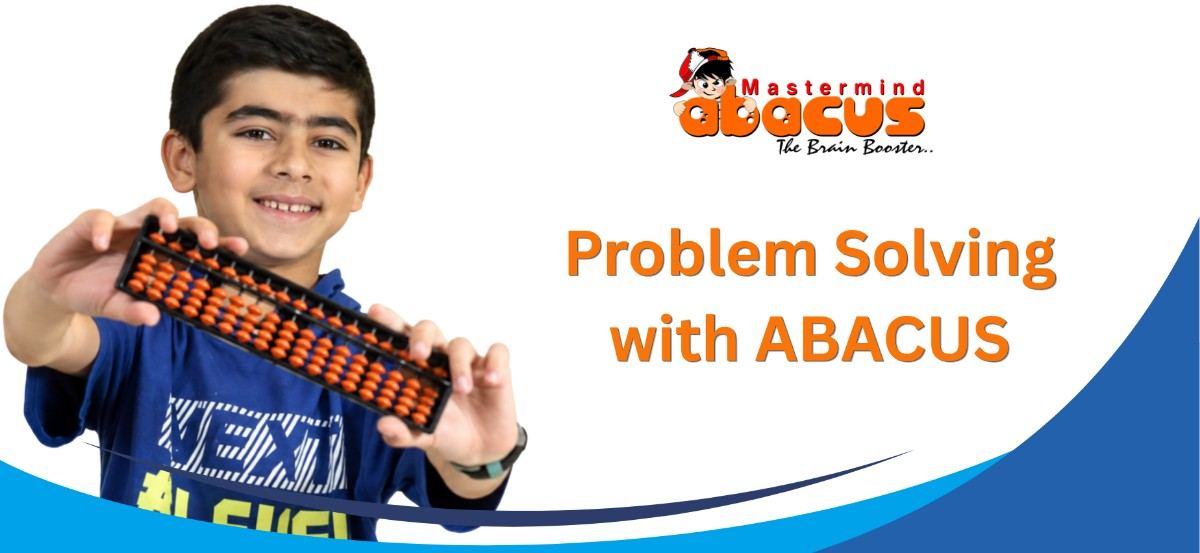
An abacus has a wooden frame divided horizontally into two parts by a bar. It has an odd number of vertical rods with beads in the upper and lower deck. These beads represent numbers and facilitate calculating from single-digit to numerous digits numbers. It also allows the use of all the arithmetic operators. One can even solve roots. The kids can virtually see numbers in the image of the bead position. The numbers are no more abstract.
This is also why the benefits of abacus training go well beyond faster calculation — the same visualizing habit that helps a child add and subtract also helps them make sense of a written problem.
Let Us See How One Can Use An Abacus For Doing Calculations
1. The Use of An Abacus
For using an Abacus device, a child needs training in the Abacus and its methods before using it proficiently for doing a calculation. It requires Abacus training and rigorous practice. Once trained, the child can do mental math involving a series of multiple digits of numbers by using a Virtual Abacus (The child can visualize an Abacus and move the beads mentally to do the calculations).
To master the methods of using an Abacus tool efficiently, one has to attend Abacus Classes regularly and complete the Abacus course. It is a gradual process, starting from simple addition, subtraction, multiplication, and division, moving on to a stage when students develop Mental Math skills.
2. Addition and Subtraction On Abacus
Understanding the Abacus Tool is the preliminary thing one has to do before initiating Abacus learning. Either the middle of the extreme right rod of the Abacus is considered the unit rod, and subsequent rods on the left of the unit rod would be tens, hundreds, and so on. One can calculate tens of millions of place values. Once a child understands the basic structure and the value of Abacus beads starting from the unit rod, the child will be able to solve single-digit additions. The upper deck of the Abacus has one bead and has a numeric value of 5, while the lower deck has four beads with one as the numeric value of each. Only when a bead touches the horizontal bar does it attain the value.
For example, if we have to add 1 + 2, we move one bead on the unit rod from the lower deck towards the Horizontal bar. Next, add 2; we will move 2 beads on the unit rod toward the Horizontal bar. Now, since three beads are touching the horizontal bar of the Abacus, you get a value of 3.
To solve a sum, we have to start from the unit's rod and move to the left rod for tens, hundreds, etc., and so on. A similar method of solving from left to right is applied while solving addition and subtraction sums.
Where Word Problems Trip Children Up — And How Abacus Thinking Helps
Once a child is comfortable moving beads for addition and subtraction, the next hurdle is usually the word problem — not because the maths is hard, but because turning a sentence into a sum feels like a separate skill. This is really an extension of the same problem-solving instinct abacus training builds, a link we explore further in how abacus practice quietly builds a child's problem-solving instincts. Here's how a few common word-problem types map to abacus-style thinking:
| Word Problem Type | What It's Really Asking | How Abacus Thinking Helps |
|---|---|---|
| Simple story sums ("Rohan had 8 marbles, gave away 3") | Spotting the operation hidden in the sentence | Child converts the story straight into a bead move instead of getting stuck on the wording |
| Money and shopping problems | Combining several small amounts correctly | Place-value columns on the abacus make adding mixed amounts feel natural |
| Sharing / division problems | Splitting a quantity fairly into groups | Beads let a child picture equal groups instead of guessing an answer |
| Comparison problems ("who has more/fewer") | Holding two quantities in mind at once | Side-by-side bead positions make the difference visible rather than abstract |
| Multi-step problems (two operations in one sum) | Doing the steps in the right order | Each step is its own physical bead move, so a step is less likely to get skipped |
3. Multiplication In Abacus
Let us understand how to do multiplication on Abacus through this sum.
Say you have to solve 5 x 2.
We will set 5 on the extreme left and 2 on the extreme right of the Abacus Tool.
Now 2 times 5 is 10, so we will place 0 on the unit rod and one on the 10's rod.
This process is followed for multiplying any number of digits on an Abacus. If it is a multiplication of 2 digits, the result of the first digit multiplication will be placed on the unit rod and need to be on the 10's rod. The result of the 2nd digit will be placed on the 10's rod and need to be on the 100's rod. So on and so forth. The final position will give the perfect multiplication.
Frequently Asked Questions
My child can calculate quickly but freezes on word problems — will abacus help with that?
Yes, to an extent. Abacus training builds strong number sense and mental calculation, but a child also needs practice reading and breaking down the story before applying that number sense. Working on both skills together usually shows the best results with word problems.
At what stage of abacus learning do word problems usually get easier for a child?
Most parents notice a difference once a child is comfortable doing two-digit addition and subtraction mentally. That's typically when they stop counting on fingers and can focus on understanding what the question is actually asking.
Can abacus practice replace regular school homework on word problems?
No, abacus training is a supplement, not a replacement. It strengthens the calculation part of a word problem; reading the question, translating it into numbers, and checking the answer still need regular classroom practice.
Does abacus specifically help with division and sharing-type word problems?
It can. Abacus makes division concrete because a child can represent a quantity being split into equal groups on the rods, which is often the hardest part of sharing-type word problems for young learners.
My child is 8 and still gets confused by "how many more / how many less" questions. Is this common?
It's a common stage, not a sign of a learning gap. These comparison problems ask a child to hold two quantities in mind at once, and the visual bead-position practice from abacus training can make comparing two amounts easier over time.
One can also solve questions of division and fractions on an Abacus, done mentally without needing a calculator.
Several companies are providing Abacus Training through their Abacus centers. One of them is the premium company Mastermind Abacus. They have a technologically advanced program that maintains the sanctity of the traditional Abacus method calculation. They offer conventional Abacus Classes and Online Abacus Classes, with indigenously developed Abacus Math-based Math video games.
Also Read: Abacus Learning leads to a better understanding of Math calculation
Author – Mr. Naveen Chowdhari
Naveen Chowdhari is the Founder & Director of Mastermind Abacus, a leading name in children's mental math and brain development training. By blending traditional abacus methods with modern teaching techniques, he has created an innovative system that enhances children's concentration, memory, visualization, speed, and overall cognitive skills. Under his leadership, Mastermind Abacus now provides worldwide online abacus classes and has built a strong global franchise network, making quality brain-development education accessible across the world.
Last Updated: 26 September 2026