
How Abacus Training Helps Children Fall in Love with Math
📅 03 Jun, 2022 · ✍️ Admin
Last updated: 23 September 2026
Abacus has been a very popular after-school activity in recent years. Abacus can help kids in their overall brain development. Parents have been insisting on enrolling their children for Abacus Training for the love of Math.
Some studies suggest that students who learn abacus may do better in maths than those who do not.
Now the question arises, should abacus training be a part of a student’s school academics?
If yes, how will abacus training get accommodated in the school schedule?
According to the need, studies have always led to re-evaluation and updates in school curriculums. Newer skills are always needed to update the kids.
Why Do Kids Need An Abacus?
Some kids learn abacus easily, and some take a little more time. But after getting proper abacus training, everyone can enjoy its benefits.
Apart from improving arithmetic skills, abacus provides many other advantages. We can list them as below:
A) Boosts Self-Confidence
A kid learning abacus often gets the chance to perform before large audiences at national and international Abacus competitions.
These kids get a strong boost in their self-esteem and confidence, which creates confident kids ready for future challenges.
B) Improves Concentration
While learning Abacus, the child also learns to mask any distractions in the surroundings, which boosts their concentration skills and helps them in all the aspects of their academics.
C) Increases Speed and Accuracy In Math
Learning Abacus helps to teach a child to compute at speed with accuracy. Most competitive exams are time-bound; hence Abacus can help your kid perform better within the time limits.
D) Improves Observation Skills and Listening
As the training moves forward in an Abacus Class, a child who has been learning Abacus math can start processing numbers with just a fleeting look. The child sharpens up their observational skills.
The listening skills also get better as the kids are allowed to hear the numbers only once while training to solve the problems, which teaches them to listen carefully to the questions and improve their listening skills.
E) Enhances Imagination and Visual Skill
Initially during the abacus training, kids perform the calculations on the Abacus tool. Later they are encouraged to use an imaginary virtual abacus in their mind. By just imagining the abacus, they can quickly solve problems.
Once they have mastered this skill, they learn the visualization technique that helps them imagine the Abacus tool in their mind and carry out calculations mentally.
The more the kid starts using this technique, the better their visualization and imagination skills are developed.
F) Enhances Creativity
The improved visualization and imagination skills inspire the child’s creativity because of the training and activation that the abacus gives to the brain.
G) Strengthens Memorizing Power
During the number training and while solving problems, the kids have to remember the positions of the Abacus Beads. The students give the answer based on the final image formed.
Through regular practice, a child’s ability to memorize & recall things improves and supports a stronger visual memory.
H) Lays A Strong Academic Foundation
When your kid attains all of the above parameters. Abacus training becomes a strong foundation for them to outshine in their academics.
I) Eases Maths Worry and Stress
For many children, maths feels stressful because numbers seem confusing. As abacus practice makes numbers clearer and easier to handle, that everyday worry around maths often reduces.
Therefore, the more the child enjoys using the Abacus, the happier they are, reducing stress levels.
Abacus is an educational activity, not a therapy; persistent difficulties should be assessed by a qualified professional.
J) Improves Fine Motor Skills
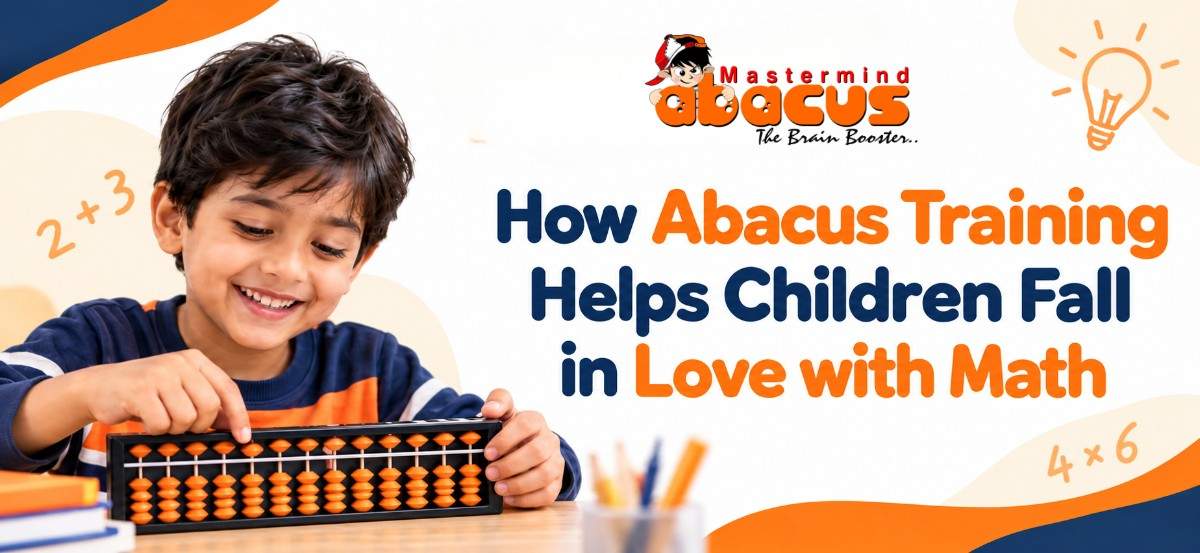
The children use both their hands and fingers to move the beads of the Abacus. This movement of the beads helps the child develop their fine motor skills. It also keeps the hands and the mind working together.
K) The Child Gains Analytical Skills
While a child solves an arithmetical problem with the help of an abacus, they are also sharpening their analytical skills. These analytical skills can be later used in different situations in life.
Many countries around the globe use an abacus to teach basic calculations. Several schools, especially in Asia, use the Abacus as an additional tool for learning math in both primary and secondary classes.
Many parents and teachers find it a very effective method for young kids to learn mental math.
Abacus Training does not only help with the basic calculations like addition, subtraction, division, and multiplication, but also helps in effective counting of decimal points, negative numbers, etc.
While a small percentage of lucky children find it easy to solve math problems, many children find numbers and math very difficult! Learning Abacus in an in-person or an online Abacus class is one of the best ways to improve mathematical skills and number fluency.
Abacus also helps develop an interest and passion in math for many students by enhancing their confidence and understanding. Moreover, learning Abacus is also fun.
We all know that students mostly prefer the subjects they perform well in!
Hence, Mastermind Abacus has made it a mission to make the students fall in love with math.
Myths That Stop Kids Loving Maths
Many children decide very early that they are "not maths people", and that belief quietly shapes how they feel about every maths class. If you want to understand where this fear begins, read our guide on why children are scared of maths. Below are the myths I hear most often from parents, and what we have actually seen in our classes.
| Common myth | What we actually see |
|---|---|
| "Some children are just not maths people." | Most children grow comfortable with numbers when they learn step by step, at their own pace, with regular practice. |
| "A child who fears maths needs more pressure and more homework." | Fear usually grows with pressure. Small daily wins and a calm, playful routine build confidence far better. |
| "If maths is fun, the child is not really learning." | Children practise longer and remember more when they enjoy it. Play and real skill-building can go together. |
| "Only naturally smart kids enjoy abacus." | Children learn at different speeds. With patient guidance, slower starters often end up enjoying it just as much. |
| "We should see big results in a few weeks." | Our programme runs over 10 levels of 3 months each, with two 1-hour classes a week. Confidence builds steadily over time. |
Many parents might think it is difficult or almost impossible for their child to enjoy math. But since 2005, we have seen many children change the way they feel about math through Abacus education. Mastermind Abacus gives an additional option of Online Abacus Classes and conventional Abacus classes.
A structured abacus math programme can help many students who are facing math phobia. Over the years, I have seen abacus training help many children overcome their fear of math.
Another factor that strongly emerges is the need for Abacus Training for teachers who could provide adequate Abacus education to the aspiring Students. Mastermind Abacus provides structured Abacus Training facilities for teachers. An aspiring teacher can opt for either Online Abacus Training or offline.
Frequently Asked Questions
My child says they hate maths. Can abacus training really change that?
It often can. Many children dislike maths because they feel slow or unsure, not because they lack ability. Abacus turns numbers into something they can see and touch, and small wins in class build confidence. As a child starts getting answers right, their attitude towards maths usually becomes much more positive.
How long does it take for a child to start enjoying maths with abacus?
It is different for every child. Some children warm up within the first few classes, while others need more time and steady practice. Our programme runs over 10 levels of 3 months each, with two 1-hour classes a week, so confidence builds gradually. Patience and regular practice matter more than speed.
Should abacus training be part of a child's school academics?
Abacus works well alongside school maths because it strengthens number sense, focus and mental calculation. Some schools include it as an activity or skill period, while many families choose after-school classes. Schools that want to add it to their week can explore our abacus programme for schools to see how it could fit their timetable.
What age is best to start abacus for building a love of maths?
The Mastermind Abacus programme is for children aged 6 to 14, both in live online classes and at our centres. Starting in the early primary years helps a child build confidence before maths gets harder in higher classes. Older children can also join and benefit, because the programme moves step by step through each level.
How can parents keep maths fun at home alongside abacus classes?
Keep practice short, regular and pressure-free. Ten to fifteen minutes a day works better than long weekend sessions. Use everyday moments like shopping bills, cooking measurements or car number plates for quick mental sums. Praise effort rather than only marks, and never compare your child with siblings or classmates. Enjoyment grows when maths feels safe.
Will abacus replace my child's school maths lessons?
No. Abacus does not replace the school syllabus; it supports it. It mainly builds calculation speed, accuracy, concentration and visualisation, which help a child feel more at ease in school maths. Topics like geometry, fractions and word problems are still learnt at school, but a confident, number-friendly child usually approaches them with less fear.
It’s an enhancement tool for mental math operations that helps solve math from the very basic to the complex problems.
It is your chance to make your child the math champion of their class.
So, book a free demo today!
Also read: Are classes like Abacus, etc., really helpful to Indian kids?
Author – Mr. Naveen Chowdhari
Naveen Chowdhari is the Founder & Director of Mastermind Abacus, a leading name in children’s mental math and brain development training. By blending traditional abacus methods with modern teaching techniques, he has created an innovative system that enhances children’s concentration, memory, visualization, speed, and overall cognitive skills. Under his leadership, Mastermind Abacus now provides worldwide online abacus classes and has built a strong global franchise network, making quality brain-development education accessible across the world.
Last Updated: 23 September 2026