

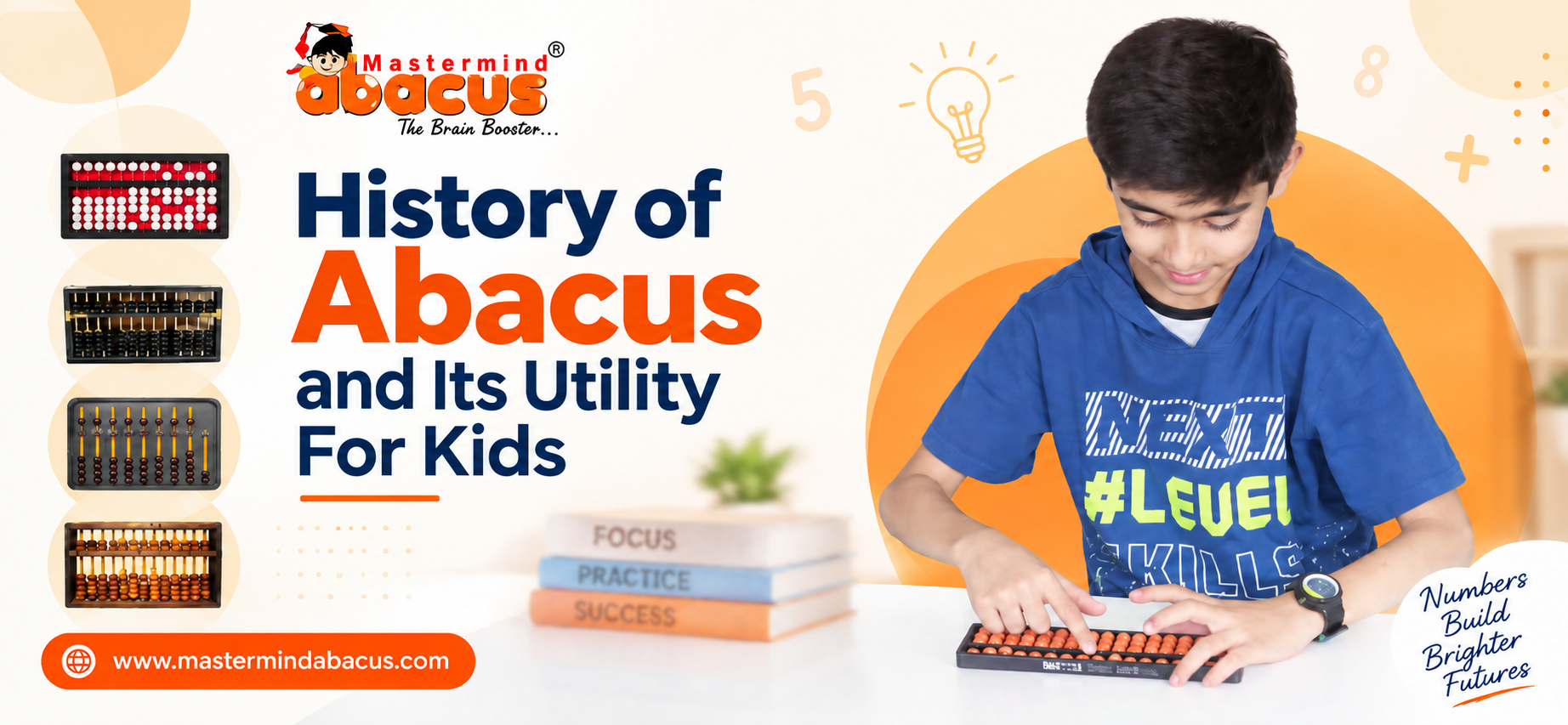
History of Abacus and Its Utility For Kids
📅 14 Dec, 2022 · ✍️ Admin
Last updated: 22 September 2026
History of Abacus
The word "abacus" comes from the Latin word abacus, which was borrowed from the Greek word "abax," meaning a flat "table" or "board." In mathematical history, Abacus holds an extraordinary place. It is one of the oldest calculation devices, and it is primarily used to calculate arithmetic problems. This write-up discusses the brief of Abacus history, its types and utility for kids. Available evidence suggests the History of Abacus goes back more than 4,000 years, to the counting boards of ancient Mesopotamia.
This phenomenal device comprises rods, beads, and a wooden or polymer frame. Each rod represents a specific place value, and each bead represents a value. These beads are used by moving them along the rods according to the need of the calculations.
One fact that we all know about Abacus for kids is that the modern Abacus is widely used as a brain development tool for children, which helps in improving one's mental math ability. There are a few more amazing facts about Abacus that you might want to know. A few are listed below;
About Abacus
1. A horizontal bar divides the Abacus into two parts, the upper and the lower deck.
2. The name given to the Russian Abacus is 'Schoty.' The difference between other abacuses and Schoty is that it does not have decks.
3. The earliest known written record of the Chinese abacus is usually dated to around the second century CE, although counting boards were used even earlier in Mesopotamia, Greece and Rome.
4. The creator of the Cranmer abacus is Tim Cranmer. It is used to conduct calculations quickly and simply for Visually Impaired individuals.
5. Most people confuse the Abacus with the counting board, but the fact is that both these tools are different from each other.
6. Our current computers work on the binary number system, and a "binary abacus" is sometimes used to show how computers handle numbers.
7. The Chinese Abacus is called a "Suanpan." This term typically means- 'a calculating pan'.
From Counting Board to Mental Math Trainer
Over thousands of years, the abacus changed its shape many times, but its job stayed the same: to make numbers visible. The table below shows how each version was used and where children fit in today, and our guide to the difference between the Chinese Suanpan and the Japanese Soroban explains the two bead layouts in detail. To see why this ancient tool matters even more now, read why your child's brain still needs to do the mental math in the age of AI.
| Version | Where it was used | What it was used for |
|---|---|---|
| Counting boards | Ancient Mesopotamia, Greece and Rome | Moving pebbles or counters along lines for trade and record-keeping |
| Suanpan (2 beads above, 5 below) | China | Everyday business and shop calculations |
| Schoty (no upper and lower deck) | Russia | Counting money in shops and offices |
| Soroban (1 bead above, 4 below) | Japan | Fast calculation and school maths lessons |
| Cranmer abacus | Designed by Tim Cranmer | Accurate calculation by touch for visually impaired people |
| Soroban for children today | Abacus classes, online and offline | Children first move real beads, then learn to picture them and calculate mentally |
Now that we have known some facts about Abacus, let us now answer some of the common questions you might have in your mind.
1. What Material Is Used For Making The Abacus?
A wooden or polymer rectangular frame divided by a horizontal bar makes the Abacus tool. It has vertical wires or rods across the length of the structure in odd numbers. On the modern Soroban, these wires have beads embedded, one in the upper deck and 4 in the lower deck. The bead helps in performing the calculation. You can find beads of different shapes. Abacus was created as a counting device for calculation in ancient times.
2. What Is The Person Who Uses The Abacus Called?
The term for the person who uses an abacus is called an Abacist.
3. What Is Japanese Soroban?
The Abacus in the Japanese version is called a Soroban. In Japan, the Soroban is still introduced in primary school maths lessons, and many children also learn it in after-school classes.
4. How Was Abacus Teaching Initiated?
In the earlier days, the Abacus was used only for calculations. But with time, people found difficulties in learning math. Only after this people started using Abacus as a learning tool and later discovered the benefits of the Abacus for kids.
5. What About Technological Development
While calculators have taken the place of Abacus as a tool, they can certainly not replace Abacus as a learning program because of the different advantages it offers.
6. What Is A Russian Abacus?
The Russian abacus, called the Schoty, was widely used in Russian shops and offices for centuries. Interestingly, it travelled from Russia to France, not the other way round: the French mathematician Jean-Victor Poncelet took the idea back to France after returning from Russia in the early 1800s.
7. What Were The Influences of China On The Abacus?
China is amongst the countries that influenced the Abacus the most. The Chinese Suanpan was in wide use by around the 14th century, and from China the bead abacus spread to its neighbours. Japan adapted it into the Soroban, and Korea into the Jupan.
8. What Is Unique About The Modern Abacus?
At present, we use Soroban for calculations. The reading on the Abacus becomes zero by sweeping a finger along the horizontal bar. It has one bead in the upper deck and 4 beads in the lower deck.
9. What Is The Use of An Abacus For Kids?
Using an abacus for your kid's learning can support your kid's brain development. It also enhances mental arithmetic in kids and adults.
10. What Is Special About The Cranmer Abacus?
Cranmer Abacus was developed for blind people to learn calculations quickly and accurately.
Frequently Asked Questions
Who invented the abacus?
No single person invented the abacus. It grew out of ancient counting boards used in Mesopotamia more than 4,000 years ago, where people moved pebbles along lines to count. The bead-and-rod abacus later developed in China as the Suanpan and was refined in Japan as the Soroban. You can explore each stage in our detailed history of the abacus.
Why do children still learn the abacus when calculators exist?
Because the goal is not the answer, it is the thinking. A calculator does the sum for the child, while the abacus lets the child see place value and work out each step. With practice, children picture the beads in their mind, which exercises concentration, memory and number sense that a calculator does not build.
What is mental abacus or Anzan?
Mental abacus, called Anzan in Japanese, is calculating with an imagined abacus instead of a real one. Children first learn to move beads on the physical abacus. Over the levels, they start picturing the same bead movements in their mind and solve sums mentally. This visualisation is what turns an ancient counting tool into a mental math skill.
What is the right age for a child to start learning the abacus?
At Mastermind Abacus, the abacus programme is for children aged 6 to 14, in both online and offline classes. By six, most children can recognise numbers and follow bead movements comfortably. For younger children, our Lingo Bingo programme for ages 5–6 at offline centres is a playful starting point before formal abacus training.
How long does it take to complete an abacus course?
The Mastermind Abacus programme has 10 levels, and each level takes about 3 months with two 1-hour classes a week. That makes the full course roughly two and a half years. Short daily practice at home helps children move steadily from using the physical abacus to calculating mentally.
Can my child learn the abacus online?
Yes. In Mastermind's live online classes, a teacher guides the child in real time while the child works on the abacus at home, and practice games make revision engaging. Online and offline students follow the same 10-level programme, so families can choose the format that suits their schedule.
What to Take?
Firstly, I hope that the above facts were interesting and helped you learn something new about Abacus that you were not already aware of.
Now the question is
Is Abacus Helpful For Your Kid?
Well, Abacus influences a child's overall mental development in several ways. With regular practice, this can include advantages like faster learning, better memory, stronger listening skills, a longer attention span, self-confidence, etc.
Are you the parent using Abacus for kids as a tool for brain development? Or the teacher that helps learn mathematics quickly by using an abacus for kids?
If Not, What Are You Waiting For?
Mastermind Abacus is an Abacus program for children aged 6–14. The program is specially designed to reduce the fear of math in children.
We have been promoting the Abacus Math Program since 2005 through our 1,000+ centres spread across 17 countries.
The parent's challenge is choosing the right Abacus Company for their ward.
Moreover, Mastermind Abacus provides both Offline and Online Abacus Classes to its students.
We have developed an Online Abacus E-learning platform and a hybrid Abacus E-Teaching platform. Together, they make up Mastermind's live online abacus learning platform, a live and interactive portal especially designed to teach Abacus.
Our online Abacus Program trains students through indigenously developed Abacus Math-based game videos. The teacher monitors the entire system through an inbuilt video conferencing window.
Check it for yourself; Mastermind Abacus welcomes you to book an online demo class and then make a decision.
Also Read: Abacus-Journey From A Physical Calculator To Mental Math Tool
Author – Mr. Naveen Chowdhari
Naveen Chowdhari is the Founder & Director of Mastermind Abacus, a leading name in children’s mental math and brain development training. By blending traditional abacus methods with modern teaching techniques, he has created an innovative system that enhances children’s concentration, memory, visualization, speed, and overall cognitive skills. Under his leadership, Mastermind Abacus now provides worldwide online abacus classes and has built a strong global franchise network, making quality brain-development education accessible across the world.
Last Updated: 22 September 2026