

How to Improve Your Child’s Maths Skills Through Visual Learning
📅 09 Jan, 2023 · ✍️ Admin
Math can be daunting for many children, causing anxiety and stress at an early age. However, math is a crucial subject that helps children develop logical thinking and problem-solving skills. As a parent, it's essential to find ways to help your child improve their math skills and overcome any math phobia they may have. One effective method is to improve Math Skills in Children with Abacus Education.
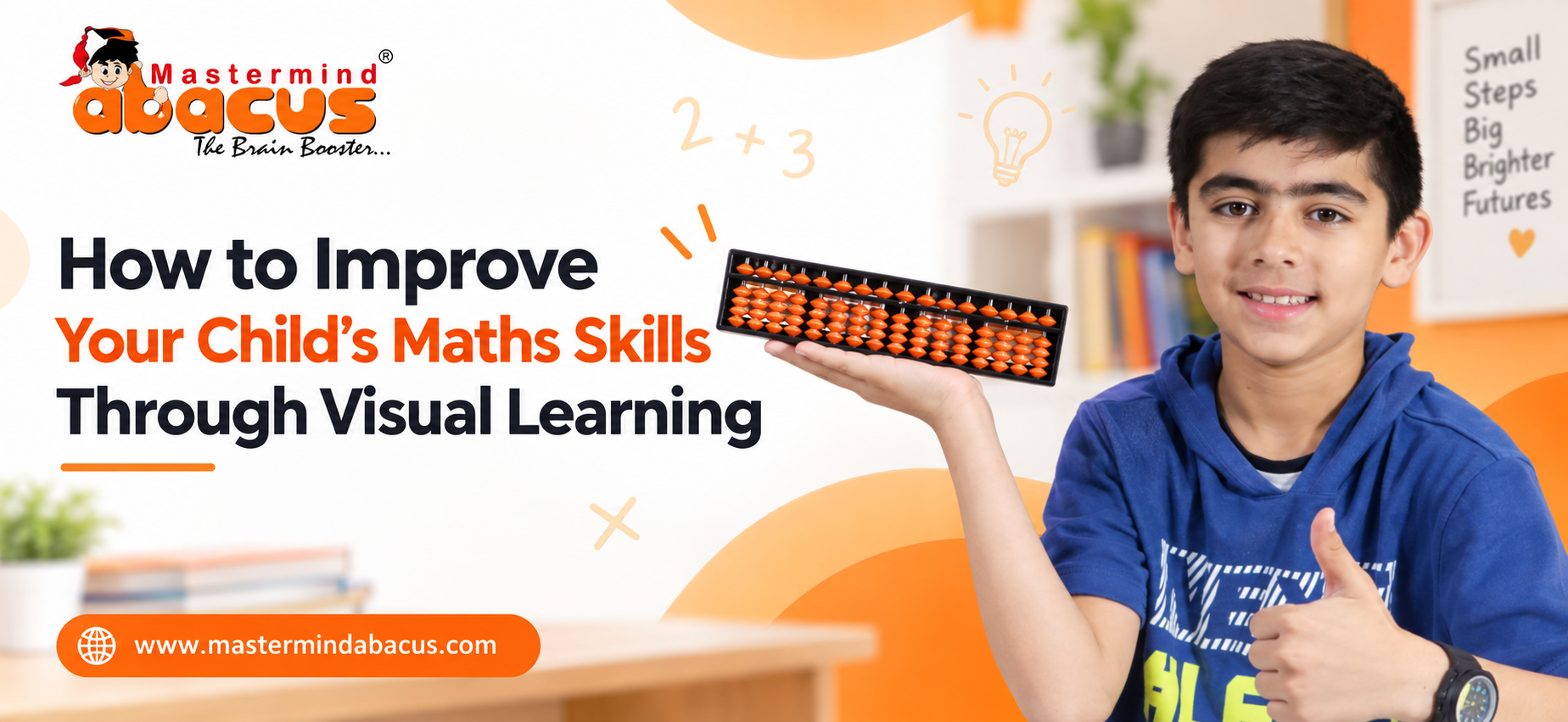
An Abacus is an ancient calculating tool used in China and Japan that consists of a wooden frame divided horizontally into two parts by a bar. It has vertical rods with beads in the upper and lower decks, representing numbers and facilitating calculations from single to numerous digits. The Abacus also allows for using all arithmetic operators and even solving roots.
Using an abacus can help children visual
Last updated: 22 September 2026
Improve Math Skills In Children With Abacus Education
Math can be daunting for many children, causing anxiety and stress at an early age. However, math is a crucial subject that helps children develop logical thinking and problem-solving skills. As a parent, it's essential to find ways to help your child improve their math skills and overcome any math phobia they may have. One effective method is to improve Math Skills in Children with Abacus Education.
An Abacus is an ancient calculating tool used in China and Japan that consists of a wooden frame divided horizontally into two parts by a bar. It has vertical rods with beads in the upper and lower decks, representing numbers and facilitating calculations from single to numerous digits. The Abacus also allows for using all arithmetic operators and even solving roots.
Using an abacus can help children visualize and touch numbers, making them less abstract and easier to understand. It allows children to see the numbers in the image of the bead position, making math more tangible and relatable.
Children will need training and practice in its methods to improve math skills with an Abacus. Enrolling in Abacus classes and completing an Abacus course can help children master the tool and gradually develop Abacus mental math skills.
Children can move on to more advanced concepts starting with simple addition, subtraction, multiplication, and division. Addition is done by moving beads towards the horizontal bar and subtraction by moving them away from it, starting from the rightmost rod and moving left for tens, hundreds, etc. Multiplication is done by setting the multipliers on the extreme left and right of the Abacus and following the process of placing the results on the appropriate rods. Division is done by setting the dividend on the left and the divisor on the right, with the quotient represented by beads on the unit rod.
In addition to learning math concepts, using an Abacus can also improve a child's memory, concentration, and hand-eye coordination. It helps them develop their mental calculation skills and enables them to solve math problems faster and more efficiently.
Which Math Skills Does Abacus Build?
Parents often ask us which math skills actually change when a child learns abacus. The table below shows, skill by skill, what your child does on the abacus and what you may start to notice at home. For simple ways to build these skills outside class, read our parent's guide to developing mental math skills at home, and see how the course is structured on our abacus math programme page.
| Math skill | What the child does on the abacus | What parents may notice |
|---|---|---|
| Number sense | Sees every number as a clear pattern of beads | Recognises and compares quantities more easily |
| Place value | Sets ones on the rightmost rod, then tens and hundreds moving left | Fewer mix-ups when reading or writing bigger numbers |
| Carrying and borrowing | Moves a value to the next rod when one rod is full or empty | Understands why we carry and borrow, not just the steps |
| Mental calculation | Learns to picture the bead positions without a physical abacus | Works out everyday sums in the head with growing confidence |
| Concentration and accuracy | Follows each bead movement step by step | Works more carefully, with fewer careless errors |
As a parent, you can support your child's Abacus education by encouraging regular practice and providing a positive learning environment. For added convenience and flexibility, consider enrolling your child in live online abacus classes for children, such as those offered by Mastermind Abacus. Using an Abacus to improve math skills can help your child overcome their math phobia and develop a love for the subject.
Frequently Asked Questions
At what age can my child start abacus classes?
Mastermind Abacus classes are for children aged 6 to 14, both online and at our offline centres. The programme has 10 levels, each about three months long, with two 1-hour classes a week. For children aged 5 to 6, our Lingo Bingo programme at offline centres is the better starting point.
How soon will I see a change in my child's math skills?
Every child learns at a different pace, so there is no fixed timeline. With regular classes and short home practice, many parents first notice better number sense and more careful working in everyday sums. Mental calculation grows gradually, level by level, as the child learns to picture the beads without the physical abacus.
Will abacus methods confuse my child in school math?
In most cases, no. The abacus uses the same place value system children learn in school, ones, tens and hundreds, only in a visual form. Many children find that seeing numbers as beads makes school methods like carrying and borrowing easier to understand. Our teachers help children connect both approaches.
How much should my child practise abacus at home?
Short, regular practice works better than one long session a week. A few focused minutes on most days, as guided by your child's teacher, helps the bead movements become automatic. Keep practice calm and encouraging; praising effort rather than speed helps children stay motivated and enjoy working with numbers.
Can abacus help a child who is scared of maths?
It can help. Because the abacus turns numbers into something children can see and touch, many children feel less anxious and more in control. Abacus is an educational activity, not a therapy; if a child's difficulties with numbers persist, they should be assessed by a qualified professional.
Also Read: Why Abacus For Kids?
Author – Mr. Naveen Chowdhari
Naveen Chowdhari is the Founder & Director of Mastermind Abacus, a leading name in children’s mental math and brain development training. By blending traditional abacus methods with modern teaching techniques, he has created an innovative system that enhances children’s concentration, memory, visualization, speed, and overall cognitive skills. Under his leadership, Mastermind Abacus now provides worldwide online abacus classes and has built a strong global franchise network, making quality brain-development education accessible across the world.
Last Updated: 22 September 2026
Children will need training and practice in its methods to improve math skills with an Abacus. Enrolling in Abacus classes and completing an Abacus course can help children master the tool and gradually develop Abacus mental math skills.
Children can move on to more advanced concepts starting with simple addition, subtraction, Multiplication, and division. Addition and subtraction can be done by moving beads on the unit rod towards the horizontal bar, starting from the rightmost rod and moving left for tens, hundreds, etc. Multiplication is done by setting the multipliers on the extreme left and right of the Abacus and following the process of placing the results on the appropriate rods. The division is done by setting the dividend on the left and the divisor on the right, with the quotient represented by beads on the unit rod.
In addition to learning math concepts, using an Abacus can also improve a child's memory, concentration, and hand-eye coordination. It helps them develop their mental calculation skills and enables them to solve math problems faster and more efficiently.
As a parent, you can support your child's Abacus education by encouraging regular practice and providing a positive learning environment. For added convenience and flexibility, consider enrolling your child in online Abacus classes, such as those offered by Mastermind Abacus. Using an Abacus to improve math skills can help your child overcome their math phobia and develop a love for the subject.
Also Read: Why Abacus For Kids ?