

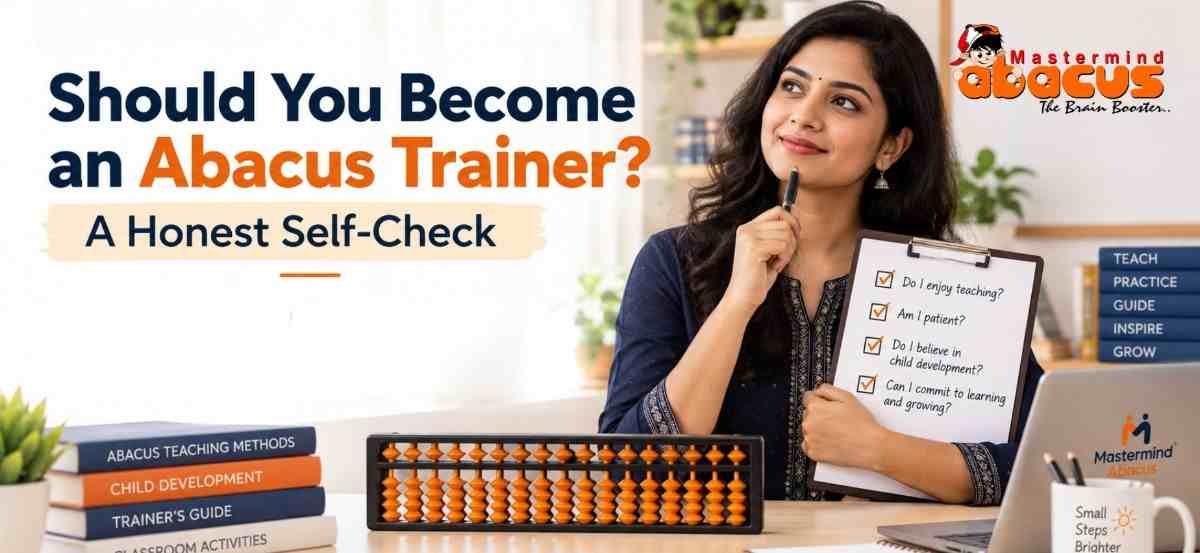
Should You Become an Abacus Trainer? A Honest Self-Check.
📅 04 Sep, 2013 · ✍️ Admin
Last updated: 30 September 2026
With the increase in the demand for supplemental courses to provide the best education to children, Abacus is being widely adopted universally. With its wonderful and jaw-dropping effects on small children, most of the parents are availing the course to utilize all its advantages.
Now to supply these demands, education companies like ours have been serving a large number of students with their top-rated programs through our vast franchise network. We, therefore, realize the importance of quality trainers for Abacus and so encourage dynamic educators to train kids for the same.
Why become an Abacus Trainer?
Abacus as a course is widely used as a brain development tool, apart from imparting mental arithmetic skills in the students. Being an Abacus trainer you will:
· Train kids on a time-tested ancient calculating system that enhances mental arithmetic skills
· Incorporate skills like visualization, concentration, listening, logical reasoning, memory and recall thus help in developing their complete brain
· Offer students a course that gives them an edge over others by improving their academic and co-curricular performance
· Generate revenue and income by pursuing a career that brings meaningful changes in the education patterns and overall personalities of small kids
· Be satisfied with a feeling of serving a noble cause that shapes children's future by making them competent and confident
Is This Role A Fit For You? A Quick Self-Check
Before you look at fees, batches or certificates, it helps to know what the work actually feels like on an ordinary teaching day. Many of our best trainers came from outside formal teaching — one of them tells her story in how a homemaker became a proud abacus business owner. Use the table below as an honest self-check before you enquire about our abacus teacher training programme.
| What the role asks of you | You will enjoy this if… | It may feel demanding if… |
|---|---|---|
| Explaining the same step again and again | you are patient and enjoy the moment a child finally gets it | slow progress makes you restless |
| Speaking slowly and clearly during dictation | you are comfortable holding a steady pace for the whole batch | you tend to hurry through explanations |
| Handling a small group of 6 to 14 year olds together | you like the energy of a children's classroom | you prefer quiet, one-to-one work |
| Keeping up your own bead and mental practice | you like staying a few steps ahead of your students | you would rather teach only what you already know |
| Talking to parents about a child's progress | you can give honest feedback gently | difficult conversations drain you |
| Tracking speed and accuracy over months | you enjoy records, charts and small improvements | detailed follow-up feels tedious to you |
If most of the middle column sounds like you, the next question is what the training itself covers — that is explained in detail in our guide to abacus training for trainers, and the teaching approach you would be trained in is described in the Mastermind method of abacus pedagogy.
What skills should you pursue to be an Abacus Trainer?
Teaching is a skill that grows with practice, not something a person is simply born with. If you enjoy being around children and are willing to learn the method properly, you can become an effective Abacus trainer. The qualities below are the ones we most often see in trainers whose batches do well, and parents look for many of the same qualities in a good abacus trainer:
· Should be a passionate educator at heart
· Should have a love for children and should adapt teaching methods understanding their psychology
· Should be readily available to help children with all their difficulties and problems ensuring equal attention to all
· Should measure the progress of students regularly and take corrective strategies to improve scores
· Should teach difficult and complex methods easily without complications
· Should ensure complete involvement of students throughout the 10 levels without making the course uninteresting for them
· Should be clear on his/her intentions of educating children to make them better and more efficient every single day.
Questions People Ask Before Becoming An Abacus Trainer
I have never taught in a classroom before. Can I still become an Abacus trainer?
Yes. A large number of our trainers had no classroom background before they started. What matters more is patience, clear speech and a genuine liking for children. The training covers both the abacus method and the classroom side of teaching, so you learn how to run a batch before you take one.
What does a typical Abacus class look like from the teacher's side?
A one-hour class usually moves between a short revision, new bead work, dictation at a steady pace, practice time and a quick check of each child's sheet. You are watching hands, listening for hesitation and correcting on the spot. It is active work, but the pattern repeats every class, so it becomes familiar quickly.
I am quite shy in front of groups. Will teaching Abacus be difficult for me?
Not necessarily. An abacus batch is small, the children are young, and much of the class follows a fixed structure rather than open speaking. Many quiet, soft-spoken trainers do very well because children settle better with a calm voice. Confidence usually builds within the first few weeks of teaching.
How much of my own practice does teaching Abacus require?
You need to stay comfortably ahead of the level you are teaching, which means regular short practice of your own. In the early levels this is light. As your students move up, your practice time grows too. Trainers who keep this habit find dictation and error-spotting far easier in class.
What is usually the hardest part of the first year as a trainer?
For most new trainers it is not the abacus itself. It is keeping a mixed batch engaged when one child races ahead and another is still struggling. Planning small differences in practice work, and speaking to parents early when a child slips, solves most of this within a few months.
How will I know I am ready to take my own batch?
Readiness is judged during training, not guessed at. Once you have completed a level and can handle its bead work, dictation and common child errors confidently, you can begin teaching that level while continuing your own training. You can discuss your starting point with our team through the become an abacus teacher page.
Do I need to be comfortable with technology to teach Abacus today?
Basic comfort helps. Even at a centre, trainers use digital practice tools and share progress with parents online. If you plan to teach live online classes, you should be at ease with a laptop, a headset and screen sharing. These are learnable skills, and our team guides trainers through the tools we use.
By being an Abacus trainer, you can enlighten both your own and your student's future.
We at Mastermind Abacus, ensure quality training to the trainers of our Abacus franchises through advanced technology like our Virtual Abacus. Thus, we offer brain development solutions to children along with infusing mental math skills into them.
Author – Mr. Naveen Chowdhari
Naveen Chowdhari is the Founder & Director of Mastermind Abacus, a leading name in children’s mental math and brain development training. By blending traditional abacus methods with modern teaching techniques, he has created an innovative system that enhances children’s concentration, memory, visualization, speed, and overall cognitive skills. Under his leadership, Mastermind Abacus now provides worldwide online abacus classes and has built a strong global franchise network, making quality brain-development education accessible across the world.
Last Updated: 30 September 2026