

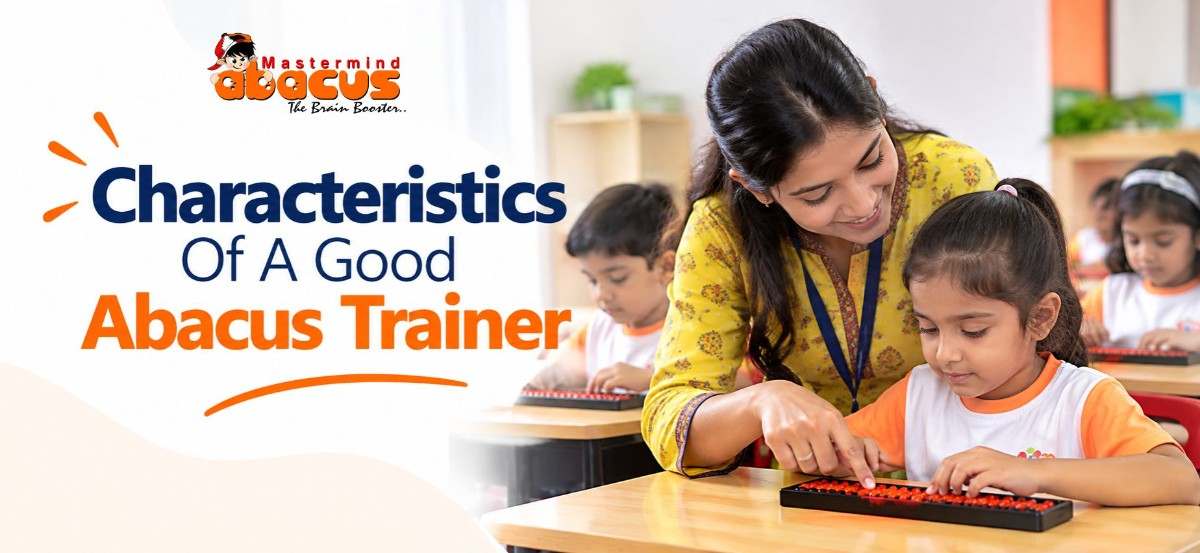
Characteristics Of A Good Abacus Trainer
📅 03 Oct, 2013 · ✍️ Admin
Last updated: 29 September 2026
We all are aware that Abacus is a course that is meant for small kids of age 6 to 14 years. These kids need step by step guidance and support to be able to understand well. Also, a child can be effective in performing calculations using Abacus only when he/she is well trained.
Trainers play a major role in what a child learns. Let us take a close look on some of the characteristics of an Abacus trainer:
· Should have complete knowledge on the subject
· Should un-complicate the methods to make them easier for grasping
· Should have patience to teach same concepts for a number of times (if needed)
· Should possess good listening skills
· Should understand the psychology of students
· Should be adaptable to different situations
· Should be dedicated in shaping the future of children
· Should be honest towards his work and empathetic towards children
Spotting Good Teaching Through Your Child
The list above tells you what a good trainer should be like. As a parent, you cannot sit through every class, but your child gives you clues at home. The table below links each quality to something you may notice, and you can also read how the step-by-step teaching in the Mastermind Method of abacus teaching is designed for the classroom.
| Trainer quality | What you may notice in your child | A gentle question to ask |
|---|---|---|
| Explains the method simply | Your child can show you a bead move or explain a step in their own words. | “Can you teach me how you did that sum?” |
| Patient with repetition | Your child is comfortable saying “I did not get it” and asking again. | “Did you get to ask again today? How did it go?” |
| Listens well | Your child says the trainer answered their exact doubt. | “What did you ask your trainer today?” |
| Understands children’s minds | Your child speaks about wrong answers calmly, without fear. | “Which sum was tricky, and what helped?” |
| Adapts to the situation | Your child stays interested even on a tired day because the pace or activity changed. | “Was today’s class easy, tricky or just right?” |
| Empathetic and dedicated | Your child looks forward to class and speaks warmly about the trainer. | “What was the best part of class today?” |
These are signs, not a test. Every child is different, so use them to start a friendly conversation with your child and with the trainer.
Abacus experience can be joyous and extremely beneficial for kids. It definitely depends on his/her dedicated efforts, but also depends on the quality training provided by their trainers during the complete course of 2 and half years (10 levels of 3 months each).
Frequently Asked Questions
How can I tell if my child’s abacus trainer is doing a good job?
Watch how your child talks about class. A child who can explain a step in simple words, feels free to ask doubts and looks forward to the next session is usually being taught well. If possible, sit in on a trial class, and use this 10-point checklist for choosing an abacus class to compare options.
Does an abacus trainer need to be a maths expert?
Strong subject knowledge matters, but it is only one part. A good trainer must also explain the method simply and stay patient with young learners. Mastermind’s live teacher training covers the abacus method level by level, and trainers are certified after an assessment, so the method is taught in a proper order.
My child is shy and never asks doubts in class. What should I do?
Tell the trainer about it. A patient trainer will invite questions gently, repeat a concept without making the child feel slow, and give quiet children a chance to speak. At home, ask “What was confusing today?” instead of “Did you understand?” That small change often makes children more open.
Is it normal for a trainer to explain the same concept again and again?
Yes, especially with younger children. Repetition is part of learning, and a good trainer repeats without losing patience. What matters is variety: the trainer should try a fresh example or activity if the first one did not work. If your child stays confused for several weeks, speak to the centre or trainer.
Can live online abacus classes have the same teaching quality as a centre?
Quality depends on the trainer more than the place. In a live online class, a good trainer keeps children engaged on screen, notices when someone is lost and gives individual attention. Mastermind’s live online abacus classes follow the same step-by-step learning structure as its centres.
My child is 7. Is that a good age to start abacus classes?
Mastermind’s abacus programme is for children aged 6 to 14, so 7 is a comfortable age to begin. For children aged 5 to 6, we offer Lingo Bingo, an early childhood programme in offline centres. In both cases, a good trainer meets the child at their own pace.
How long does the abacus course take to complete?
Mastermind’s abacus programme has 10 levels of 3 months each, which is about two and a half years, with two 1-hour classes a week. Your child spends a long time with the trainer over this period, so patience and guidance matter at every level.
I love working with children. Can I become an abacus trainer?
Yes, if you have good communication skills and enjoy teaching children. Mastermind offers live online teacher training by a Master Trainer covering all 10 levels, followed by a certification assessment. Read more on our become a teacher page or in our post on abacus training for trainers.
Make your child learn Abacus from experienced trainers at Mastermind Abacus. Imbibe in them mental arithmetic skills that build their confidence in math. Help them develop their brain through Abacus classes and reach academic heights.
Author – Mr. Naveen Chowdhari
Naveen Chowdhari is the Founder & Director of Mastermind Abacus, a leading name in children’s mental math and brain development training. By blending traditional abacus methods with modern teaching techniques, he has created an innovative system that enhances children’s concentration, memory, visualization, speed, and overall cognitive skills. Under his leadership, Mastermind Abacus now provides worldwide online abacus classes and has built a strong global franchise network, making quality brain-development education accessible across the world.
Last Updated: 29 September 2026