

How to Improve Your Childs Attention Span in 30 Days Without Banning Screens
Watch your child do homework for five minutes. How many times do their eyes drift, their hands fidget, or their mind visibly wander? If the answer worries you, you are seeing something researchers measured this year, and the good news is that attention is not a fixed trait. It is a trainable skill, and with the right daily habits, most children show visible improvement within 30 days. This guide explains what the newest 2026 research says about screens and focus, why simply banning devices rarely works, and gives you a practical week-by-week plan to rebuild your child's attention span at home.
What changed in 2026The research every parent should know
Two large studies published this year have reshaped how experts think about children's focus. The first, published in January 2026 in Humanities and Social Sciences Communications (a Nature journal), analysed data from 50,231 American children aged 6 to 17. Four or more hours of daily screen time was linked to sharply higher risk of anxiety, depression, and attention problems, and much of the harm worked indirectly, through lost sleep and lost physical activity.
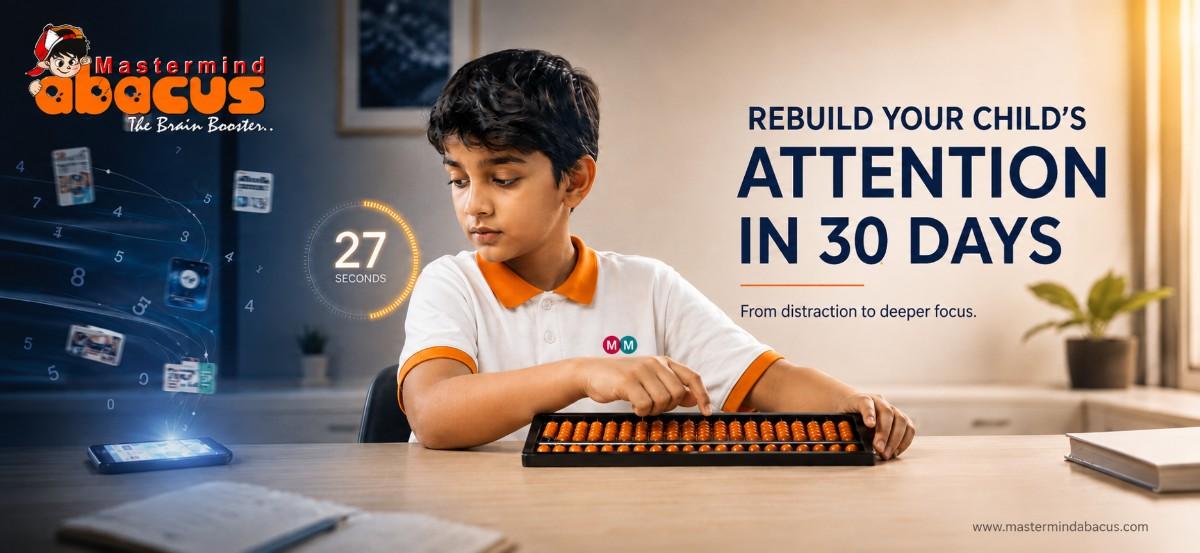
The second, an international study of 18,500 children led by researchers at Johns Hopkins University and the Child Mind Institute, measured average sustained attention at roughly 27 seconds, and found that heavy screen users showed a 34 percent steeper decline in focus over a single test. Heavy screen users do not just start with weaker focus. Their focus also tires faster.
Screen habits are contagious. When parents use short videos heavily themselves, the negative effect on their children's attention is significantly amplified. When parents keep their own usage low, the effect on children shrinks.
Full bans rarely fix this. The American Academy of Pediatrics has moved away from strict hourly limits toward quality and context, because the damage is concentrated in one pattern: passive, fast-paced, solo consumption. Removing a screen takes away stimulation, but gives the brain nothing to strengthen focus with. The winning formula is replacement, not just restriction.
Try it nowTwo minute screen habit audit
Tick what happens in your home on a normal day
Each habit below is one researchers link to weaker attention. Count your ticks, then check your result underneath.
The real differenceWhat weakens focus vs what builds it
| Trains the brain to expect stimulation | Trains the brain to sustain attention |
|---|---|
| Short-form video reels and autoplay content | Reading a story for 15 to 20 minutes |
| Rapid-fire mobile games with constant rewards | Puzzles, mazes, blocks, and board games |
| Background TV during meals and homework | Abacus practice and mental math exercises |
| Switching between apps every few minutes | One task, completed start to finish |
| Solo passive watching | Outdoor play and sports, 60 minutes daily |
The methodThe 30 day attention rebuild plan
Attention improves through small, consistent daily wins. Follow one week at a time.
Observe and remove the worst offenders
Do not change your child's routine yet. Track for three or four days how much passive screen time they get and when. Then make just two changes: no screens during meals, and no screens for 60 minutes before bed. Sleep is one of the two main pathways through which screens damage attention, so protecting bedtime gives you the fastest visible gains.
Introduce one daily focus block
Add one 15 minute focus block each day at a fixed time. During this block your child does one single-task activity: a puzzle, reading, drawing, or abacus practice. Keep it short enough to succeed. A completed 15 minute session builds more attention than an abandoned 45 minute one. Sit nearby with your own phone away. Your visible focus is part of the training.
Stretch the block and add movement
Extend the daily focus block to 20 or 25 minutes, and add at least 60 minutes of physical activity, since exercise is the second pathway the 2026 study identified. If your child enjoys the focus block, this is the ideal week to try a structured class. A free demo of a live online abacus class is a low-pressure way to test whether guided training holds their attention better than solo practice.
Replace, do not just restrict
By now your child has a daily focus habit, better sleep, and daily movement. This week, swap the most harmful remaining screen habit, usually short-form video, for an interactive alternative they choose: a hobby, a sport, a family game, or continued abacus levels. Compare notes with Week 1. Most parents report their child sits noticeably longer with homework and finishes tasks they previously abandoned.
Keep it growingHow abacus training builds attention that lasts
The 30 day plan starts the repair. Structured abacus learning sustains it, because every session exercises the exact mental systems that screens weaken. A child calculating on the abacus must watch or listen to the problem, hold numbers in working memory, move beads precisely, and check the result. Skipping attention for even a moment breaks the calculation, so focus is not optional.
As children advance, they visualise the abacus mentally and calculate entirely in their head, which stretches concentration and memory further. This is why abacus students so often improve not just in math, but in listening ability, classroom attention, and performance across subjects.
The Mastermind Abacus program
A structured, game-based abacus math program for children aged 5 to 14, delivered at centers near you and on the world's first live online abacus learning platform.
In shortKey takeaways
- A 2026 study of 50,231 children linked 4+ hours of daily screen time to significantly higher risk of anxiety, depression, and attention problems.
- Average sustained attention in children aged 6 to 12 has fallen to roughly 27 seconds, and heavy screen users tire faster during focus tasks.
- The harm is concentrated in passive, fast-paced, solo screen use. Replacing that pattern beats banning all screens.
- Protecting sleep and daily physical activity repairs the two main pathways through which screens damage attention.
- A daily 15 to 25 minute single-task focus block, built up over 30 days, produces visible improvement in most children.
- Abacus training keeps building attention, working memory, and mental math together for the long term.
Parents also askFrequently asked questions
What is the average attention span of a child in 2026?
How much screen time is too much for a school-age child?
Does screen time cause ADHD?
How can I improve my child's concentration without gadgets?
How long does it take to improve a child's attention span?
Why does my child focus on games but not on homework?
Does abacus really improve concentration?
What is the best age to start abacus classes?
Are online abacus classes as effective as offline classes?
Should parents reduce their own screen time too?
Is all screen time bad for children?
What daily habits improve focus in children fastest?
Your child's focus can be rebuilt
Reduce the passive scroll, protect sleep and play, give your child one focused task a day, and let structured training do the rest. Book a free demo class, online or at a center near you.
Book a free demo Find a center near meLast Updated: 15 August 2026
Recent Posts


