

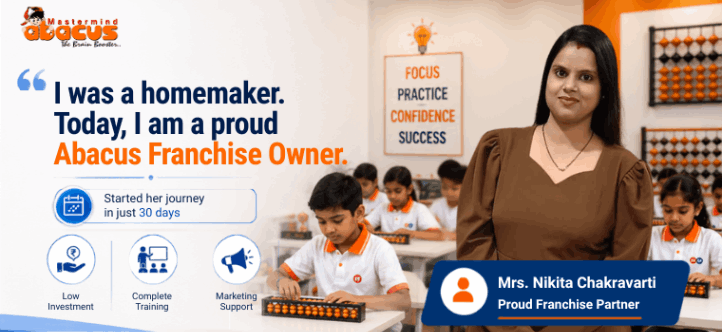
From Homemaker to Proud Business Owner
When you manage a household, your day is naturally built around a rhythm of multitasking—balancing chaotic schedules, coordinating family needs, and keeping a home running smoothly. Yet, many homemakers carry a quiet, persistent ambition to channel their focus into something that belongs entirely to them.
They look for a professional identity that offers financial independence and intellectual fulfillment, but it must be a career that respects their family time and offers genuine purpose.
Over my years of standing in front of classrooms, developing training modules, and working directly with families, I have seen a recurring pattern. Parents constantly share their anxiety over their child’s declining attention span, screen habits, and fear of numbers during early school years.
At the same time, I meet capable and passionate individuals who want to solve this exact problem but feel they lack the corporate business background to start.
This is exactly where the story of Mrs. Nikita Chakravarti begins—a proud franchise partner who transitioned from managing a household to running a successful home-based abacus center. Her journey shows how starting an abacus franchise can bridge the gap between home-life balance and true entrepreneurial success.
Inside Nikita’s Classroom: A Real-World Teaching Observation
To truly understand why this educational model resonates so deeply with families, it helps to step away from business plans and look directly at the progress of a student inside a real classroom environment, just like the one Nikita runs.
The Baseline Reality: Consider a seven-year-old student, Kabir, during his first week at a center. When presented with basic arithmetic like 34 + 18, his body language showed immediate math anxiety. He would tap his pencil anxiously, stare blankly at the paper, and rely heavily on counting his fingers under the desk.
Because abstract numbers felt overwhelming to his working memory, he would make frequent calculation slips, leading to a visible drop in his academic self-esteem.
The Post-Training Transformation: Fast forward a few months after working consistently with a structured Soroban abacus under Nikita’s trained instruction. Kabir’s entire approach shifted.
During a rapid verbal calculation drill, his hands moved precisely in the air, manipulating the columns of an invisible mental abacus. He processed a sequence of multi-digit numbers accurately in seconds, entirely without paper, pencils, or a calculator.
The most powerful change was not only his speed. It was his calmness. He no longer feared numbers because he could physically visualize them.
Watch: A real student performing fast mental calculations using imaginary abacus bead movements.
The Cognitive Blueprint: How Bead Manipulation Shapes a Child’s Mind
When a franchise owner introduces a child to the Soroban framework, they are not merely teaching a fast calculation trick. They are guiding a complete brain development process that changes how children process information across school subjects.
- Tactile-to-Visual Focus: Children begin by physically manipulating beads and gradually learn to create a sharp image of the abacus in their mind.
- Balanced Brain Activation: Using both hands stimulates both sides of the brain, supporting logical thinking as well as visualization.
- Sustained Focus: Listening to rapid spoken numbers and calculating them instantly builds attention stamina.
- Working Memory: Holding and updating multi-digit numbers mentally strengthens memory and academic sharpness.
To understand this pedagogy in greater depth, you can also read The Mastermind Method: A Global Standard in Abacus Pedagogy.
Core Benefits of the Mastermind Abacus Franchise Model
For an aspiring entrepreneur or homemaker, launching an independent educational venture from scratch can involve a difficult process of trial and error. A structured franchise system removes the guesswork through clear operational support.
- Low Initial Capital Requirement: You do not need a premium commercial storefront. A clean, quiet room at home or a small activity space can be enough to begin.
- Complete Instructional Certification: You do not need an advanced mathematics degree. A systematic franchise trains you step by step.
- Standardized Tested Syllabus: You receive a structured curriculum, textbooks, lesson plans, and testing parameters.
- Marketing and Operational Support: You get enrollment guidance, local marketing support, and brand assets to build trust faster.
Traditional Rote Mathematics vs. The Visual Abacus Approach
| Learning Attribute | Traditional Mathematics | Mastermind Abacus Method |
|---|---|---|
| Primary Tool | Paper and symbols | Beads and visualization |
| Brain Use | Mostly left brain | Whole-brain activation |
| Calculation Speed | Writing dependent | Mental visualization |
| Emotional Impact | Can create anxiety | Builds confidence |
The Step-by-Step Blueprint to Launching Your Home Center
Step 1: Establish a Dedicated Learning Zone
Whether your center is based at home or in a small studio, the environment must feel structured. Keep the room bright, quiet, clean, and free from household distractions.
Step 2: Master the Pedagogy Before Launch
Teacher certification should be taken seriously. Your bead movements, formula transitions, and classroom demonstrations should become smooth and confident before you begin teaching students.
Step 3: Deliver High-Value Parent Workshops
The most authentic way to build a student base is through direct demonstration. Host a free introductory workshop and let parents see their child experience a small success with the abacus.
Watch: Real testimonial of Mrs. Nikita Chakravarti sharing her Mastermind Abacus franchise journey.
Common Operational Pitfalls to Avoid
- Rushing to the mental stage too early: Children need enough physical bead practice before mental visualization becomes strong.
- Running dry sessions: Abacus classes should include speed games, verbal drills, and flashcard activities to keep children excited.
- Ignoring parent engagement: A few minutes of light home practice can greatly support classroom progress.
Frequently Asked Questions
1. I have been away from a professional career for years. Can I run an abacus franchise successfully?
Yes. You do not need previous business experience or advanced mathematics credentials. With proper training, love for children, and a systematic approach, you can run a respected center.
2. How much time does this home business require?
You can begin with two or three batches, requiring roughly 4 to 6 hours of active teaching time per week, and expand gradually.
3. What is the right age range for children to enroll?
The ideal age range is usually 5 to 12 years, when children can build strong visualization and number-processing habits.
4. How soon can parents see visible improvement?
Most parents notice better listening accuracy, focus, and math confidence within the first 10 to 12 weeks of structured learning.
Conclusion
Investing in an educational franchise is more than a commercial decision. It is a long-term commitment to improving the foundational cognitive skills of children in your community.
True satisfaction in this field does not come from business growth alone. It comes from watching a child who once felt defeated by numbers calculate with joy, confidence, and self-belief.
By anchoring your home center to a proven curriculum, completing your instructor training sincerely, and prioritizing the growth of every student, you can build a respected and deeply fulfilling career from your own home.
Author – Mr. Naveen Chowdhari
Naveen Chowdhari is the Founder & Owner of Mastermind Abacus, a leading name in children’s mental math and brain development training. By blending traditional abacus methods with modern teaching techniques, he has created an innovative system that enhances children’s concentration, memory, visualization, speed, and overall cognitive skills. Under his leadership, Mastermind Abacus now provides worldwide online abacus classes and has built a strong global franchise network, making quality brain-development education accessible across the world.
Last Updated: 30 June 2026
Recent Posts


