

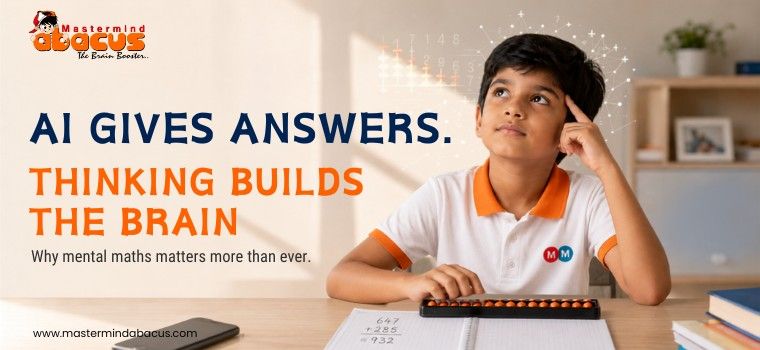
Mental Math in the Age of AI Why Your Childs Brain Still Needs to Do the Work
The short answer: AI can do the calculation, but it cannot do the brain-building. When a child solves a sum mentally, the goal was never the answer — it was the working memory, focus, and confidence built along the way. Hand that work to a chatbot, and the answer arrives but the growth doesn't.
If your child has asked you some version of this question, you're not alone. The new academic session has begun, homework is back, and so is a habit many parents quietly worry about: children typing their maths problems straight into an AI app and copying the answer.
Is that smart use of technology — or is something important being lost? This article looks at what the latest research actually says, and gives you a simple, practical plan to raise a child who uses AI without depending on it.
The New Homework Shortcut Every Parent Is Seeing
Ten years ago, the worry was children reaching for a calculator. Today, a child can photograph a word problem, paste it into a chatbot, and have a full worked solution in five seconds.
Educators are already reporting exactly this pattern. A digital-learning specialist writing for Connected Classroom describes watching children solve maths problems by typing them into a chatbot rather than reasoning through the steps — alongside students using instant summaries instead of reading.
The homework gets done. The worksheet looks perfect. But here's the uncomfortable question: whose brain did the work?
What Is Cognitive Offloading — and Why It Hits Children Hardest
Cognitive offloading means handing a mental task to an external tool instead of doing it in your head. Using a calendar for reminders or GPS for directions are everyday examples. In small doses, it's healthy — it frees the mind for bigger things.
The problem begins when offloading becomes the default. As the Connected Classroom analysis puts it, when offloading becomes a habitual substitution for effort, it weakens the very processes that build memory, understanding, and reasoning.
And here is the part every parent should pause on. For adults, over-reliance on AI risks losing a skill they already have. For children, the risk is different — and bigger. A March 2026 Psychology Today analysis draws the distinction sharply: adults who offload thinking to AI lose capacity they built; children may never build it at all. In younger learners, the neural pathways for reasoning are simply never formed — you can't atrophy a muscle that was never built.
Your 8-year-old isn't losing her calculation ability when she outsources every sum. She's skipping the years in which that ability — and the focus and memory that ride along with it — was supposed to be constructed.
What the 2026 Research Says
This isn't speculation anymore. Evidence has been stacking up fast:
- AI reliance and weaker thinking are linked. Research summarized in 2026 found a significant negative correlation between frequent AI tool usage and critical thinking abilities, with cognitive offloading as the mediating factor — and younger participants showed greater reliance on AI tools.
- Skills behave like muscles. In a May 2026 TIME feature on AI and the brain, cognitive neuroscientist Sam Gilbert explains that some mental abilities function like muscles — if a skill is always offloaded to AI, a person is likely to become deskilled at that specific task.
- Screens are already squeezing attention. A systematic review found that most studies show an association between excessive screen time and attention problems in children — and AI homework apps add yet another screen habit on top.
None of this means AI is the villain. It means the order matters: a developing brain must build a skill before it earns the right to outsource it.
The Calculator Lesson: We've Been Here Before
Parents of the 1980s asked the same question about calculators. What did decades of research conclude? As Gilbert notes in TIME, calculators could actually augment learning — provided children first had an independent phase of learning without them.
That's the principle to carry into the AI era. Nobody argues children shouldn't use calculators ever. We simply teach number sense first, tools later. AI deserves the same sequencing — just with higher stakes, because AI can replace far more of the thinking than a calculator ever could.
The "Build First, Borrow Later" Rule
Here is a one-line family policy you can start using tonight:
"You may borrow a tool's brain only after you've built your own."
In practice, for maths homework it looks like this:
| Situation | Old habit | Build-First habit |
|---|---|---|
| A sum your child can attempt | Type it into an app | Solve mentally or on paper first; tool only to check |
| A concept your child doesn't understand | Ask AI for the answer | Ask AI (or the teacher) to explain, then solve a fresh example alone |
| Daily practice | Skipped — "the app knows it" | 10 minutes of mental math, no devices |
| Getting stuck | Instant lookup | Struggle for 5 minutes first — that struggle is the learning |
The rule doesn't ban technology. It protects the productive struggle — the short, effortful stretch in which memory, focus, and reasoning are actually wired in.
How Mental Math Builds the Muscles AI Can't
If offloading weakens mental muscles, mental arithmetic is one of the most direct ways to strengthen them — which is why abacus training has quietly become more relevant in the AI era, not less.
When a child trains on the abacus, they first calculate on the physical tool, and then something remarkable happens: they begin visualizing the beads and computing entirely in their head. Every session exercises, at once:
- Working memory — holding numbers and bead positions in the mind
- Sustained focus — a full problem can't be solved with a wandering mind
- Visualization — the right-brain skill behind mental imagery and spatial thinking
- Speed with accuracy — building genuine number confidence
- Independence — the child feels their own brain getting faster, which no app can gift them
This is exactly the whole-brain development approach we've refined at Mastermind Abacus over 26 years, across 2,000+ centers in 16 countries. Our abacus math program takes children from ages 5–14 through a structured, game-based journey — twice-a-week classes, level by level — until mental calculation becomes as natural as reading. Children who once feared maths start racing their parents (and winning). And because the training itself is screen-light and hands-on, it's a natural counterweight to a screen-heavy childhood — available both at our centers and through our live online classes, where a real teacher (not an algorithm) guides every session.
The point is not to beat AI at arithmetic. The point is that a child who can think without a tool will always use tools better than a child who can't.
A Simple Weekly Plan for Parents
You don't need to overhaul your home. Start with this:
- Adopt the Build First, Borrow Later rule — say it out loud, stick it near the study table.
- Protect 10 device-free maths minutes a day — mental sums during dinner prep, car rides, or quick oral questions.
- Change your homework question — instead of "Is it done?", ask "Which one did you work out yourself?" Praise the struggle, not just the tick marks.
- Model it — let your child see you estimate the grocery bill mentally before checking.
- Give the brain a gym — a structured program like abacus classes turns brain-building from a nagging battle into a fun, levelled game with visible progress.
Key Takeaways
- AI answers are instant, but a child's brain grows only from doing the mental work — the answer was never the point.
- Cognitive offloading hits children hardest: adults lose skills they built; children never build them.
- 2026 research links heavy AI reliance in young users to weaker critical thinking, mediated by offloading.
- The calculator era taught us the fix: learn first without the tool, then use the tool wisely.
- The "Build First, Borrow Later" rule protects productive struggle without banning technology.
- Mental math training — like abacus-based whole-brain development — deliberately builds the working memory, focus, and confidence AI can't supply.
Frequently Asked Questions
Is mental math still important when AI can calculate everything?
Yes — more than ever. The purpose of mental math was never just answers; it builds working memory, concentration, and reasoning. AI can supply answers, but only mental effort builds the brain that judges, checks, and uses those answers well.
What is cognitive offloading in children?
Cognitive offloading is handing a mental task — calculating, remembering, reasoning — to an external tool like an app or chatbot. In children it's risky because skills that are constantly offloaded may never develop in the first place.
Should I let my child use AI for homework?
Use it as a tutor, not a solver. Let AI explain a concept or check completed work, but the first attempt at every problem should be your child's own. That order — build first, borrow later — is what protects learning.
Does too much screen time really affect attention?
Most studies reviewed on the topic find an association between excessive screen time and attention problems in children. Balancing screens with hands-on, effortful activities is one of the strongest protective habits.
How is abacus training different from a maths app?
An app computes for the child; the abacus trains the child to compute within their own mind. Over time, students visualize the beads and calculate mentally — strengthening memory, focus, and visualization rather than outsourcing them.
At what age should my child start abacus classes?
Between 5 and 14. Mastermind Abacus has a game-based number-sense program for 5–6-year-olds and a structured levelled program for ages 7–14, so children can begin at the stage that fits them.
How long does it take to see results from mental math training?
Many parents notice better focus and faster calculation within the first few months; the full Mastermind program runs level by level over about 2.5–3 years, with twice-a-week classes and short daily practice.
Will banning AI at home solve the problem?
Bans usually backfire — children will meet AI everywhere. Teaching sequencing (own effort first, tools second) builds judgment they'll carry into every classroom and career.
My child already depends on apps for maths. Is it too late?
Not at all. Brains remain highly plastic through childhood. Reintroducing daily mental practice — and a structured program that makes it enjoyable — steadily rebuilds confidence and independence.
Isn't struggling with maths bad for my child's confidence?
Short, supported struggle is where confidence comes from. When a child works through a problem and succeeds, they learn their brain can do it. Instant AI answers deny them exactly that experience.
How do online abacus classes work — aren't they more screen time?
Not all screen use is equal: passive scrolling differs from a live teacher-led class where the child actively calculates on a physical abacus at home. Mastermind's live online platform keeps the hands-on tool at the center; the screen only connects the teacher.
What skills does abacus training build beyond calculation?
Concentration, memory, listening, visualization, speed, accuracy, and confidence — the same executive-function skills that support every school subject, and the same ones weakened by habitual offloading.
How can I practice mental math with my child at home?
Five to ten minutes daily: quick oral sums, estimating bills, number games in the car. Mastermind provides a Parent Handbook with level-appropriate questions so home practice matches class learning.
Will my child fall behind classmates who use AI to finish homework faster?
Fast homework isn't fast learning. Exam halls, olympiads, and real problem-solving are tool-free. The child who built genuine skill overtakes the one who outsourced it — usually within a single school year.
Conclusion
When your child asks, "Why should I learn maths when AI can do it?", you now have an answer worth giving: "Because we're not training the AI, beta — we're training you."
AI will keep getting better at answers. That makes children who can think, focus, and reason for themselves more valuable, not less. The families who win the AI era won't be the ones who banned technology or the ones who surrendered to it — but the ones who built the brain first.
Your child's mental muscles are waiting for their gym.
Prefer a center near you? Find an offline Mastermind Abacus class — 2,000+ centers globally. Found this helpful? Share it with a parent in your class WhatsApp group.
About the Author
Naveen Chowdhari is the Founder & Owner of Mastermind Abacus, a premier global institution in children's mental math and cognitive brain development. With decades of hands-on teaching experience, deep pedagogical research, and franchise development expertise, he has pioneered an innovative system that blends time-tested soroban methods with modern digital tools. Under his vision, Mastermind Abacus has successfully expanded into a highly respected international network, empowering educators, providing premier online classes, and equipping thousands of children worldwide with lifelong mental stamina and self-confidence.
Last Updated: 31 July 2026
Recent Posts


