A Parent’s Guide · Ages 6–14
What Is an Abacus?
The 3,000-year-old tool that trains your child to do fast, accurate mental math — and builds focus, memory and confidence for life.
The Simple Answer
Abacus, explained in one breath
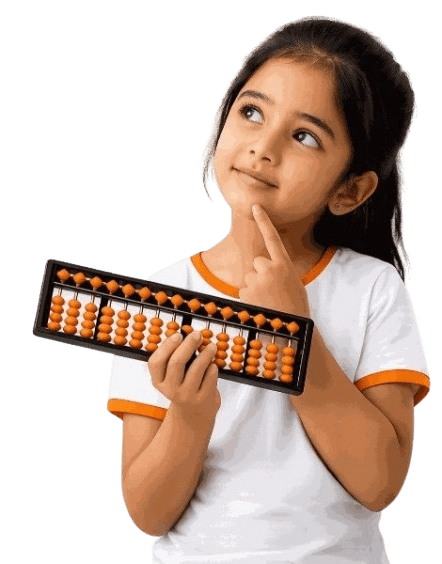
Today the abacus is recognised worldwide as a holistic brain-development system. Children aged 6 to 14 benefit the most — while even younger learners begin with our Lingo Bingo foundation programme. Moving the beads with both hands lights up both sides of the brain, turning a simple counting frame into a lifelong thinking tool.
How It Works
From real beads to mental math — in three moves
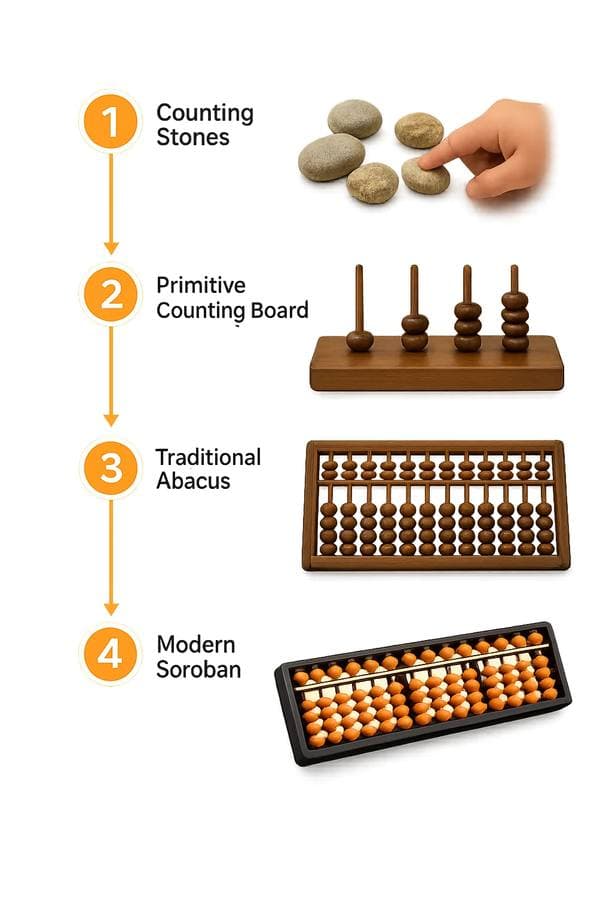
The “magic” you see is really a trained skill. Here’s the journey every Mastermind child takes.
Move the beads
Children add, subtract, multiply and divide by sliding real beads. Numbers become something they can see and touch.
Picture the abacus
With practice, the physical tool moves into the mind. Your child begins to “see” the beads instead of holding them.
Calculate mentally
Now the beads move in imagination alone. Children solve big sums in their heads — fast, accurate, no calculator.
Clearing The Confusion
Abacus vs mental math — what’s the difference?
Parents often use these words interchangeably. Here’s how they connect.
Abacus
The physical frame of beads. It’s the training ground — where your child first learns to represent and calculate with numbers using their hands.
Mental Math
The ability it builds: solving sums in the head by visualising the abacus and moving its beads mentally — quickly and accurately, without any device.
In short: the abacus is the tool, and abacus mental math is the skill your child keeps for life.
The Brain Science
Not a party trick — real brain development
When children work the abacus with both hands, they activate both sides of the brain at once — the logical left and the creative, visual right. That’s why abacus learners often show gains far beyond arithmetic.
Starting abacus early activates a child’s brain — engaging both hands sparks whole-brain functioning and a sharper intellect.— Dr. Toshio Hayashi, brain-development researcher (paraphrased)
*Based on published studies on abacus training. See the research →
Parent Voices
What parents tell us
Real experiences from parents whose children are learning with Mastermind Abacus.
My daughter had very poor focus. But after attending classes for three months at Mastermind, she now sits through and solves her homework sums mentally—faster than me.
While Abacus classes improved his maths, the surprise was his confidence. Now he is the first to raise his hand in the class. His grades have also improved.
I was not very sure about the results of an Abacus Online Class, but in the live classes at Mastermind, every session is engaging. They have several games that keep the kids excited.
Start Your Way
Offline or online — join the way that suits you
Online classes
The world’s finest abacus e-learning platform, with live teachers and a physical kit delivered to your door. Book your one-hour FREE live online demo class and see it firsthand.
Offline classes
With 1,000+ centres across 17 countries, there’s likely one close by. Start with 3 days of free demo classes — tell us where you are and we’ll share the nearest centre’s details.
Common Questions
Parents’ most-asked questions
An abacus is an ancient calculating tool — a frame of beads on rods — used for over 3,000 years. Children learn to move the beads to add, subtract, multiply and divide, then to picture the abacus in their minds and calculate mentally without a calculator.
It's the skill of solving arithmetic in your head by visualising an abacus and moving its beads mentally. After training on the physical tool, children recall bead positions from memory and calculate quickly and accurately — no device needed.
Children join the Mastermind Abacus programme between ages 6 and 14, when the brain is highly adaptable. Even younger children begin with our Lingo Bingo foundation programme, which prepares them for the abacus; older children join at a level matched to their ability. It's rarely too late to benefit.
Many parents notice better focus and faster calculation within the first few months of regular practice. Deeper mental-math ability builds across the 10 structured levels of the full programme, with short daily practice making the biggest difference.
Yes. With a physical abacus kit at home, live teachers, and a platform that tracks progress, online classes develop the same visualisation and mental-math skills as classroom learning — with the convenience of learning from home.
No. The fast calculation you see is the visible result of stronger concentration, working memory and visualisation built through training — real, lasting abilities that support academics well beyond maths.
Commonly, yes. The focus, memory and logical thinking abacus develops tend to show up across subjects — from problem-solving in science to attention in reading — not only in maths.
Short, regular practice works best — typically a few minutes a day alongside a weekly class. Consistency matters far more than long sessions, which makes it easy to fit into a busy routine.
A structured curriculum available online and offline, a learning platform to track your child's progress, a free worksheet generator for home practice, national competitions, and a trusted network of 1,000+ centres across 17 countries — plus a free demo to start.
Tap Book a Free Demo below, or message us on WhatsApp with your child's age. We'll arrange your free, no-obligation demo — a one-hour live online class, or 3 days of free demo classes at your nearest centre.
Your Next Step
See it for yourself — free demo class
- Online: a one-hour FREE live demo class from home.
- Offline: 3 days of free demo classes at your nearest centre.
- Your child tries the abacus with a trained teacher.
- You see the right starting level before you decide — no obligation to enrol.