

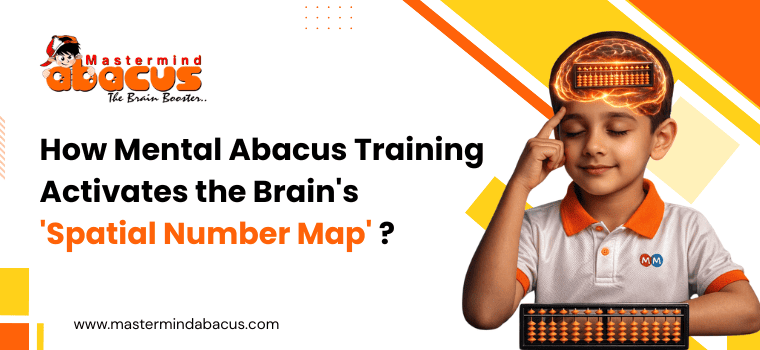
How Mental Abacus Training Activates the Brain's Spatial Number Map
In my fifteen years of standing before a whiteboard, I’ve watched thousands of children grapple with the same invisible wall. A child sits with a math worksheet , eyes glazed, struggling to remember if 7 times 8 is 54 or 56. They are trying to pull a "fact" from a crowded verbal memory, much like trying to find a specific lyric in a song.
But then, I see the "Abacus transition." When a student starts Mental Abacus training, they stop looking for words. Their fingers twitch in the air, moving invisible beads. Their eyes track a movement only they can see. In that moment, they aren't "doing math" in the traditional sense; they are navigating a mental territory.
As an educator, I’ve always known this felt different. Recent neuroscience, particularly the work of Stanislas Dehaene in his seminal book The Number Sense, now confirms why: Abacus training moves math from the brain’s "word center" to its "spatial center." It activates what scientists call the Spatial Number Map.
________________________________________
What is the 'Spatial Number Map'?
According to neuroscientist Stanislas Dehaene, humans are born with an innate "number sense"—a biological ability to perceive quantities that exists even in infants. However, as children grow, traditional education often forces them to rely on verbal memory to store math facts. We make them recite multiplication tables like nursery rhymes.
The problem? Verbal memory is "noisy" and easily confused.
The Spatial Number Map, located in the inferior parietal cortex of the brain, is different. This area of the brain handles spatial representations—like how you know where your coffee cup is without looking, or how you visualize the route to your house. Dehaene’s research shows that the brain areas contributing to number sense and spatial representations occupy neighboring convolutions.
When a child uses an abacus, they are not just calculating; they are mapping numbers onto space.
________________________________________
The Process: How Abacus 'Rewires' Mathematical Thought
In a Mastermind Abacus classroom, we move a child through three distinct phases that transition them from "verbal math" to "spatial math."
1. The Tactile Anchor (The Physical Abacus)
The child starts by physically moving beads. In the brain, this links a numerical value to a physical location and a tactile sensation. A "5" isn't just a symbol on a page anymore; it is the specific "clack" and "feel" of the upper bead moving toward the bar.
2. The Mental Image (The Transition)
We then ask the child to close their eyes and "see" the abacus. This is where the inferior parietal cortex begins to light up. The child is now using their spatial imagery to maintain a "picture" of the beads.
3. The Spatial Number Map (The Mental Abacus)
Finally, the physical tool is removed. The child performs "Anzan" (mental calculation). At this stage, they are manipulating a Spatial Number Map. They aren't thinking "56 + 22"; they are observing a mental shift in beads. Because this happens in the spatial center of the brain—the same area used for navigation—it is incredibly fast and virtually immune to the "memory interference" that causes traditional math errors.
________________________________________
Classroom Observation: A Tale of Two Methods
I recall a student, Arjun, who joined my class at age 8. He was "good" at math but suffered from severe math anxiety.
• Before Abacus: When asked to solve 124 + 67, Arjun would stare at the ceiling, his lips moving as he tried to perform "column addition" in his head. He often lost his place when "carrying the one." His brain was overloaded, trying to hold numerical digits in his short-term verbal memory.
• After 6 Months of Training: Arjun no longer moved his lips. His right hand made small, rhythmic movements in the air. When I gave him the same problem, he answered in under two seconds. He wasn't "calculating" in the way he used to; he was simply reading the final position of the beads on his mental map.
The difference wasn't just speed—it was certainty. Because he could "see" the answer, his anxiety vanished.
Watch this real example of a child performing mental abacus calculation:
________________________________________
Impact on Brain and Skill Development
By activating the spatial number map, we aren't just making "human calculators." We are developing a suite of cognitive "muscles":
• Enhanced Focus: Maintaining a mental image of moving beads requires intense concentration. This "executive function" naturally spills over into other subjects like reading and science.
• Visual-Spatial Memory: Because students practice "seeing" the abacus, their ability to remember maps, diagrams, and physical layouts improves.
• Confidence: There is a profound psychological shift when a child realizes they have a "secret tool" inside their own head. This builds a "Growth Mindset."
• Whole-Brain Activation: Traditional math is often a left-brain (logical/verbal) activity. Mental abacus forces the right-brain (visual/spatial) to participate, creating "whole-brain" connectivity.
________________________________________
The Benefits: Why Spatial Math Wins
| Benefit | Description |
|---|---|
| Eliminates Math Phobia | Numbers become physical objects rather than scary abstract symbols. |
| Increased Accuracy | Spatial maps don't "forget" as easily as verbal lists. |
| Speed | The brain processes visual–spatial information faster than it decodes language. |
| Foundation for STEM | Deep "number sense" is a prerequisite for high-level physics and engineering. |
________________________________________
Abacus Learning vs. Traditional Learning
In traditional learning, we often treat the brain like a computer hard drive—we try to "upload" facts (like the multiplication table). As Dehaene points out, this is an "unnatural practice" for the human brain, which is why so many children find it difficult.
Abacus learning treats the brain like a GPS. It uses the brain’s natural ability to understand space and quantity to build a framework where math "lives." Instead of memorizing that 8x7 = 56, the child learns the territory of 56.
Also Read:
Abacus vs Vedic Math vs School Math – A Parent’s Guide to Choosing the Right FoundationCompare how Abacus, Vedic Math and School Math differ in speed, accuracy, concept-building and brain development — and discover which foundation is best for your child.
________________________________________
Common Mistakes & Pro-Tips for Parents
Mistake 1: Rushing to Mental Math
Many parents want their child to drop the physical abacus immediately.
The Tip: The physical "clack" of the beads is what builds the mental map. Let them use the tool until the mental image is rock-solid.
Mistake 2: Mixing Methods
Teaching a child to do "column addition" (the school way) while they are learning abacus can cause a "map-clash."
The Tip: Encourage the child to use the abacus method for all calculations during their first year of training to ensure the spatial map becomes their primary reflex.
________________________________________
Frequently Asked Questions (FAQs)
Q: My child is already 12. Is it too late to build this "Spatial Map"?
A: While the "golden window" is 4–14 due to peak neuroplasticity, a 12-year-old can still benefit immensely. They may even progress through the early levels faster because of their existing logical understanding.
Q: Does this help with word problems in school?
A: Yes. Once the "calculation" part of a word problem becomes automatic and spatial, the child has more "mental bandwidth" left over to focus on the logic and language of the problem.
Q: Will they become dependent on the abacus?
A: Quite the opposite. The goal of the abacus is to eventually discard the physical tool. They become dependent on their own internal "Number Sense," which is the ultimate goal of any mathematician.
________________________________________
Conclusion: The Long-Term Value of a Spatial Brain
As we move toward 2026 and beyond—where AI tools and calculators are part of everyday life—the true value of mental math is no longer the answer itself, but the strong cognitive engine behind it.
Developing a Spatial Number Map does far more than help a child score well on a 4th-grade test. It builds a mind that is comfortable with complexity, capable of sustained focus, and grounded in a natural, intuitive understanding of numbers. When we teach a child the abacus, we’re not just teaching calculations—we’re empowering them to create mathematics within their own mind.
For parents who want to give their children this lifelong advantage, our abacus online classes offer a structured, child-friendly path to develop strong mental math skills and a truly spatial, confident brain.
Author – Naveen Chowdhari
Naveen Chowdhari is the Founder & Owner of Mastermind Abacus, a leading name in children’s mental math and brain development training. By blending traditional abacus methods with modern teaching techniques, he has created an innovative system that enhances children’s concentration, memory, visualization, speed, and overall cognitive skills. Under his leadership, Mastermind Abacus now provides worldwide online abacus classes and has built a strong global franchise network, making quality brain-development education accessible across the world.
Last Updated: 26 February 2026
Recent Posts

.png)

