

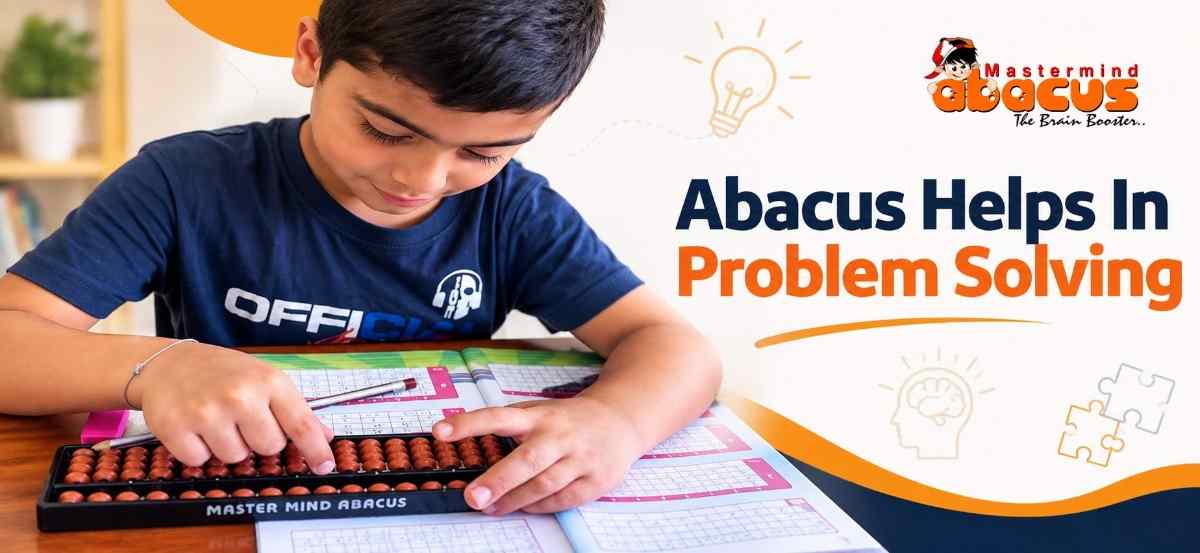
Abacus Helps In Problem Solving
📅 17 Sep, 2013 · ✍️ Admin
Last updated: 30 September 2026
Abacus Learning Helps Kids Solve Math Problems
Abacus, a counting instrument, is well-known for providing huge benefits to children. Besides being a brain development tool, it is more popular for aiding kids' mathematical abilities. Abacus has become adaptable because of its simplicity and use. Let us look at how Abacus learning helps kids solve math problems.
Abacus and Problem Solving
The fundamental of effective problem-solving skills is that an individual can perform basic mathematical operations like addition, subtraction, multiplication, and division without difficulties. The skill develops further if a child is trained to perform the calculations mentally. One of the most effective ways to build the ability to perform mental math is regular training with the Abacus, supported by simple everyday habits that develop mental math skills.
Abacus training prepares the user to perform calculations with speed and accuracy. The accurate results add confidence in the kids, thus making the pathway to problem-solving smooth. Learning Abacus Math enhances skills like visualization, memory, and recall. It makes problem-solving easy.
Improved mathematical skills facilitate minimizing the math pressure and improving academic performance. It ultimately reduces children's aversion to numbers, often referred to as Math phobia — a fear that usually has simple, everyday reasons behind it.
Children who practise the Abacus method regularly are often able to work through math problems at an impressive speed. Speed, though, is only the visible part. The bigger gain is that they learn to read a problem, decide the steps and check their own answer — one of the everyday benefits of abacus learning for children.
Where Children Usually Get Stuck In Math Problems
Most children do not struggle with maths as a whole. They get stuck at one particular point in a particular type of sum, and that point repeats every time. The table below shows the five or six places parents notice most often, and what steady Abacus practice builds at each of them. If you would like to read more about the thinking side of this, see how abacus training is linked to creative problem solving in children.
| Type of math problem | Where children usually get stuck | What regular Abacus practice builds |
|---|---|---|
| Long addition and subtraction | Carrying and borrowing across columns, or losing track halfway through | A clear sense of place value, so each column is handled in its own turn |
| Multiplication and division | Depending only on memorised tables and stopping when memory fails | A method to work through the sum step by step instead of recalling an answer |
| Word problems and story sums | Reading the story but not knowing which operation the question needs | Practice in breaking one long question into smaller, ordered steps |
| Mixed operation questions | Jumping straight to the answer and skipping a step in between | The habit of following one sequence from start to finish, every time |
| Checking the answer | Accepting the first answer written down, without verifying it | Enough confidence to redo the sum mentally and compare the two results |
| Timed class tests | Knowing the method but freezing once the clock starts | Familiarity with working calmly under mild time pressure |
Selecting An Abacus Class For Your Child
Abacus classes are in huge demand nowadays, but you must enroll your child in the right one. Opt for the Abacus course at Mastermind and facilitate your child to learn mental maths skills to solve problems easily.
At Mastermind Abacus, you can enroll your child in our online classes if it is your preference. The online Abacus class of Mastermind is designed around the way children actually learn and practise. A few of the salient features are:
1) A live teacher conducts the class.
2) Every student gets an individual Student panel that enables the child to attend the Abacus online class.
3) The inbuilt video-conferencing window on the Student Panel allows the students to communicate with their teacher.
4) They learn the Abacus fundamentals through animated videos, which come with the option of replay. This option ensures the student can see the learning videos to enhance their understanding if they have any doubts.
5) A 24x7 Virtual Abacus option helps the student to get a solution to their problem if they ever get stuck while doing their homework.
6) The math practice for classwork and homework is done on captivating math-based video games. These games make sure the learning process is smooth and always interesting.
7) The students can see their scores in real-time.
8) The exams after each level are conducted online.
9) They earn virtual medals and points for their performance.
10) They can see the scores earned by the other students in their batch. The will to be on top of the chart creates a competitive atmosphere and motivates one to perform better.
11) They can download an unlimited number of practice sheets, mark sheets & certificates.
The process to reach us is simple. Book a free online Abacus demo class. You will get a first-hand experience of the online Abacus classes' quality and ease of operations. This will enable you to take a decision.
Frequently Asked Questions
My child knows the steps but still gets math problems wrong. Why does this happen?
Usually the method is not the problem, attention is. A step gets skipped, a carry is missed, or the question is read too quickly. Short, regular practice on the same type of sum helps a child slow down at the exact point where the mistakes keep repeating.
Does solving problems faster always mean my child has understood them?
No. Speed only shows that the steps have become familiar. Understanding shows up when a child can explain why a step was taken, or solve the same sum in a second way. Ask your child to talk you through one problem aloud; the explanation tells you more than the timing does.
How can I help my child with long word problems at home?
Ask them to read the question twice, underline the numbers, and say in their own words what is being asked. Only then decide the operation together, before any calculation begins. Doing this two or three times a week slowly builds the habit of thinking before writing.
Will Abacus practice help with the sums my child gets in school homework?
Yes, particularly with addition, subtraction, multiplication and division. When the calculation part becomes quicker and more accurate, your child can spend homework time on understanding what the question is asking, instead of getting tired inside the arithmetic itself.
How much practice does my child need before we see a difference?
At Mastermind, children attend two one-hour classes a week and practise briefly on the other days. Ten to fifteen focused minutes daily works better than one long session on a Sunday. You can print extra sheets from our abacus worksheet generator.
At what age can my child join Abacus classes at Mastermind?
The Mastermind Abacus programme is for children aged 6 to 14 years, both in live online classes and at our centres. It runs across 10 levels of about three months each. Children aged 5 to 6 years can begin with Lingo Bingo at our offline centres.
Also Read: How Abacus Math Helps Overcome Math Phobia
Author – Mr. Naveen Chowdhari
Naveen Chowdhari is the Founder & Director of Mastermind Abacus, a leading name in children’s mental math and brain development training. By blending traditional abacus methods with modern teaching techniques, he has created an innovative system that enhances children’s concentration, memory, visualization, speed, and overall cognitive skills. Under his leadership, Mastermind Abacus now provides worldwide online abacus classes and has built a strong global franchise network, making quality brain-development education accessible across the world.
Last Updated: 30 September 2026