
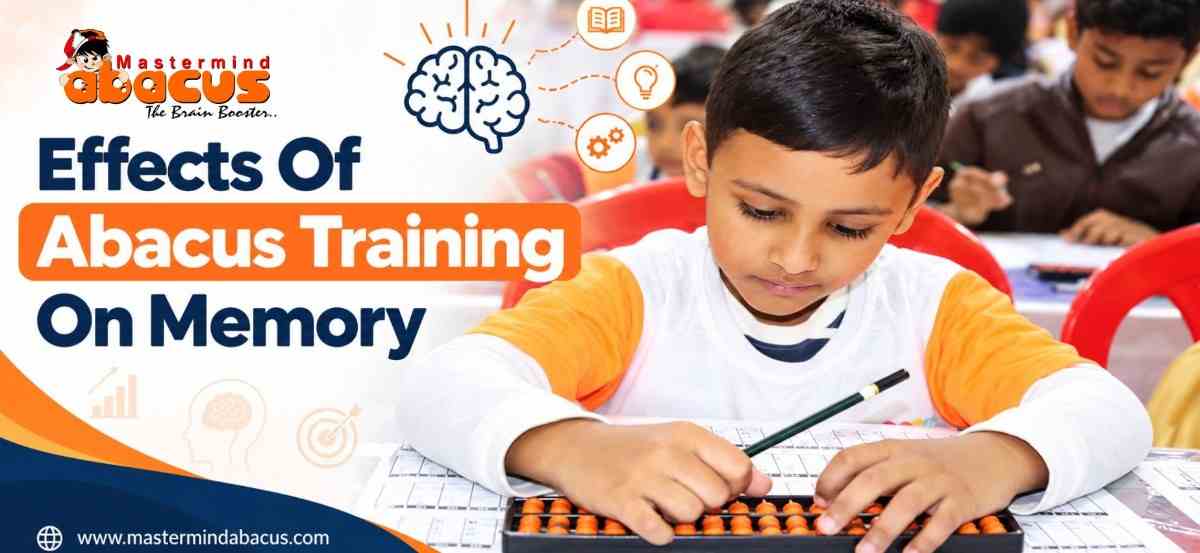
Effects Of Abacus Training On Memory
📅 04 Sep, 2013 · ✍️ Admin
Last updated: 30 September 2026
Abacus, in the modern times has been used invariably as a Brain Development tool. A well developed brain is the one which can visualize things, concentrate, coordinate with the situations around, memorize and recall the events.
Abacus is a proven technique to enhance all these skills and therefore Abacus training is given to small kids for improving these abilities at an early age. In this post we will be discussing the effect of Abacus learning on the memorizing abilities in children.
Studies have shown that the mental calculations involve well learned procedures, problem solving questions and dependence on memory (Sokol et al, 1991). You can read more in our summary of research studies on abacus learning and the brain. The effects of Abacus training on memory of children are:
- It trains the child to visualize beads for multi-digit numbers and run through them mentally, which develops better memorizing skills. It means that the numerical memory gets amplified
- It augments the memory of spatial arrangement as it develops skills to be able to draw the same picture on a blank surface, with horizontal and vertical dimensions that they have memorized through the Abacus board
- It strengthens the visual memory as the arithmetic calculations can be performed mentally by picturing the Abacus and doing the relevant hand movements to give the answer.
Which Kind Of Memory Does Abacus Practice Actually Use
Memory is not one single ability. A child can be excellent at remembering a song and still lose track halfway through a three-step sum, because those two tasks use different kinds of memory. An abacus class quietly works on several of them in the same hour, which is also why children often picture numbers in a more organised way — something we explain further in our post on how mental abacus training activates the brain's spatial number map.
| Kind of memory | Where your child uses it every day | What abacus practice asks of it |
|---|---|---|
| Working memory | Solving a three-step sum without writing down every step | Hold the running total in mind while the next number is being said |
| Numerical memory | Remembering tables, dates, house numbers, scores | Recall the bead position for each digit of a multi-digit number |
| Spatial memory | Arranging a school bag, reading a map, copying a diagram | Remember which rod a bead sits on and whether it is above or below the bar |
| Visual memory | Recognising spellings, shapes and faces | Picture the abacus clearly once the physical tool is put aside |
| Listening memory | Following instructions the teacher gives only once | Answer a string of numbers that is read out at speed, without repetition |
Because all five are being used together, the change parents notice first is usually not in maths at all. It shows up as fewer “I forgot” moments with school instructions, and it is closely tied to the way recall works for children in their studies.
Frequently Asked Questions
Can memory really be improved, or is a child simply born with a good or a weak memory?
Memory is a skill, not a fixed quantity. Some children start with an advantage, but memory responds to regular, structured practice at any age. What matters is repetition with attention — the child has to actively hold and use the information, not just read it once and move on.
What exactly is working memory, and why do teachers keep mentioning it?
Working memory is the small mental notepad a child uses to hold information while doing something with it — carrying a number, following a two-part instruction, keeping track of a story. Teachers mention it because most classroom mistakes come from this notepad overflowing, not from a lack of understanding.
My child remembers film dialogues perfectly but forgets maths tables. Why does that happen?
Dialogues come with sound, emotion and repetition, so the brain stores them almost effortlessly. Tables are usually learnt as flat, unconnected sounds. When numbers are given a visual form, as beads on rods, they become far easier to store and to bring back later.
Is memorising tables the same thing as abacus practice?
No. Memorising tables stores a fixed answer. Abacus practice trains the child to build the answer mentally by moving remembered beads. One gives a single stored fact; the other gives a method the child can apply to numbers never seen before.
Is it true that abacus training gives children a photographic memory?
That claim is overstated, and we prefer not to make it. What abacus practice does build is a strong, trained visual memory for numbers, because the child repeatedly pictures a familiar layout of beads. That is useful and measurable, but it is not the same as remembering pages at a glance.
How soon do parents usually notice a difference in memory?
Most parents mention small changes after a few months of regular practice — remembering instructions the first time, or keeping numbers in mind while calculating. Progress depends on how consistently the child practises at home. It builds steadily rather than suddenly, so daily short sessions matter more than long weekend ones.
Does memory work improve concentration too, or are they separate?
They support each other. A child cannot remember what was never properly attended to, so any memory practice is also attention practice. If focus is the bigger worry at home, our guide on improving your child's attention span without banning screens will be more useful first.
At what age can my child join, and what if my child is only 5?
The Mastermind Abacus programme is for ages 6 to 14, with 10 levels of about three months each and two one-hour classes a week. For younger children, our Lingo Bingo programme for ages 5 to 6 is the right starting point at our offline centres.
To get benefitted by the amazing effects of Abacus training for kids, you can book a free demo of our live online abacus classes for children aged 6 to 14 with Mastermind Abacus, or see how the bead-to-brain connection works in our post on connecting your child's left and right brain hemispheres.
Author – Mr. Naveen Chowdhari
Naveen Chowdhari is the Founder & Director of Mastermind Abacus, a leading name in children’s mental math and brain development training. By blending traditional abacus methods with modern teaching techniques, he has created an innovative system that enhances children’s concentration, memory, visualization, speed, and overall cognitive skills. Under his leadership, Mastermind Abacus now provides worldwide online abacus classes and has built a strong global franchise network, making quality brain-development education accessible across the world.
Last Updated: 30 September 2026