
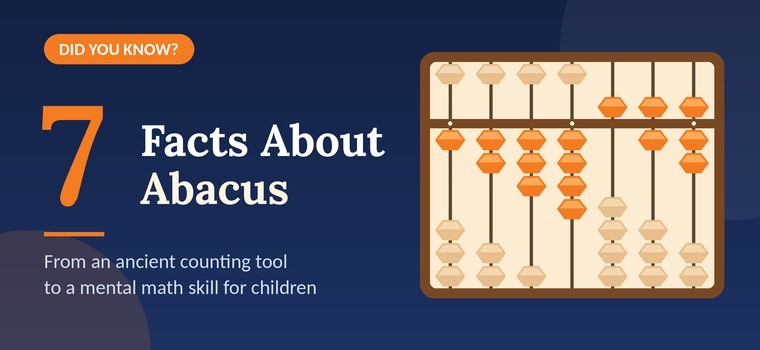
Top 7 Facts About Abacus
📅 17 Aug, 2013 · ✍️ Admin
Last updated: 30 September 2026
- Abacus is one of the most primitive calculating devices known. It is still being used in some countries for calculations.
- China is often considered to be the place of origin of Abacus. The originally written documentation on Chinese abacus is dated in the second century BC.
- The Abacus that we use today, i.e. Soroban, can be instantly made to read zero by a horizontal pull along the center of the frame.
- Abacus can be used to perform additions, subtractions, multiplication, divisions for both positive and negative numbers. It can also perform advanced functions like calculating up to decimal places.
- In modern times, Abacus is widely used as a brain development tool that also aids in enhanced mental arithmetic abilities in small kids.
- A “Binary Abacus” is used to explain how the computers that we use today manipulate numbers. Each bead is either on or off, just like the 1s and 0s of binary language. Codes such as ASCII turn signs, symbols and numbers into this binary language so that computers can read them.
- “Cranmer Abacus”, which was invented by Tim Cranmer, is used by blind people to make calculations easy and accurate.
Try These Abacus Facts at Home
Facts stay longer in a child’s mind when they are tested by hand. The table below turns five of the facts above into two-minute activities you can try with a real abacus, a few coins, or our virtual abacus. If your child enjoys them, you may also like to read how mental abacus training activates the brain’s spatial number map.
| The fact | Two-minute activity | What your child discovers |
|---|---|---|
| Fact 1: One of the oldest calculating devices | Use pebbles or coins to count up to 20, keeping a separate pile for every five. | Grouping makes counting easier. Every abacus is built on this idea. |
| Fact 3: The Soroban can be set to zero in one move | Set any number on the abacus. Tilt it towards you so the lower beads drop, then slide a finger along the beam to push the upper beads away. | Every calculation begins from a clean zero. |
| Fact 4: One tool, many operations | Show 12 on the abacus, then take away 2 and read what is left. | The same beads are used for adding and taking away. |
| Fact 6: The on and off idea behind computers | Line up three coins. Heads means “on” and tails means “off”. Count how many different patterns you can make. | There are eight patterns. Computers store numbers and letters using this same on and off idea. |
| Fact 7: An abacus that is read by touch | Set a number on the abacus, close your eyes and try to read it with your fingertips. | Beads slip easily under the fingers. That is why the Cranmer abacus has a backing that holds each bead in place. |
Frequently Asked Questions
Did one person invent the abacus?
No, the abacus has no single inventor. Counting boards were used in ancient Mesopotamia, and the bead abacus took shape over many centuries in China before Japan refined it into the Soroban that children learn on today. Our post on the history of the abacus and its use for children follows this journey.
Is the abacus still used today, or is it only found in museums?
It is still very much in use. Some shopkeepers in parts of Asia continue to calculate on it, visually impaired learners use the Cranmer version, and children around the world learn on the Soroban to build mental arithmetic. Its main role has moved from the shop counter to the classroom.
What does the word “abacus” mean?
The word comes from the Latin “abacus”, which was borrowed from the Greek “abax”, meaning a flat table or board. The earliest counting tools were simply boards with lines or grooves on which pebbles were moved. The beads and rods we see today came much later.
How many beads are there on each rod of a Soroban?
Each rod has five beads. One bead sits above the beam and counts as five, and four beads sit below it and count as one each. With just these five beads a child can show every digit from 0 to 9. We have explained the structure of the abacus part by part in a separate post.
Can children really calculate without touching the abacus?
Yes, with regular practice. Children first work on the physical abacus, and over time they begin to picture the beads in their mind and move them there. This skill develops gradually, and the pace differs from child to child. We have described it in the abacus journey from a physical calculator to a mental math tool.
Is an abacus faster than a calculator?
Speed is not the real point of learning abacus. A calculator gives an answer, while abacus practice builds the child’s ability to work with numbers. A well-practised child can be quick with everyday sums, but the lasting gain is understanding and confidence. Read more on why a child’s brain still needs to do the maths in the age of AI.
My child enjoyed these facts. How do we move from facts to actual abacus learning?
Begin with a class where your child can handle a real abacus. Mastermind’s abacus course takes children from 6 to 14 years, through live online classes or an abacus centre near you, across 10 levels of three months each with two one-hour classes every week. Children of 5 to 6 years begin with Lingo Bingo at our centres.
Take the Mastermind Abacus Program for overall brain development of your child and make them learn to use their mental arithmetic to the core.
Author – Mr. Naveen Chowdhari
Naveen Chowdhari is the Founder & Director of Mastermind Abacus, a leading name in children’s mental math and brain development training. By blending traditional abacus methods with modern teaching techniques, he has created an innovative system that enhances children’s concentration, memory, visualization, speed, and overall cognitive skills. Under his leadership, Mastermind Abacus now provides worldwide online abacus classes and has built a strong global franchise network, making quality brain-development education accessible across the world.
Last Updated: 30 September 2026