
Wholesome Brain Development Through Abacus Program
📅 24 Jul, 2013 · ✍️ Admin
Last updated: 30 September 2026
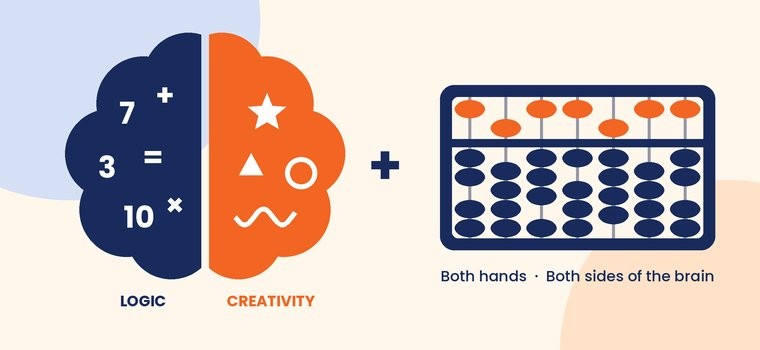
It is an interesting fact to know that our brain functions are often described as divided into two parts namely the left brain functions and right brain functions. The left brain functions are related to logical thinking, reasoning abilities etc., while the right brain functions are more related to creativity and innovative ideas. We can conclude, we live in a left brain dominated world.
The right brain in right handed people is often said to be under-utilized, but this does not mean that it cannot be utilized to its full potential in order to enhance the performance in studies, work processes and elsewhere.
The abacus program is an ancient means of doing fast mental calculations by utilizing the hand and finger movements that directly send signals to the brain. This makes utilization of both left and right sides of brain at a single time, and supports overall brain development.
Since a large part of brain development takes place during the childhood years, school-age children benefit the most out of the abacus course. These children are taught to make use of both their hands to move the beads on the instrument while performing arithmetic calculations. This activity promotes their brain development when the same practice is done without using any abacus instrument and performing mental calculations.
Both Kinds of Thinking in One Abacus Class
It is easy to talk about the "left brain" and the "right brain" as if they work separately. In an abacus class, the step-by-step work and the picture-based work happen together in almost every activity, as the table below shows. If you would like to read more on this, see our post on how abacus connects the left and right hemispheres, and our explanation of why both hands are used to operate the abacus.
| Activity in class | Step-by-step (logical) work | Picture-based (creative) work |
|---|---|---|
| Moving beads with both hands | Following the rule for each bead and each place | Seeing the number take shape as a bead pattern |
| Listening to dictated sums | Keeping the numbers in the right order | Picturing each number as soon as it is heard |
| Mental sums without the abacus | Working through the steps one after another | Imagining the beads moving in the mind |
| Timed practice pages | Staying accurate within a time limit | Recognising familiar bead patterns at a glance |
| Checking one's own answer | Going back over each step calmly | Noticing when the bead picture does not look right |
It imparts skills that increase concentration, like:-
- Visualization- The ability to visualize the abacus instrument (or any other content/subject etc.)
- Listening- Increased listening skills of students adds to their better understanding of the other subjects (in addition to the abacus course)
- Logical reasoning- Enhancement of skills for applying logics and doing faster numerical calculations
- Visual memory- Ability to remember and reproduce instances and incidents (or even lessons) as they were in the mind, for future use
- Recall- The capability to recall the accumulated data, the right one at the right time.
Frequently Asked Questions
Is my child "left-brained" or "right-brained"?
Neither, really. These are popular labels for two styles of thinking, one more logical and one more imaginative. In daily life both sides of the brain work together on almost every task. Activities that use both styles help more than any label. You can read what studies say on our research on abacus page.
What does "wholesome brain development" mean in simple words?
It simply means a child is not practising one skill alone. In an abacus class the child listens, moves the beads, pictures the numbers, calculates and remembers, all in the same few minutes. Using many skills together, again and again, is what we mean by wholesome or overall development.
Is it true that most brain development is over by a certain age?
Childhood is widely accepted as a period of rapid brain growth, but the exact percentages quoted in articles differ from one source to another, so we prefer not to quote a number. What matters for parents is that children learn new skills easily in the school years, and learning continues well beyond them.
Does the abacus help only with calculation?
Calculation is the most visible result, but the practice also exercises listening, visualization, memory and recall, as described above. How much each child gains depends on regular attendance and practice. Our page on the benefits of abacus learning explains these in more detail.
How will I notice these skills at home, outside the maths class?
Look for small everyday signs. Your child may follow an instruction the first time, remember the order of a story, or stay patient with a task that has many steps. These changes come slowly and differ from child to child. Our guide on improving your child's attention span has simple home ideas.
How does a child start "seeing" the beads without an abacus?
It grows out of repetition. After many sums on the real abacus, the bead positions become familiar, and the child begins to imagine them while calculating. We have explained this in our post on how mental abacus training works with the brain's number map.
We want to start early. What is the youngest age for the abacus course?
The Mastermind Abacus programme is for children aged 6 to 14, in live online classes and at offline centres. It has 10 levels of three months each, with two one-hour classes a week. For children aged 5 to 6, we offer Lingo Bingo, an offline early-learning programme.
Is abacus a treatment for attention or learning difficulties?
No. Abacus practice can give a child regular, enjoyable work on listening, focus and numbers, but it does not treat any condition. Abacus is an educational activity, not a therapy; persistent difficulties should be assessed by a qualified professional. Do share any such concern with your child's trainer as well.
So in conclusion, we can say that making use of both the hands and brain functions of left and right brain can help children become more confident learners. With regular practice, they can do better in studies, co-curricular activities, competitions etc.
Mastermind Abacus, an Abacus training institute, provides an overall brain development program to students which also enhances the mental arithmetic calculations. The abacus course is structured in consideration of children psychology that gives them a joyful experience of learning while giving a feeling of being in a play.
Author – Mr. Naveen Chowdhari
Naveen Chowdhari is the Founder & Director of Mastermind Abacus, a leading name in children’s mental math and brain development training. By blending traditional abacus methods with modern teaching techniques, he has created an innovative system that enhances children’s concentration, memory, visualization, speed, and overall cognitive skills. Under his leadership, Mastermind Abacus now provides worldwide online abacus classes and has built a strong global franchise network, making quality brain-development education accessible across the world.
Last Updated: 30 September 2026