

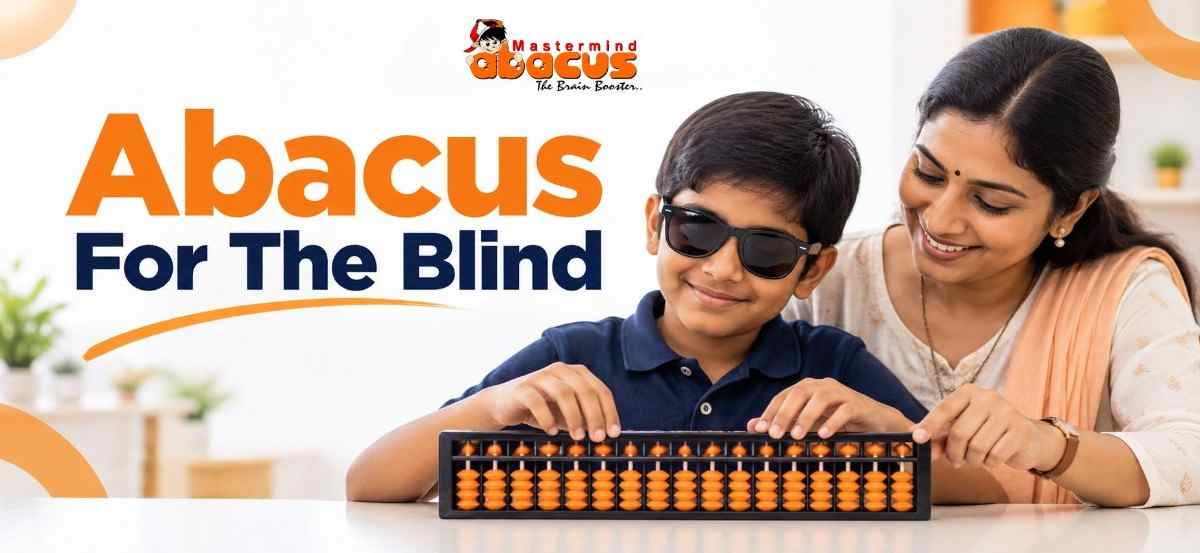
Abacus For The Blind
📅 24 Mar, 2014 · ✍️ Admin
Last updated: 28 September 2026
Abacus is a promising aid for the Blind to learn and calculate mental arithmetic operations. It teaches the Blind Abacus learners to perform mental arithmetic calculations efficiently with ease and accuracy, but without a need of watching the bead movements on the Abacus instrument.
Abacus can be learned by using both the hands on the instrument and feel, observe and move the beads on the frame. This ensures consciously utilizing the brain. The touch of beads on the finger tips sends sensory signals to the brain and helps activate both left and right sides of the brain. This helps in performing mental math with high level of attention.
Cranmer Abacus
We all are already aware about the fact that Abacus has been in use for centuries to learn arithmetic. Even in today’s generation it is being used in many countries to teach children fast and accurate mental calculations. With the widespread applications of Abacus device, it was also modified to be used by the Blind. This modified Abacus was then called Cranmer Abacus. This Abacus was named after its inventor Tim Cranmer who had transformed ancient Abacus to be used by the Blind people. Unfortunately, the Abacus which is used by the sighted people does not suit the need of those who are blind, and so was the reason for the invention of Cranmer Abacus.
Blind learners still make use of the Cranmer Abacus to perform arithmetic calculations like addition, subtraction, multiplication, division, square root and cube root. A rubber or some soft fabric is used behind the beads of Abacus to restrict their spontaneous movement. It is invariably used by the schools for blind to teach calculations to the students right from the early grades. Abacus helps the blind and visually impaired students to compute long and complex mathematical problems with the required speed. Also, the knowledge of using Abacus reaps benefits for a lifetime to the students.
Skills incorporated in Blind students through Abacus
· Learns basics of all arithmetic operations
· Understanding of the concepts and methods
· Mastery in simple and complex problems
· Good knowledge about the place values
· Set and clear the numbers on Abacus instrument
· Use the correct fingers like normal students
Cranmer Abacus vs Standard Abacus at a Glance
Whether a child reads the beads by sight or by touch, the goal of abacus learning is the same — building a clear mental picture of numbers. Research explained in our blog on how mental abacus training activates the brain’s spatial number map shows that learners store the abacus as a mental image rather than as words, which is exactly why touch-based learning works so well for blind students. Here is a quick comparison of the two instruments:
| Feature | Standard Abacus | Cranmer Abacus |
|---|---|---|
| Bead movement | Beads slide freely on the rods | A rubber or soft fabric backing holds the beads in place |
| How numbers are read | By sight | By touch, with the fingertips |
| Designed for | Sighted learners | Blind and visually impaired learners |
| Origin | Traditional design, centuries old | Adapted by Tim Cranmer for blind users |
| Operations covered | Addition, subtraction, multiplication, division | The same operations, including square root and cube root |
| Where it is commonly used | Homes, abacus classes and schools | Schools for the blind, right from the early grades |
Can you imagine the applications of this ancient tool i.e. Abacus serving the needs of different people in the olden and modern times? The tool has been modified, rather simplified, as per the requirements in different ages. In the modern times, it is widely used as a means of brain development in small children of 6 to 14 years.
Frequently Asked Questions
Can a blind child really learn the abacus?
Yes. Blind learners use the Cranmer abacus, which is designed to be read by touch. They feel and move the beads with their fingertips, learn place value, and progress to full arithmetic operations. Schools for the blind have taught this method successfully for decades, right from the early grades.
How is the Cranmer abacus different from a normal abacus?
A Cranmer abacus has a soft rubber or fabric backing behind the beads, so they stay in place instead of sliding freely. This lets a learner read numbers by touch without disturbing them. Otherwise, it works on the same place-value principles as the standard abacus used in regular classes.
Which calculations can blind students perform on the Cranmer abacus?
Addition, subtraction, multiplication, division, and even square root and cube root. With regular practice, blind and visually impaired students can solve long, complex problems with good speed, because the abacus gives them a reliable, tactile way to hold and work with numbers.
Why does touch-based abacus learning work so well?
The fingertips are extremely sensitive, and every bead movement sends sensory signals to the brain. This constant hand-brain coordination engages both hemispheres and builds a strong mental picture of numbers — the same foundation that sighted learners develop through mental abacus practice.
Who invented the Cranmer abacus?
Tim Cranmer, who adapted the traditional abacus for blind users. His key change — a backing that stops the beads from moving on their own — made it possible to read the instrument by touch. The Cranmer abacus is still widely used in schools for the blind today.
Mastermind Abacus, a renowned Abacus training center has been offering its Abacus course to students across the globe since 2005. Get the benefits of our personalized Abacus for kids’ sessions today. Contact us at www.mastermindabacus.com.
Author – Mr. Naveen Chowdhari
Naveen Chowdhari is the Founder & Director of Mastermind Abacus, a leading name in children’s mental math and brain development training. By blending traditional abacus methods with modern teaching techniques, he has created an innovative system that enhances children’s concentration, memory, visualization, speed, and overall cognitive skills. Under his leadership, Mastermind Abacus now provides worldwide online abacus classes and has built a strong global franchise network, making quality brain-development education accessible across the world.
Last Updated: 28 September 2026