

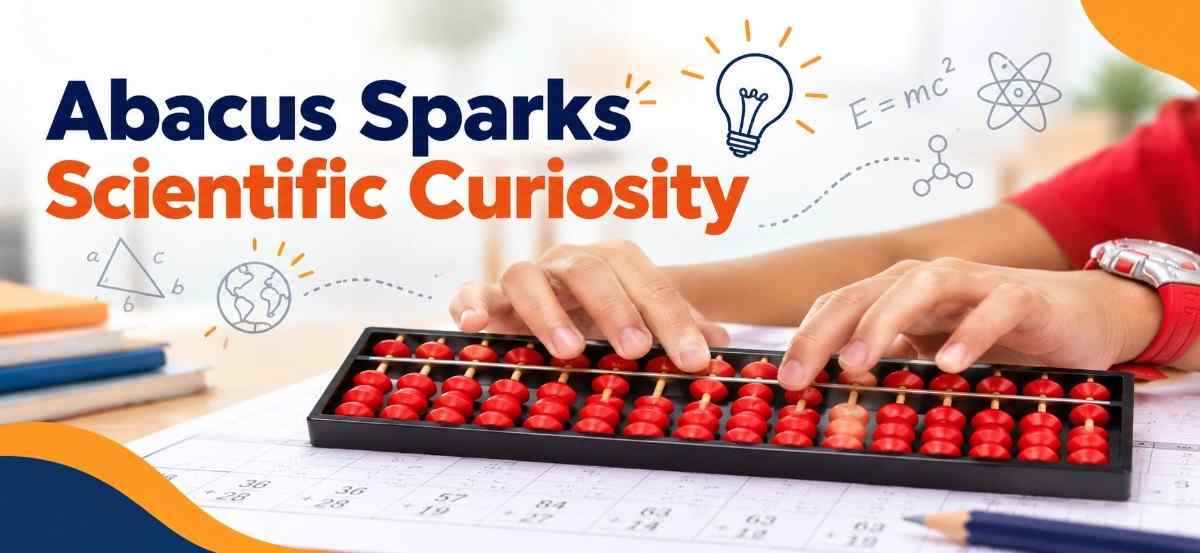
Abacus Sparks Scientific Curiosity
📅 08 Feb, 2014 · ✍️ Admin
Last updated: 28 September 2026
Historically, India has been known for its contributions to science. It has been ahead of many other nations in the instructions of science. Our scientists have reached research centers as big as NASA. With the emerging trends of technology playing a critical role in most people’s daily life, getting answers to all curiosities is easy. Parents have started encouraging their children’s interest in fields like science, technology, and others. Getting children to chase their curiosity and discover the world around them in scientific terms. This leads them to craft their science-related interest and make it their passion or career perspective.
What exactly is scientific curiosity?
There are many uncertainties and unanswered questions around us. Sometimes we have to accept a few concepts based on beliefs, customs, traditions, or others. But this raises curiosity, mostly in children. We must know that there is definitely some science involved in every event that occurs around us. When our anxiousness leads us to research or study unanswered concepts, it is known as ‘Scientific Curiosity’. And, if your child is curious and carries a scientific attitude, you must celebrate as it will lead him/her to the zenith.
Scientific Curiosity helps kids explore the “?”!
Scientific curiosity allows an individual to explore the areas that are unconcluded or contradictory. It is (directly or indirectly) a motivation or driving force that sets a goal-oriented behavior. It builds a desire and gives a positive direction to actions.
How does Abacus spark the child’s scientific curiosity?
The abacus as a brain development tool indeed encourages children to think and comprehend beyond, starting early in life. When children of 6 to 14 years start learning early, utilizing the full potential of their left and right brain, they automatically become more aware and enlightened. This awareness drives more curiosity in knowing about the natural world (i.e. science). Thus the children research, experiment, and experience the science involved behind every event. Learning the abacus also gives children frequent small wins, which keeps them engaged and motivated — and a motivated mind naturally becomes an inquisitive one. You can see what happens inside a child’s head during this practice in our post on how mental abacus training activates the brain’s spatial number map.
How Abacus Practice Builds Curiosity Habits
Curiosity is not just a mood — it is a set of habits: imagining, experimenting, checking and asking better questions. Every abacus session quietly exercises these habits, which is why abacus-trained children often carry the same explorer’s mindset into science, projects and puzzles, as we explain in the hidden link between abacus and creative problem solving.
| What the child does in abacus class | Curiosity habit it builds |
|---|---|
| Visualises the beads and solves sums mentally | Imagining “what if” possibilities before acting |
| Tries faster ways to reach the same answer | Experimenting instead of memorising one fixed method |
| Checks each answer back on the abacus | Questioning and verifying rather than assuming |
| Listens to numbers and calculates in real time | Observing small details closely and patiently |
| Moves up through 10 levels of new challenges | Asking deeper questions as skills grow |
Benefits of Abacus and Scientific Curiosity together
· Helps overcome ‘forgetful attitude’
· Develops an ‘art of memorizing’
· Builds the ‘competitive spirit’
· Makes children ‘flexible and mentally agile’
· Ignites ‘creativity and innovativeness’
· Encourages ‘Inquisitiveness’
· Makes children ‘open minded’
Frequently Asked Questions
Q1. Is scientific curiosity something children are born with, or can it be developed?
It can be developed. Children are naturally curious, but the habit of questioning, testing and verifying grows with practice. Activities that reward exploration — like abacus-based mental math — encourage children to keep asking “why” and “how” instead of accepting answers passively.
Q2. How does abacus learning encourage my child to ask more questions?
Abacus training rewards experimentation. Children discover that the same sum can be approached in different ways, and each new level brings a fresh challenge. This builds the confidence to try, fail and retry — the exact mindset behind scientific questioning at school and at home.
Q3. Can abacus classes really help my child in science subjects?
Indirectly, yes. Abacus practice strengthens concentration, memory, visualisation and logical thinking — skills that science subjects depend on. A child who calculates confidently spends less effort on numbers and more on understanding concepts, experiments and observations in class.
Q4. What is the right age to start abacus for building thinking skills?
The Mastermind Abacus program is designed for children aged 6 to 14, through both live online classes and offline centres. Within this range, starting earlier generally helps, because curiosity habits formed in the primary years carry naturally into higher classes.
Q5. My child is only 5 years old. Is there any program for them?
Yes. For 5–6 year olds, Mastermind offers Lingo Bingo, an offline program that builds early language and cognitive skills through play. Children can then move into the abacus program from age 6 onwards.
Besides, the abacus has a lot more benefits to offer to small children. To experience them, enrol your child in Mastermind Abacus live online classes — helping children build sharper minds since 2005, with 1,000+ centres across 17 countries.
Author – Mr. Naveen Chowdhari
Naveen Chowdhari is the Founder & Director of Mastermind Abacus, a leading name in children’s mental math and brain development training. By blending traditional abacus methods with modern teaching techniques, he has created an innovative system that enhances children’s concentration, memory, visualization, speed, and overall cognitive skills. Under his leadership, Mastermind Abacus now provides worldwide online abacus classes and has built a strong global franchise network, making quality brain-development education accessible across the world.
Last Updated: 28 September 2026