
Enhanced Number Representation Through Abacus
📅 09 Oct, 2013 · ✍️ Admin
Last updated: 29 September 2026
While working with digits, it is essential that they are represented correctly so that their value can be read efficiently and calculations can be performed in the right manner. Numbers are represented with a systematic positioning of digits in the places like units, tens, hundreds and so on…
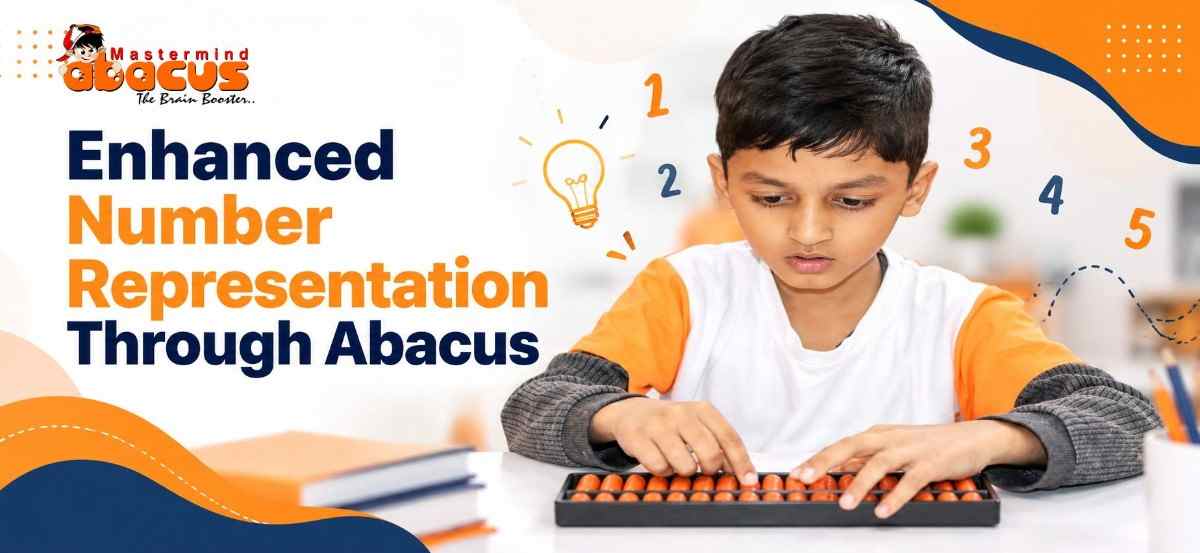
Abacus instrument is a calculating device which makes number representation convenient even for numbers as long as 9 digits (including the positive and negative numbers too). The rods in the instrument represent a digit’s place constituting of beads which are assigned a value each.
Reading the Number 4,205 on an Abacus
Place value becomes much easier to grasp when children can see it. The table below reads one number, 4,205, rod by rod, so you can see how every digit gets its own place on the abacus. Once this feels natural, children are ready for the next step, picturing the beads in the mind, which we explain in developing mental math skills at home.
| Digit | Place | What the rod shows |
|---|---|---|
| 4 | Thousands | Four lower beads moved up to the beam (each lower bead is worth 1) |
| 2 | Hundreds | Two lower beads moved up to the beam |
| 0 | Tens | No bead touching the beam: an empty rod stands for zero |
| 5 | Units | The upper bead (worth 5) moved down to the beam, and no lower beads |
The beads are moved across the rods for performing operations like addition, subtraction, multiplication and division etc. as per the requirement of the question. This position of the beads is then read out to derive an answer to question.
Devices like calculators make calculations faster but do not, on their own, build a child’s skills of numerical representation. Abacus on the other hand helps strengthen numerical representation, and may indirectly support language skills too, through the concentration, listening skills and memory it exercises.
Frequently Asked Questions
What is place value, and why do children find it confusing?
Place value means a digit’s worth depends on where it sits, so the 4 in 40 is not the same as the 4 in 400. Children often read digits one by one without noticing position. On the abacus, every rod is a fixed place, so learning how an abacus works makes position something they can see and touch.
My child writes 305 as 3005 or mixes up tens and hundreds. Is this normal?
This is a common stage while children are still learning how numbers are built. They often write what they hear, digit by digit, without thinking about place. Short daily practice with beads, coins or blocks usually helps. If the confusion continues for several months, speak to the class teacher or a qualified professional.
My child uses a calculator for every sum. Will an abacus give something extra?
A calculator gives the answer but hides how the number is built. An abacus makes the child place each digit in its position and move beads step by step, so the working stays visible. Both have their place. For why the thinking part still matters, read why your child’s brain still needs to do the mental math.
How does moving beads help a child picture numbers?
Beads turn an abstract symbol into something a child can touch and see. Over time, many children begin to picture the bead positions in their mind, which is the idea behind mental abacus. Every child progresses at their own pace. How mental abacus training builds a spatial number map explains this in more detail.
How can I practise place value with my child at home?
Start with everyday objects: bundle ten sticks into one group, then build numbers like 24 or 135 and ask your child what each group stands for. You can also let them try bead moves on the virtual abacus, available 24×7, and find more play-based ideas in fun learning activities to boost your child’s math skills.
What age should my child start learning the abacus?
Mastermind’s abacus programme is for children aged 6 to 14, with live online abacus classes as well as offline centres. It runs across 10 levels, with two one-hour classes each week. For children aged 5 to 6, there is Lingo Bingo, offered offline.
This post says abacus may support language skills too. How?
Abacus is not a language programme. What class practice builds is concentration, listening and memory, and these skills are useful in every subject, including reading and speaking. How much a child benefits differs from child to child, and it depends on regular practice, not on the abacus alone.
Abacus course is a valuable educational program for today’s generation to become competent and confident with numbers. Mastermind Abacus is an education provider that helps build the students’ mental arithmetic skills and confidence.
Author – Mr. Naveen Chowdhari
Naveen Chowdhari is the Founder & Director of Mastermind Abacus, a leading name in children’s mental math and brain development training. By blending traditional abacus methods with modern teaching techniques, he has created an innovative system that enhances children’s concentration, memory, visualization, speed, and overall cognitive skills. Under his leadership, Mastermind Abacus now provides worldwide online abacus classes and has built a strong global franchise network, making quality brain-development education accessible across the world.
Last Updated: 29 September 2026