Abacus classes in Sharjah — live online mental maths for ages 6–14
In Sharjah the hard part is rarely finding a class. It is finding one that survives a long bus route and a drive back from Dubai. So you pick the slot: two live hours a week with a certified trainer, four children at a time, in Gulf Standard Time. The first hour is free.
Book a free demo class
No fees. No obligation. See your child learn live.
Or message us directly on WhatsApp.
The problem in Sharjah is the evening, not the distance
Sharjah households run on a tight clock. School buses cover long routes across the emirate and some cross into Dubai, so children arrive home at a time that shifts by twenty minutes either way. Parents commuting back over the border join one of the busiest roads in the region. By the time everyone is in, an hour has gone that nobody planned to lose.
A class fixed at half past five does not bend around that. Families sign up in September meaning every word of it, and by half term the attendance has become apologetic. The commitment was never the issue; the timing was.
So the slot is yours to choose, in Gulf Standard Time, and it can be moved if the year changes shape. Mastermind has taught abacus since 2005, through 1,000+ centres and a portal built for this one subject — four children to a trainer, ten assessed levels, running straight through the summer.
Six things that stay after the abacus is put away
A child uses the bead frame for a while and then stops needing it. What remains is the reason for doing it at all.
How to hold and move beads
The finger method is fixed properly in the first level, because it is the one thing that cannot be corrected later.
Sums with nothing in front of them
The frame is set aside around the middle levels and the calculation carries on in the head.
Staying with one thing
An abacus sum collapses the moment attention wanders, so children learn to hold it.
Holding a picture steady
Keeping a changing bead frame in mind is memory work, repeated until it is easy.
Correct before fast
Accuracy is built first. Speed arrives on its own once the method is dependable.
Less dread at homework time
The clearest sign it is working is a child who stops putting the maths book last.
Parents generally report these across the levels. How far a child gets comes down to attending and to a few honest minutes of practice a day. Read the research on abacus training →
Students, filmed mid-class
Enrolled Mastermind students at three different levels. The moment worth watching is when the hands stop and the answers keep coming.
The shape of the programme
One free hour, and a starting level
Your child takes a live class. The trainer then tells you which level to begin at — Level 1 for most, further in for a child who has already done some abacus.
Two hours a week, at your time
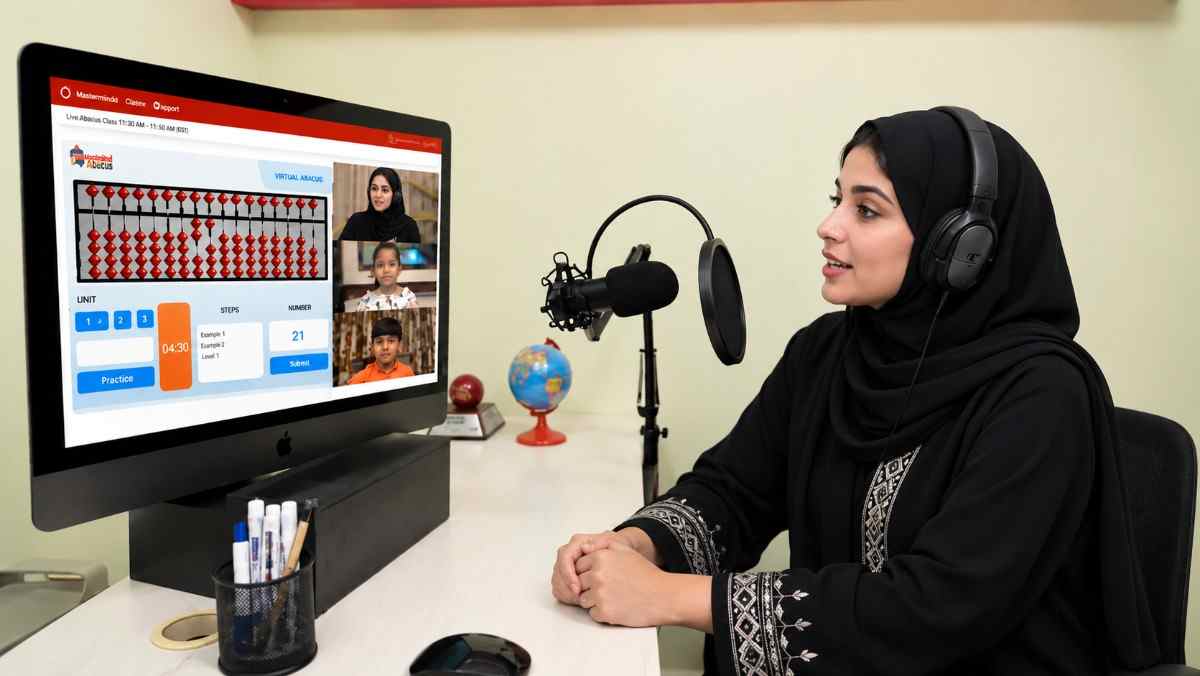
Held on Mastermind’s own portal with bead races, timed rounds and flash drills. Four children to a trainer. You set the days and hours when you book, and they can be adjusted later.
What comes to the house
An abacus, the level workbooks and a Parent Handbook. Day to day, the student app and the free Virtual Abacus cover five to ten minutes of practice.
Ten levels, each one assessed
About three months apiece, closing with a graded assessment. A child moves up when the level is finished, not when the batch does.
The setup at home: a laptop or tablet, a connection that holds and a quiet corner. Batches run in Gulf Standard Time across after-school, evening and Saturday–Sunday slots, and they carry on through the summer break. More on the format: how our live online classes work.
Put one hour against your own evening
Book a free class at the time you would genuinely use, and see whether it holds.
A time you choose vs a time you are given
Most abacus programmes teach something similar. What separates them over a full year is what happens when life gets in the way.
| When this happens | Mastermind live online | A fixed local class |
|---|---|---|
| The bus runs late | Your slot already sits clear of it — you set it | The class starts without your child |
| You are held up coming back from Dubai | No one has to drive anyone anywhere | The lesson is missed |
| The routine changes mid-year | Ask us and the timing moves | Usually the timetable, or nothing |
| Summer arrives | Levels carry on without a pause | Often stops for the break |
| You move house or emirate | Nothing changes at all | Usually means starting over |
| Your child needs more attention | Four children to one trainer, always | Depends on how full the room is |
| Before you pay anything | A full free hour, at your chosen time | Sometimes a trial |
This compares Mastermind’s live online format with a scheduled in-person class. Providers differ, and some are flexible — the point is to ask before the fees are paid.
British, CBSE, American, IB — it makes no difference here
Sharjah’s private schools are inspected by SPEA and run a wide spread of curricula, with British and CBSE particularly well represented across the emirate. Families often choose between them on rating, fees and bus routes rather than on syllabus.
None of that touches what this programme does. Abacus is not a syllabus and does not compete with one — it builds the arithmetic fluency that every curriculum quietly assumes a child already has. Once calculation stops being effortful, attention goes to the reasoning, which is what school is actually marking.
It also means a change of school, or of emirate, leaves your child’s level exactly where it was.
One trainer, all the way through
Each class is taken by a certified, company-trained Mastermind trainer — the same one each week, who remembers what went wrong last time and picks it up there.
Teaching Abacus isn't just my job—it's my daily source of pride.
Harsha BanthiyaB.Tech and B.Ed
Nothing feels better than shaping young minds and making parents proud.
Amrisha DubeyMBA
Abacus teaching gave me purpose—I feel proud of every small achievement.
Sonali GahoiM.A. (English)
My students' confidence and calculation speed amazed parents within just weeks!
Kanta SarkarPost Graduate
Students' focus and confidence improved so much that parents often thank me!
Ayushi SharmaPost Graduate
Every child's progress gives me deep satisfaction as an Abacus teacher.
Khyati MalhotraMBA
Children between six and fourteen
- Never touched an abacus — counting and following instructions is the whole entry requirement
- Started somewhere and stopped — often because the timing stopped working; we assess and resume
- Fast at maths and unchallenged — the upper levels are genuinely hard
- Quiet in a full classroom — being one of four is a very different experience
Use the free hour as a test of the timing
Book it at the time you would actually use every week, not the time that is easiest this once. That tells you what you need to know: whether your child is still alert then, and whether the household can hold that hour twice a week. A certified trainer runs it, nothing is presented at you, and the fees come afterwards.
How the hour goes
- Name your windowThe days and hours that genuinely work; we come back with what is open.
- A real class runsOne hour, certified trainer, the portal enrolled students use. Sit in throughout.
- A plain assessmentWhich level your child starts at, and what that level demands of them.
- Nothing owedFees follow afterwards. Declining is a perfectly ordinary outcome.
Abacus classes in Sharjah — the essentials
- What it is: a ten-level abacus and mental-maths programme, taught live online to children across Sharjah.
- Ages: six to fourteen, beginners and children resuming from elsewhere.
- Class size: four children to one certified trainer, every session.
- Time commitment: two live hours a week, plus five to ten minutes of daily practice.
- Scheduling: you choose the slot — after-school, evening or weekend, in Gulf Standard Time — and it can be changed later.
- Through the year: levels continue over the summer and are not tied to any campus.
- To start: one free hour, fees quoted after, no obligation.
The practical questions
The bus drops my child home late and it is never the same time. Does that ruin this?
It is the usual reason a fixed class stops working, and it is why you choose your own slot here. Pick a time that sits comfortably after the bus normally arrives rather than right against it, and tell us if that needs to change later in the year.
I get back from Dubai after seven. Can classes be that late?
Batches run in Gulf Standard Time across after-school and evening hours, plus Saturday and Sunday. Tell us the window that actually works for your household and we will tell you what is open in it.
Do you have a centre in Sharjah we can visit?
We teach Sharjah families online instead. A certified trainer, four children, your own sitting room — which also means nothing to reach on Al Ittihad Road at the end of a working day.
Which areas do you cover — we are in Muwaileh / Al Nahda / Al Taawun?
All of them, on identical terms. Children join from Muwaileh, Al Nahda, Al Taawun, Al Qasimia, Al Rahmaniya, Al Zahia and the wider emirate. Nothing about the programme depends on where you live.
What exactly are we paying for?
Two live hours a week with a certified trainer, four children to a class, ten assessed levels, and a kit with the abacus, the level workbooks and a Parent Handbook. The figure itself depends on the level and the batch, and we give it to you after the free class so you can weigh it against something you have actually seen.
My child goes to school in Dubai but we live in Sharjah. Any difference?
None. The class is tied to your child, not to a campus or an emirate, so the school run has no bearing on it.
SPEA-rated British, CBSE, American, IB — we are in one of those. Does the programme suit it?
It suits all of them, because it is not teaching a syllabus. Abacus builds the calculation ability every curriculum assumes a child already has, and then school maths gets easier on top of it.
If we move to Dubai or back to India, do we lose the levels?
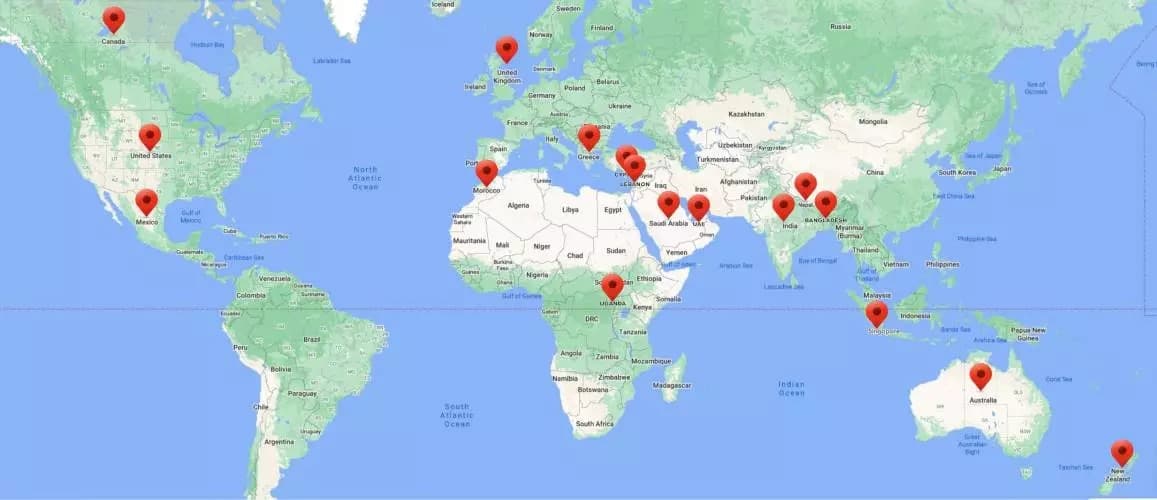
No. The same programme runs in 17 countries, so your child resumes at the level they reached. That is worth knowing before committing to anything tied to one building.
What age is right to start?
Six to fourteen. The younger end picks up bead technique with less effort; the older end moves faster but has to be willing to begin at Level 1 like everyone else.
Test it against a normal Tuesday evening
Not a quiet one. The real one, with the bus late and everyone tired. That is the week you need it to survive.