Abacus classes in Melbourne — live online mental maths for ages 6–14
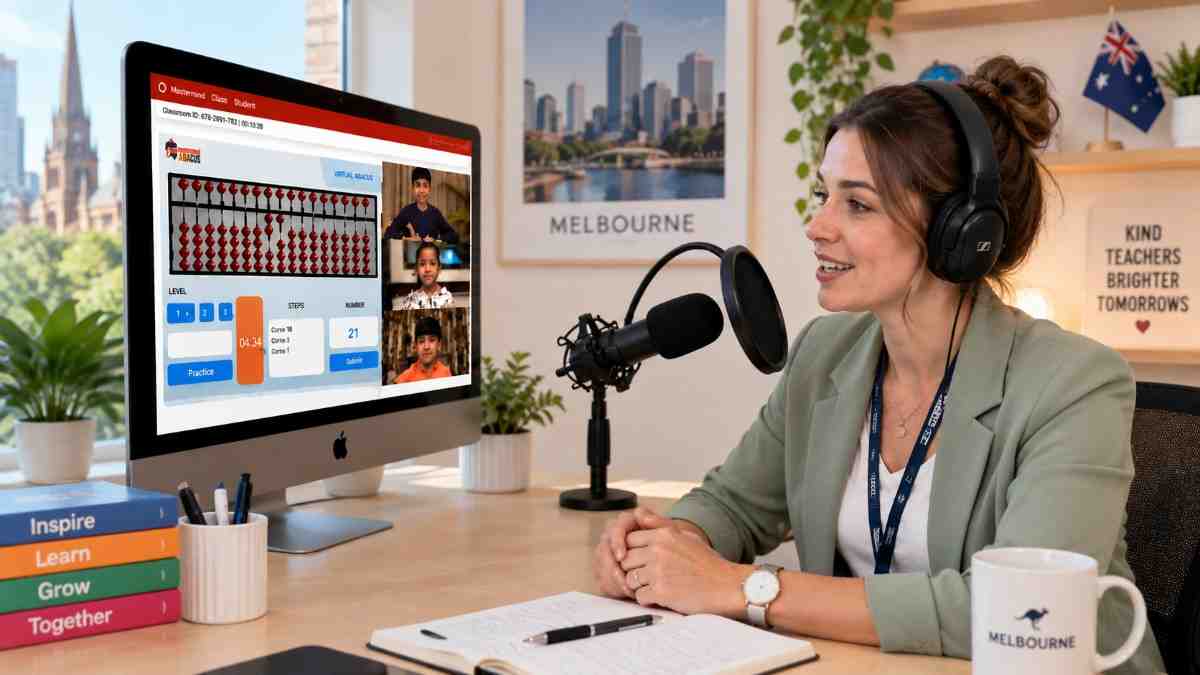
Taught live from India, at a normal Melbourne after-school hour — half past four here is about eleven in the morning there. Four children to a certified teacher, ten graded levels, and nobody up at an absurd hour on either side. The first class is free.
Book a free demo class
No fees. No obligation. See your child learn live.
Or message us directly on WhatsApp.
Where the teacher is, and what hour that makes it
Our teachers are in India. We say so at the top rather than leaving you to deduce it, because in Melbourne it happens to be good news.
India runs five and a half hours behind Melbourne through the warmer months and four and a half through winter. So your child’s whole after-school window — roughly half three to seven — lands between ten in the morning and half two in the afternoon for the teacher. An ordinary working day at both ends.
That is not true of most online programmes an Australian family could choose. A teacher in New York would be starting your 4pm class at half past two in the morning; one in London, at half nine at night. Tired teaching is worse teaching, and the hour a class actually happens is not a detail.
Mastermind has taught this one subject from Indore since 2005, through 1,000+ centres and a portal built for it: ten levels, four children to a certified teacher, a graded assessment closing each level.
Six things the programme is aiming at
The bead frame does its job early and is then deliberately taken away. These are what should remain.
Bead technique, watched live
Finger movement corrected in the first level, with four pairs of hands on screen rather than a roomful.
Working without the frame
Midway through the programme the abacus is set aside and the sums keep going mentally.
Attention at the end of a school day
The exercise falls apart if a child is only half there, which is exactly the hour it is testing.
Visual working memory
Holding a changing bead picture steady, twice a week, until it stops taking effort.
Accuracy graded before speed
In that order at every level, so pace never arrives on top of a shaky method.
Numbers stop being a chore
Usually the first thing a parent notices, and it turns up at the kitchen table.
This is what parents tend to report as the levels go on. Getting there depends on showing up and on a short, regular practice at home. Read the research on abacus training →
Students of the same teachers, three levels apart
Enrolled Mastermind students in live classes. This is the standard of teaching your child would be getting.
The shape of a week
A free hour and a level
One live class, then the teacher names a starting level. A child who has done abacus before is assessed onto the right one rather than started again.
Two live hours a week, Melbourne time
Bead races and timed rounds on Mastermind’s own portal, four children to one certified teacher, the same teacher each week.
The kit posted to you
An abacus, the level workbooks and a Parent Handbook, with the student app and free Virtual Abacus for five to ten minutes on other days.
Ten levels, each assessed
Around three months apiece, closing with a graded assessment. A child repeats a level where they need to instead of being carried along.
All that is needed: a laptop or tablet, a connection that holds and a quiet corner. Classes run through the term breaks and the summer holidays. More on the format: how our live online classes work.
Book it at the hour you would actually use
A free class, live, with your child doing the work and you watching.
What a 4:30pm Melbourne class means at the other end
Australian families have more choice of online programmes than ever, and most of them are staffed somewhere awkward. The arithmetic is worth doing before you enrol.
| Teacher based in | Local time for a 4:30pm Melbourne class | What that tends to mean |
|---|---|---|
| India (ours) | About 11am | Mid-morning, full staffing, ordinary working day |
| United Kingdom | Around 5:30am | Before the working day starts |
| United States, east coast | Around 12:30am | Overnight shift |
| United States, west coast | Around 9:30pm the evening before | Late, and a day out of step |
Times are approximate and shift by an hour with daylight saving. The point is not that teachers elsewhere are worse — it is that the hour a class runs at their end affects who is available to teach it, and how many slots exist at all.
Underneath the Victorian Curriculum, not competing with it
The programme teaches no curriculum and rehearses no test. It builds the number fluency that the Victorian Curriculum assumes a child already has — which is why it makes no difference whether your child is in a government, Catholic or independent school, or which suburb you are in.
Because batches form around levels rather than terms, a child can start in February, in July or over the summer holidays. A change of school, state or country leaves their level and their teacher exactly as they were.
Certified, company-trained, and named
These are real Mastermind teachers, not a pool of contractors. Four children to one of them, and the same one week after week.
Teaching Abacus isn't just my job—it's my daily source of pride.
Harsha BanthiyaB.Tech and B.Ed
Nothing feels better than shaping young minds and making parents proud.
Amrisha DubeyMBA
Abacus teaching gave me purpose—I feel proud of every small achievement.
Sonali GahoiM.A. (English)
My students' confidence and calculation speed amazed parents within just weeks!
Kanta SarkarPost Graduate
Students' focus and confidence improved so much that parents often thank me!
Ayushi SharmaPost Graduate
Every child's progress gives me deep satisfaction as an Abacus teacher.
Khyati MalhotraMBA
Suited to six- to fourteen-year-olds
- Beginners — counting and following instructions is the whole requirement
- Quick but careless — accuracy is graded ahead of speed at every level
- Ahead of the class — the upper levels are demanding by design
- Returning to abacus — assessed and placed at the level they reached
One hour, at a Melbourne-time slot you choose
Not a sales call. A real lesson on the portal enrolled students use, taken by a certified teacher, with your child doing the work and you free to watch the whole thing. Afterwards you get a level, the reasoning behind it, and the fees.
How the hour goes
- Choose your slotTell us which afternoons work and we confirm what is open.
- A full live classSixty minutes with a certified teacher. Stay and watch.
- A level, and whyThe teacher explains where your child lands and what is ahead of them.
- You decide afterFees at the end, with no deadline attached.
Abacus classes in Melbourne — the essentials
- What it is: a ten-level abacus and mental maths programme taught live online to Melbourne families.
- Where the teachers are: India — which puts a Melbourne after-school class in the middle of their working day.
- Timings: after-school and weekend slots in Melbourne time, fixed as booked.
- Ages: six to fourteen, beginners and children returning to abacus.
- Class size: four children to one certified teacher.
- Curriculum: teaches no syllabus and rehearses no test, including NAPLAN.
- Starting: batches form around levels, so any month works.
- To begin: one free hour, fees afterwards, no obligation.
Starting with the obvious one
Where are the teachers actually based?
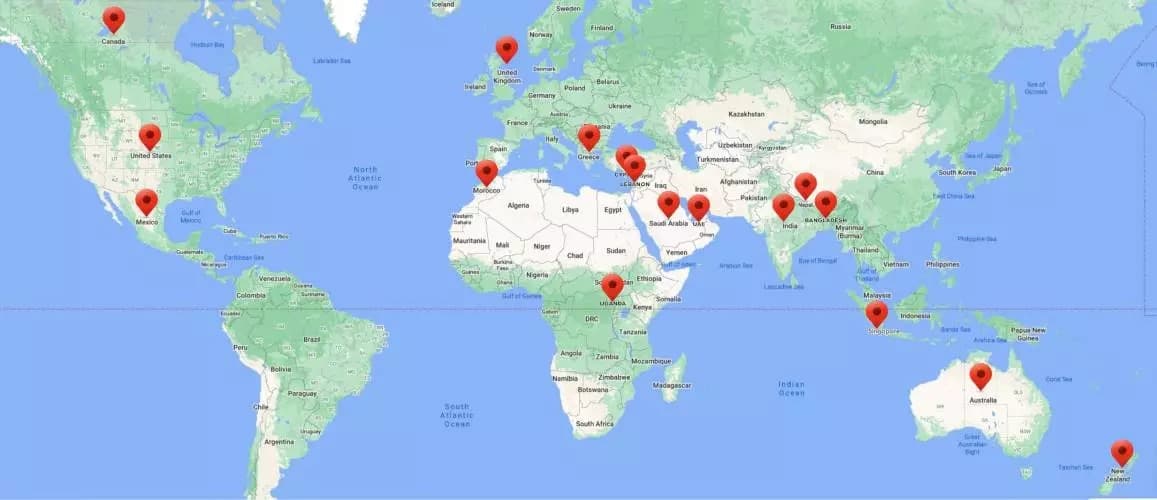
In India. We would rather say that plainly than have you work it out later. Mastermind has taught abacus from Indore since 2005 and now teaches children in 17 countries, and the teachers your child would have are certified, company-trained staff there.
Then what time will my child's class be?
A normal Melbourne after-school hour. India runs five and a half hours behind Melbourne in summer and four and a half in winter, so 4:30pm for your child is around 11am for the teacher. Nobody is teaching in the middle of the night at either end, which is not true of every overseas programme you could pick.
Do class times shift when daylight saving changes?
The hour in Melbourne time stays as booked. India does not observe daylight saving, so the teacher's clock moves rather than yours - which is the right way round.
Which parts of Melbourne do you cover?
All of it, and the rest of Australia. Children join from the inner suburbs, Glen Waverley, Point Cook, Craigieburn, Berwick, Doncaster and regional Victoria on identical terms, and from Sydney, Brisbane, Perth and Adelaide as well.
Does it fit the Victorian Curriculum?
It sits underneath it rather than following it. The programme teaches no curriculum and rehearses no test - it builds the number fluency that the curriculum assumes is already there.
Is this NAPLAN preparation?
No. NAPLAN is sat in March by Years 3, 5, 7 and 9, and we do not teach to it. If you want practice on the test format itself, that is a tutor's job rather than ours.
Our school year runs January to December. Does that matter?
Not to us. Batches form around levels, so a child can start in February, in July or in the middle of the summer holidays without waiting for an intake.
Is it the same teacher every week?
Yes, with four children in the class. Over a ten-level programme that continuity does more work than any individual lesson.
What is the age range, and what will we pay?
Six to fourteen. Fees depend on the level your child is placed at and the batch they join, and we set them out after the free class. Nothing obliges you to continue.
A class at a sensible hour, at both ends
One free lesson, an honest placement, and a teacher who is wide awake.