Abacus classes in London — live online mental maths for ages 6–14
England expects a nine-year-old to answer a times-table question in six seconds. This programme builds the kind of number fluency that makes that unremarkable — ten levels, taught live by a certified tutor to four children at a time, from wherever in London you happen to live. The first class is free.
Book a free demo class
No fees. No obligation. See your child learn live.
Or message us directly on WhatsApp.
Six seconds a question, twenty-five questions, Year 4
Most countries say children should know their tables. England says how fast. The statutory Multiplication Tables Check, sat by every Year 4 pupil in a state school, asks twenty-five questions from the 2 to 12 times tables and allows six seconds for each. The national curriculum is equally direct: by the end of Year 4, tables to 12×12 should be memorised, with precision and fluency.
Six seconds does not leave room for working anything out. A child either has the fact or reconstructs it, and reconstruction takes longer than the timer allows. The same gap reappears later in written methods, fractions and ratio — everything that assumes the arithmetic beneath it is instant.
Abacus training works on that gap directly. It is not a times-tables drill and it does not rehearse the check; it builds the calculation fluency the check is sampling. Mastermind has taught this one subject since 2005, through 1,000+ centres and a portal built for it.
What the programme is actually training
The bead frame does the early work and is then removed on purpose. What is left is the point of the exercise.
The method itself
Bead and finger movement, established in Level 1 with a tutor watching each child’s hands.
Working without the frame
Around the middle levels the abacus is taken away and the arithmetic continues internally.
Attention that holds up
A sum breaks the instant concentration does, so children practise not letting it.
Holding a picture
Keeping a moving bead image in mind is working-memory practice, twice weekly.
Recall without hesitation
The gap between knowing a fact and producing it is where marks are lost. That gap is what closes.
Calm with numbers
Usually visible at homework long before it shows up on a report.
Parents generally report these over the levels; how far a child gets depends on attendance and short daily practice. Read the research on abacus training →
What fluent actually looks like
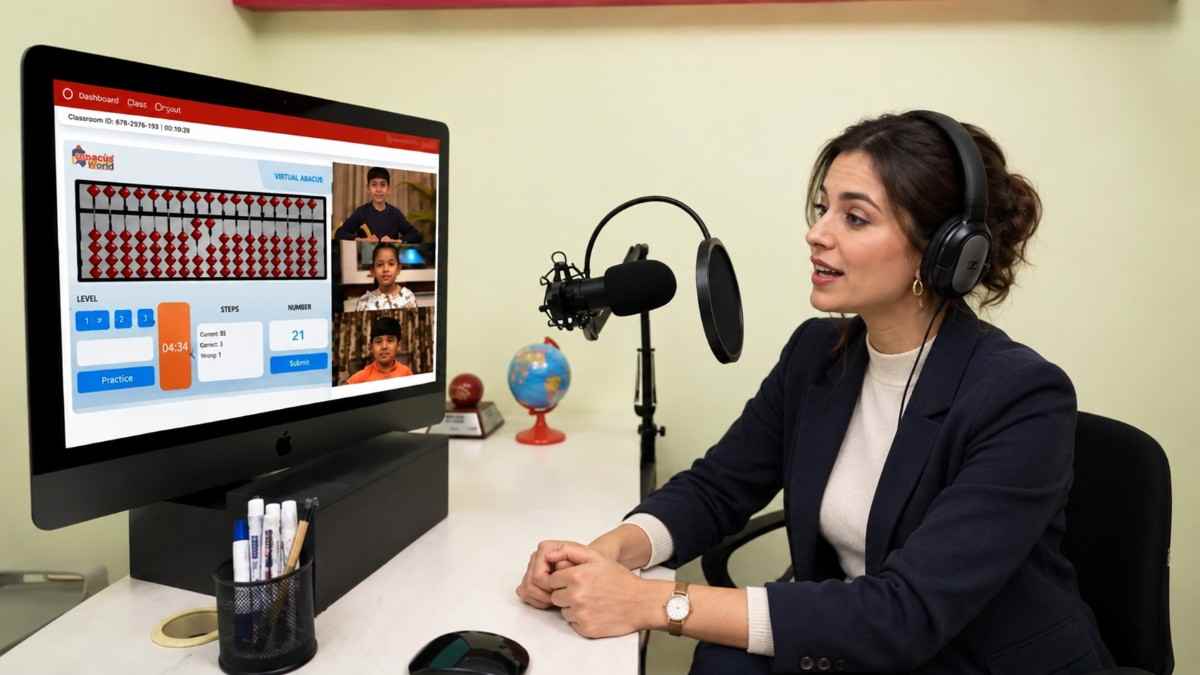
Enrolled Mastermind students in live classes. Notice how little happens visibly — no fingers, no paper, and the answers still arrive.
What a term looks like
A free hour, then a placement
Your child sits one live class and the tutor names a starting level. Previous abacus experience is assessed rather than taken on trust.
Two live hours a week
On Mastermind’s own portal, built around timed rounds and bead races rather than a tutor talking at a webcam. Four children, one tutor, every session.
Materials posted out
An abacus, the level workbooks and a Parent Handbook, with the student app and free Virtual Abacus covering short practice on other days.
Ten levels, each assessed
Roughly a term each, closing with a graded assessment. A child moves up on finishing the level, not on the calendar.
What is needed at home: a laptop or tablet, a connection that holds and somewhere quiet. Classes run through the school holidays as well as term time, so a level is never interrupted by half term or the summer. More on the format: how our live online classes work.
One free hour settles it either way
Watch a real class with your own child in it, then decide.
Getting there is what usually ends it
In a city this size, the class itself is rarely the thing that fails. The journey to it is.
| Over a school year | Mastermind live online | A class across the borough |
|---|---|---|
| The journey | None — the class is at your kitchen table | Two trips a week, often at the worst hour for it |
| Winter evenings | Makes no difference at all | Dark by four, and attendance shows it |
| Where you live | Any borough, any zone, same class | Limited to what is reachable from you |
| Moving house | Nothing changes | Often means finding somewhere new |
| Half term and holidays | Levels carry on | Frequently pauses with the school term |
| Group size | Four children to one tutor, fixed | Depends on the room and the week |
| Trying it first | A full free hour | Sometimes a taster session |
This compares Mastermind’s online format with attending a class in person. Providers vary, and plenty of in-person classes are excellent — the journey is simply the part parents underestimate in September.
State, faith, grammar, independent — all the same underneath
London holds an unusually wide spread of schools, and parents here compare them more closely than almost anywhere. But the national curriculum sets the maths expectations for state primaries and academies across England, and independent schools broadly track the same arithmetic even where they diverge elsewhere.
This programme sits underneath all of it. It teaches no syllabus and competes with no school; it builds the calculation that every syllabus assumes is already there. Once that is quick, a child’s attention goes where the marks actually are — the reasoning and the multi-step problems.
Because nothing is tied to a school or a postcode, changing either leaves your child’s level exactly where it was.
The same certified tutor each week
Not a rota. Every class is led by a certified, company-trained Mastermind tutor who already knows where this particular child tends to slip.
Teaching Abacus isn't just my job—it's my daily source of pride.
Harsha BanthiyaB.Tech and B.Ed
Nothing feels better than shaping young minds and making parents proud.
Amrisha DubeyMBA
Abacus teaching gave me purpose—I feel proud of every small achievement.
Sonali GahoiM.A. (English)
My students' confidence and calculation speed amazed parents within just weeks!
Kanta SarkarPost Graduate
Students' focus and confidence improved so much that parents often thank me!
Ayushi SharmaPost Graduate
Every child's progress gives me deep satisfaction as an Abacus teacher.
Khyati MalhotraMBA
Children from six to fourteen
- Beginning from nothing — counting and following instructions is all that is needed
- Knows the facts but is slow to produce them — the most common reason parents get in touch
- Well ahead and unstretched — the upper levels are hard on purpose
- Has lost confidence in maths — four children is a very small room to be wrong in
What the free class involves
A genuine hour of teaching on the portal enrolled students use, taken by a certified tutor. Nothing is sold at you. Stay for the whole hour and watch the part that matters: whether your child is still with it at minute fifty. Fees follow afterwards.
How the hour goes
- Pick a timeTell us which days work; we come back with the slots that are open.
- Your child joins inA full hour with a certified tutor. Parents are welcome to watch.
- You get a placementWhich of the ten levels to begin at, and what it involves.
- Then you decideFees come at the end. Saying no is entirely normal.
Abacus classes in London — the essentials
- What it is: a ten-level abacus and mental maths programme, taught live online across every London borough.
- What it is not: rehearsal for the Multiplication Tables Check or any other assessment — it builds the fluency underneath them.
- Ages: six to fourteen, beginners and children continuing from elsewhere.
- Group size: four children to one certified tutor, every class.
- Timings: after-school weekday and weekend slots in UK time, chosen when you book.
- Holidays: classes run through half term and the summer, so levels are not interrupted.
- To start: one free hour, fees afterwards, no obligation.
Questions, answered plainly
Is this preparation for the Year 4 Multiplication Tables Check?
Not in the sense of drilling the check itself - we do not rehearse the format or the question set. What the programme builds is the underlying calculation fluency that the check happens to sample. If you want targeted MTC practice in the fortnight beforehand, a tutor or a practice app is the more direct route.
Which parts of London do you cover?
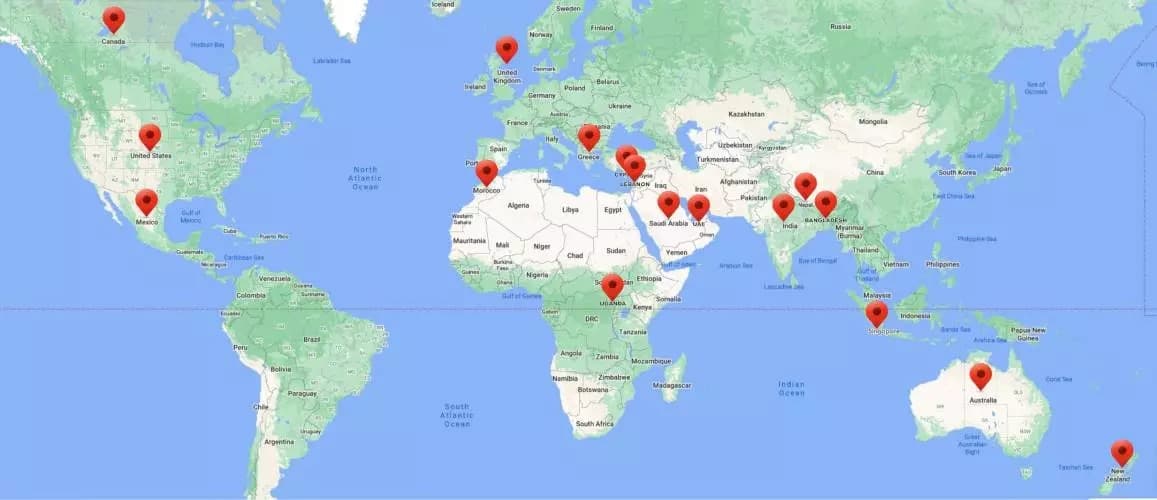
All of it, because the classes are live online. Children join from Ealing, Croydon, Barnet, Redbridge, Newham, Wandsworth, Harrow, Hounslow and everywhere between on exactly the same terms - no zones, no travel, no catchment.
What times are classes held?
After-school weekday slots and weekend slots, in UK time. You choose the day and hour when you book the free class, which matters in a city where nothing after four o'clock is predictable.
My child is at a state primary. Another parent said this is for private-school children. Is it?
No. The national curriculum applies in state primaries and academies across England, and the arithmetic underneath it is the same whatever the school. We teach children from state, faith, independent and grammar schools without distinguishing between them.
Is it the same tutor every week?
Yes. A certified, company-trained Mastermind tutor takes the class each time, with four children in it. That continuity is most of the value - the tutor knows what your child got wrong a fortnight ago.
We are moving house within London. Does that disrupt anything?
Not at all. There is no centre to be near and no catchment, so a move across the city - or out of it - leaves your child's level and batch untouched.
How long is the full programme?
Ten levels of about three months each, taken at two live hours a week. Each level closes with a graded assessment, so progress is measured rather than assumed.
What ages does it take, and what does it cost?
Six to fourteen. Fees depend on level and batch, and we give you the figure after the free class along with the slots on offer. There is no obligation to enrol.
Do the abacus and books get posted to us?
Yes - a physical abacus, the level workbooks and a Parent Handbook are sent out once your child is enrolled. The team confirms the delivery address with you when you book.
An hour, at your kitchen table, costing nothing
No journey, no commitment, and a straight answer about where your child would start.