Abacus classes in Dublin — live online mental maths for ages 6–14
This is not a grind, and it is not for sixth years. It is the arithmetic a child builds at seven and eight, a decade before anyone mentions points. Four children to a certified tutor, ten graded levels, live online. The first hour is free.
Book a free demo class
No fees. No obligation. See your child learn live.
Or message us directly on WhatsApp.
The one made at sixteen, and the one available now
Every Irish family eventually meets the same decision: whether a teenager stays at Higher Level maths. Since 2012 a pass at Higher Level has carried 25 bonus CAO points, which makes it the single most valuable subject choice in the points system, and plenty of courses expect it. It is a decision made at fifteen or sixteen, under pressure, and it turns on a great many things.
One of them is whether the student still believes number work is something they can do. That belief is not formed in fifth year. It is formed much earlier, during the years when arithmetic is either automatic or a small daily struggle.
This programme works on precisely that stretch. It is not a grind, it teaches no syllabus and it rehearses no exam. It is ten levels of bead work and mental calculation for children between six and fourteen, run by Mastermind since 2005 — the part of the story that happens long before anyone is counting points.
Six things that are still there at sixteen
The bead frame is used hard early and then deliberately removed. These are what should outlast it.
Bead technique
Set correctly in the first level, with a tutor watching four pairs of hands rather than a full room.
Arithmetic without the frame
By the middle levels the abacus is set aside and the sums continue in the head.
Concentration
A sum falls apart the moment attention does, which makes the practice self-correcting.
Working memory
Holding a shifting bead image in mind, twice a week, until it is unremarkable.
Accuracy first
Graded ahead of speed at every level, because a fast wrong answer is worth nothing later on.
A settled relationship with numbers
The quiet thing that decides, years later, whether a teenager believes maths is for them.
Parents generally describe these over the levels; how far a child gets depends on attending and on short daily practice. Read the research on abacus training →
The same programme, three stages apart
Enrolled Mastermind students in live classes. None of them is preparing for anything — this is just where the levels lead.
What a term of it looks like
A free hour and a starting level
One live class, then the tutor names a level. A child who has used an abacus before is assessed onto the right one rather than sent back to the start.
Two live hours a week
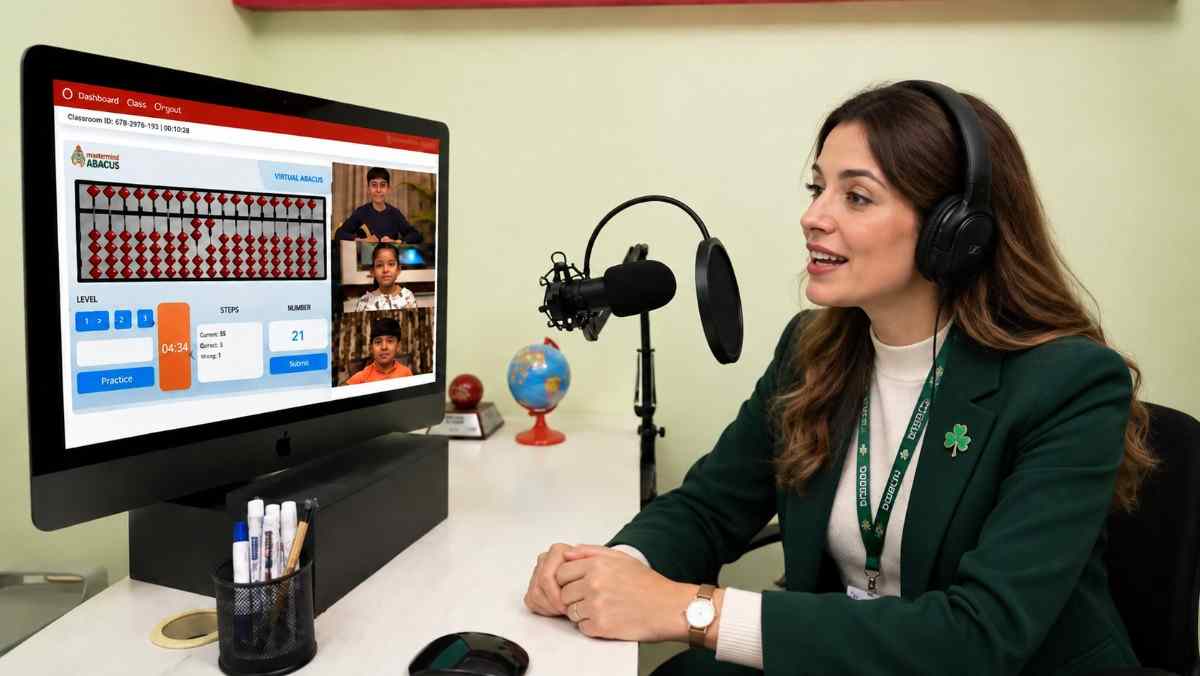
Bead races and timed rounds on Mastermind’s own portal rather than a tutor talking at a webcam. Four children, one tutor, unchanged week to week.
Materials posted out
An abacus, the level workbooks and a Parent Handbook, with the student app and free Virtual Abacus covering five to ten minutes on other days.
Ten levels, each assessed
Roughly a term apiece, closing with a graded assessment. Children move up on finishing a level, not on a school calendar.
All that is needed: a laptop or tablet, a connection that holds and somewhere quiet. Classes run through midterms and the summer, so a level is never cut in half. More on the format: how our live online classes work.
An hour now, rather than a decision later
Free, live, and taught by a certified tutor with your child doing the work.
Where this sits alongside grinds
Grinds are a normal part of an Irish education and often a good one. They are also a different thing entirely, aimed at a different stage.
| This programme | Maths grinds | |
|---|---|---|
| Typical age | Six to fourteen | Junior and Leaving Cert years |
| What it works on | Arithmetic fluency itself | The syllabus and the exam paper |
| Time horizon | Two to three years of levels | Usually a school year or a term |
| Measured by | A graded assessment per level | Mocks and the State exam |
| Group size | Four children, fixed | Varies widely, from one-to-one up |
| When it is the right call | Years before it matters | When there is a paper to sit |
Teachers surveyed on grinds in Ireland broadly agree they lift exam performance, while fewer think they build problem-solving — which is a fair reflection of what they are designed to do. Most families will use both at different stages, and that is sensible.
Underneath what the class teacher is doing
The primary maths curriculum here expects children to build number sense and to become fluent with operations. This programme does not teach that curriculum, and it is not a substitute for a teacher who knows your child. It trains the fluency the curriculum is aiming at, using a method that is entirely separate from it.
Because it belongs to no syllabus, it makes no difference whether your child is in a Gaelscoil, a community school, an ETB school or a fee-paying one — or whether the family moves school or country partway through.
Certified tutors, four children at a time
Company-trained and consistent week to week, so the tutor knows what your child found hard a fortnight ago.
Teaching Abacus isn't just my job—it's my daily source of pride.
Harsha BanthiyaB.Tech and B.Ed
Nothing feels better than shaping young minds and making parents proud.
Amrisha DubeyMBA
Abacus teaching gave me purpose—I feel proud of every small achievement.
Sonali GahoiM.A. (English)
My students' confidence and calculation speed amazed parents within just weeks!
Kanta SarkarPost Graduate
Students' focus and confidence improved so much that parents often thank me!
Ayushi SharmaPost Graduate
Every child's progress gives me deep satisfaction as an Abacus teacher.
Khyati MalhotraMBA
Primary and early secondary, six to fourteen
- Children in the middle of primary — the years when arithmetic either becomes automatic or does not
- Beginners — counting and following instructions is the whole requirement
- Quick but careless — accuracy is graded ahead of speed at every level
- Already quietly avoiding maths — four children is a small room in which to be wrong
One hour, and an honest placement
A real class on the portal enrolled students use, taken by a certified tutor. Nobody presents anything at you and nobody will tell you this decides your child’s future. You get a level, the reasoning behind it, and the fees — and you decide afterwards.
How the hour goes
- Pick a timeTell us which days suit and we confirm what is open.
- A full live classSixty minutes with a certified tutor. Stay and watch.
- A placement with reasonsWhich of the ten levels, and what it asks for.
- You decide afterFees at the end, with no deadline attached.
Abacus classes in Dublin — the essentials
- What it is: a ten-level abacus and mental maths programme taught live online across Dublin and Ireland.
- What it is not: a grind, and not preparation for any State examination.
- Ages: six to fourteen — primary and early secondary.
- Group size: four children to one certified tutor.
- Timings: after-school and weekend slots in Irish time.
- Curriculum: teaches no syllabus; builds the fluency the primary curriculum aims at.
- To start: one free hour, fees afterwards, no obligation.
Fair questions, answered plainly
Is this a grind?
No, and it is not competing with one. Grinds work to a syllabus and an exam that is coming; this has its own ten-level curriculum, its own assessments and nothing to do with any State exam. It is also aimed at a completely different age - most of our students are between six and eleven.
Will it help with the Leaving Cert?
Not directly, and we will not pretend otherwise. A ten-year-old doing Level 4 is a long way from an exam hall. What it builds is arithmetic that is quick and dependable, which is a foundation rather than a preparation. Anything anyone tells you about Leaving Cert results from a primary-age programme should be treated carefully.
Does it help a child stay at Higher Level maths later?
It can make the option easier to keep open, and that is the honest way to put it. Higher Level carries 25 bonus CAO points, so the decision matters - but it is made at fifteen or sixteen, and it turns on far more than arithmetic. What we can say is that children who find number work effortless tend not to rule themselves out of it early.
Which parts of Dublin do you cover?
All of them, and the rest of the country too. Children join from Dublin city, Rathfarnham, Clondalkin, Swords, Blanchardstown, Dun Laoghaire and Lucan, as well as Cork, Galway and Limerick, on identical terms.
What slots do you run in Ireland?
After-school and weekend slots in Irish time. You pick the day and hour when you book the free class.
Does it fit the primary maths curriculum?
It runs underneath it. The primary curriculum expects children to develop number sense and fluency; this programme trains exactly that, without teaching the curriculum itself or competing with what the class teacher is doing.
My child is in an Irish-medium school. Any difference?
None. Classes are taught in English, and the bead work and arithmetic need no translation. Children in Gaelscoileanna, community, ETB and fee-paying schools all sit the same programme here.
How long does it run and what does it involve?
Each of the ten levels takes roughly a term, at two live hours a week, and finishes with a graded assessment. Children repeat a level where they need to instead of being carried along by the group.
What age range is it, and what will it cost?
Six to fourteen. What you pay follows the level your child is placed at and the batch they join, and we set it out for you once the free class is done. Nothing obliges you to go further.
Start early, and keep the later choices open
One free class, an honest placement, and no promises about anything that happens in ten years.