

Types of Abacus, Difference Between Chinese and Japanese Abacus
📅 28 Sep, 2013 · ✍️ Admin
Last updated: 29 September 2026
Types of Abacus Instruments
The Abacus became a buzzword in the world of after-school programs for children between 6 to 14 years of age since the start of 2000. With this began the curiosity among the parents not only about the Abacus learning but also the types of Abacus Instruments being used.
There are several types of Abacus Instruments known across the world. We can list them below:
A) Soroban or the Japanese Abacus
B) Suanpan or the Chinese Abacus
C) Roman Abacus
D) Schoty Abacus
E) Cranmer Abacus
F) Sumerian Abacus
The Different Types of Abacus
The Roman Abacus
 Romans used many tools to simplify calculations. It could ring from pebbles or human calculators. Gerbert d’ Aurillac (Pope Sylvester I) introduced the Roman Abacus in the 11th century. The Abacus was later reconstructed as a portable device with eight long grooves made up of beats and tracks. It is also known as the Wax abacus.
Sumerian Abacus

Sumerian Abacus was created sometime in history between 2700 and 2300 B.C. A single frame with multiple columns and beads is organized into 60 bases.
Schoty, or The Russian Abacus
 The Russian Abacus is one of the most versatile abaci. Also known as Schoty or counting beads, it is also called the Russian Abacus. It was created in the 17th century to help with currency calculations and business transactions.
The frame of the basic Schoty is made from wood or metal. The basic Schoty frame has 11 rows and ten beads. The eighth row only has four beads. Each fifth bead is also painted in a different color. The difference is that it doesn't have columns and the Schoty beads are different colors.
Cranmer Abacus

The Cranmer abacus is specially made for visually impaired people. They can do math calculations, Subtraction, multiplication, and division.
Cranmer's Abacus features white beats, padded with fabric behind the back to ensure that beads remain static in their movements. The rectangular black frame is divided into two sections, the upper and the lower. The upper section contains one white bead, and the lower section has four beads.
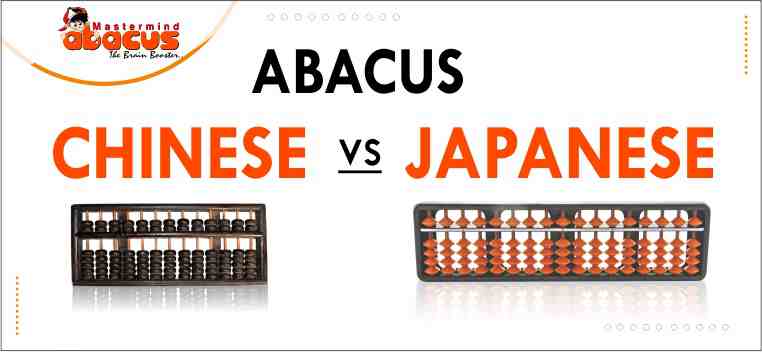
Difference Between Chinese And Japanese Abacus
The parents raised several questions, one of them being the difference between the Chinese Abacus and the Japanese Abacus.
We are giving below the information in a tabular form to make it easy for you to comprehend.
| Chinese Abacus | Japanese Abacus |
Chinese Abacus Are Considered To Be The Inventors Of Abacus During 500 BC, And The Most Primitive Written Document On Abacus Is In Chinese That Dates Back To The 2nd Century BC. | The Japanese Abacus Adapted Abacus Later Realizing Its Use As A Counting Device Around 1600 AD. |
The Chinese Abacus Is Known As The Suanpan. | The Japanese Abacus Is Named Soroban. |
Suanpan Is Rarely Used In Modern Times Except In Some Regions Of China. | Soroban Is The Abacus That Is Still Used Today As A Counting Device. It Is Being Used As A Brain Development Tool For Small Kids, Mostly As An After-School Program. |
The Suanpan Is A Horizontally Structured Abacus That Has 2 Decks. The Upper Deck Constitutes 2 Beads, And The Lower Deck Constitutes 5 Beads In Each Rod. | The Soroban Is Also A Horizontally Structured Abacus Of Modern Times Having 2 Decks. The Upper Deck Consists Of 1 Bead And The Lower Consists Of 4 Beads In Each Single Rod. |
It Is More Complex To Be Used For Performing Calculations. | The Japanese Reduced The Beads To Make Calculations Smoother And Simplified. |
All Six Abacus Types at a Glance
Parents often ask which of these instruments their child will actually touch in class. The short answer is only one of them — the rest are historical. The table below puts all six side by side so you can see where each came from, what makes it different, and whether it is still in everyday use. If you would like the full timeline of how the tool travelled from one country to another, we have covered it in the history of the abacus.
What matters in the end is not the wood and beads, but the mental picture a child builds from them — something we explain in our post on why children still need to do the maths in their own head in the age of AI.
| Abacus | Where and when | What makes it different | Still in use? |
| Sumerian | Mesopotamia, 2700–2300 BC | Columns of beads counted on a base-60 system | No — historical only |
| Suanpan (Chinese) | China, traced to around 500 BC | Two beads above the beam, five below, on each rod | Rarely, in some parts of China |
| Roman | Europe, reintroduced in the 11th century | A portable board with grooves instead of rods | No — historical only |
| Schoty (Russian) | Russia, 17th century | Rows of ten beads, no dividing beam, colour-marked middle beads | Occasionally, for shop counting |
| Cranmer | United States, 1962 | A soroban with fabric backing so beads stay where they are placed | Yes — by visually impaired learners |
| Soroban (Japanese) | Japan, adapted around 1600 AD | One bead above the beam, four below — the simplest layout | Yes — the standard in abacus classes today |
If you would like to know what each part of the soroban is called, we have explained the frame, rods, beads and beam of an abacus in a separate post.
Virtual Abacus - The Recent Development
The latest development in the world of Abacus learning is that the parents now also have the option of Virtual Abacus. The kids can now learn Abacus online from their homes.

Frequently Asked Questions
Which abacus do children learn on in Mastermind Abacus classes?
Children learn on the Japanese soroban — one bead above the beam and four below on every rod. Its simple layout suits small fingers and is easy to picture mentally later on. You can see the tool in use in our live online abacus classes.
What is the main difference between the Suanpan and the Soroban?
The Suanpan carries two beads on the upper deck and five on the lower deck of each rod. The Soroban carries one above and four below. Fewer beads mean fewer finger movements for the same sum, which is why the Japanese version is quicker to learn and faster to work on.
Which abacus came first, the Chinese one or the Japanese one?
The Chinese Suanpan came first. Its use is traced to around 500 BC, and the earliest written record of it dates to about the 2nd century BC. Japan adopted the tool much later, around 1600 AD, and reshaped it into the Soroban we use today.
Why did the Japanese remove beads from the Chinese abacus?
The extra beads on the Suanpan were needed for older Chinese units of measure and for counting that was not purely decimal. Once decimal arithmetic became the norm, those beads were no longer required. Removing them cut out unnecessary movement and made calculation smoother.
Does the type of abacus matter for learning mental math?
Yes, it does. Mental abacus works by holding a picture of the beads in the mind, so a simpler bead layout gives a cleaner mental image. The Soroban's one-and-four structure is the easiest to visualise, which is why most mental arithmetic programmes around the world use it. We have described that shift from beads to visualisation in the abacus journey from a physical calculator to a mental math tool.
Can my child practise on a virtual abacus instead of a physical one?
A virtual abacus is very useful for practice and revision at home, and ours can be used any time of the day. Beginners should still start on a physical soroban, because the finger movement itself helps build the mental picture. Most children end up using both.
At what age can a child start learning on a soroban?
The Mastermind Abacus programme is for children aged 6 to 14, in both live online classes and offline centres. It runs across 10 levels of about three months each, with two one-hour classes a week. For children of 5 to 6 years, we offer Lingo Bingo at our centres instead.
To experience the wonderful effects of learning Abacus on small children put them into the Abacus Classes of Mastermind. Help the children develop strong mental arithmetic skills to be the top scorer in mathematics.
If you are curious to know more about Abacus Education visit us at www.mastermindabacus.com and if you are looking for a business opportunity in the field of Abacus Education, reach us at
Also Read : Abacus For The Blind
Author – Mr. Naveen Chowdhari
Naveen Chowdhari is the Founder & Director of Mastermind Abacus, a leading name in children’s mental math and brain development training. By blending traditional abacus methods with modern teaching techniques, he has created an innovative system that enhances children’s concentration, memory, visualization, speed, and overall cognitive skills. Under his leadership, Mastermind Abacus now provides worldwide online abacus classes and has built a strong global franchise network, making quality brain-development education accessible across the world.
Last Updated: 29 September 2026